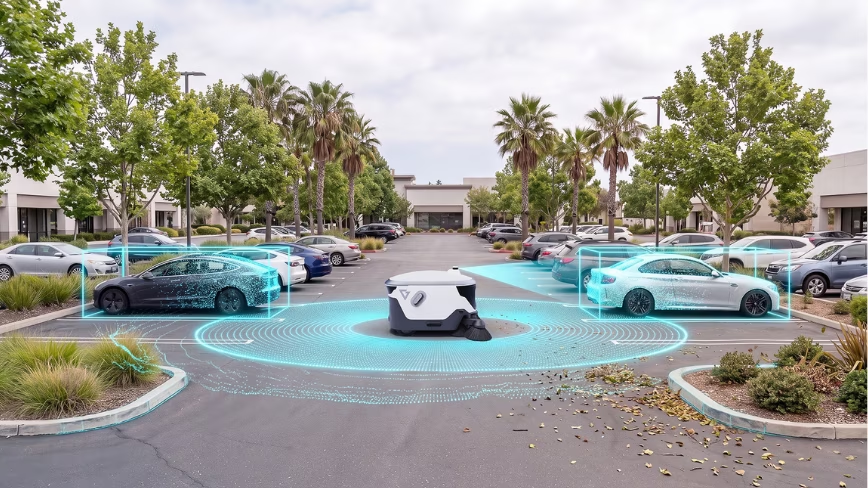
A Viabot rendering of the Viabot One, with its sensor coverage and object detection overlaid.
 Credit: Viabot
Viabot has raised a $24m Series A led by Walden International for its autonomous outdoor sweeping robot. Each battery lasts about six hours and the machine can autonomously hot-swap batteries to work 12 to 24 hours, correcting TNW’s earlier report of a six-hour runtime. The company says sweeping is the primary function, that soft security is supplemental support for existing security teams, and that it has corrected the dated litter statistic TNW identified.
Viabot has raised a $24m Series A led by Walden International, with CDIB Capital and Stalwart Ventures joining existing backers Baseline Ventures, ERA Ventures, Morado Ventures and SOSV. The Santa Clara company has now raised $43m in total.
Its flagship machine, the Viabot One, sweeps litter and debris up to 10 inches from large commercial properties and services 25 million square feet. It is sold as robotics-as-a-service rather than as equipment.
What the machine carries
The Viabot One navigates using cameras, lidar, depth sensors, differential GPS and dynamic path planning. It maps its surroundings in 3D, runs scheduled routes and empties into standard bins.
Those are the sensors a sweeping robot needs. They are also the sensors a detection system needs, and the company uses them for both.
Viabot says the base supports interchangeable tools. The durable part of the product is therefore the sensor platform, with sweeping as the job it currently does.
How long it can stay out
Each battery gives about six hours, and the machine can autonomously hot-swap its own batteries. Viabot describes that as a proprietary feature for customers who want 12 to 24 hours of sweeping and debris removal.
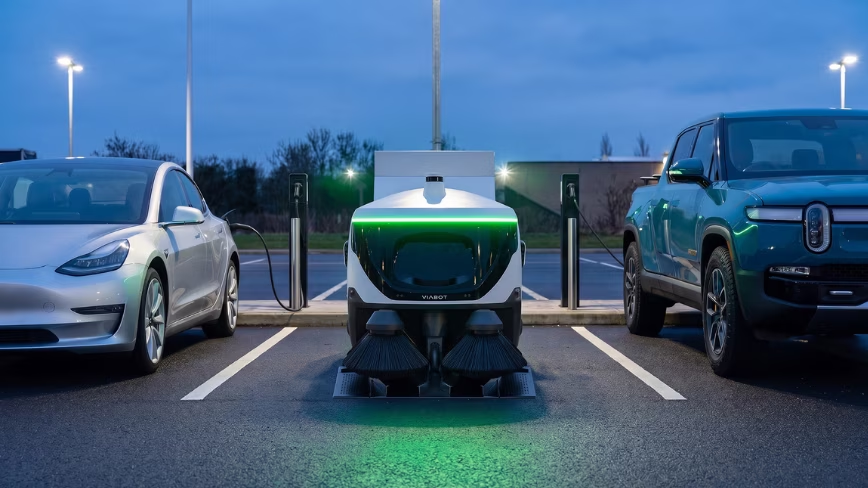
TNW originally reported a six-hour runtime and that was wrong. The correction cuts both ways, because a machine that can swap its own power and stay out for a full day is present far longer than a single shift.
Duty cycle is what separates a patrol from a watch. China’s robot traffic units run eight or nine hour shifts, which is a rota rather than continuous coverage.
The second function, in the company’s own description
Viabot says the machine provides always-on security that protects people and assets. Its sensors can identify activity including loitering and trespassing in restricted areas, and human personnel respond to the resulting alerts.
The company says sweeping is the primary function and that soft security is supplemental, supporting security teams a site already employs. It is a sweeping machine whose sensors also perform behavioural detection.
Viabot names Fortune 500 retailers, universities, healthcare sites, utilities and Class A offices among its deployments. Those are places the public walks through without being told what the machine can detect.
What always-on actually means
Viabot says the phrase refers to the human personnel supporting site monitoring, and that they are brought in when the robot notifies them. Monitoring is event-triggered rather than a continuous human watch.
That is a meaningful distinction and it is consistent with what the fact sheet said. It does not change what the sensors are capable of detecting, which is the part worth knowing.
The category it sits in
Robots that patrol and detect intruders are an established category. TNW covered Ascento’s guard robot, which carries thermal and infrared cameras and is sold openly as security.
Viabot’s position is that its customers already run security teams and the robot supports them. That makes the buyer informed, and leaves open what the people on the site are told.
The pattern is not confined to outdoor robots. Samsung has turned a robot vacuum into a mobile monitoring device for the home, using hardware bought for cleaning.
Where these platforms end up is a live question. TNW reported on ICE moving to buy Boston Dynamics robot dogs without a competition.
The litter numbers, and a correction the company made
Viabot’s original fact sheet cited Keep America Beautiful’s latest study at nearly 50 billion pieces of litter. That was the 2020 study.
Keep America Beautiful published a new National Litter Study in May. It finds litter down 34% between 2020 and 2025, with roughly 35 billion pieces remaining, roadway litter down 22% and waterway litter down 45%.
Viabot says the dated figure was included in error and that its updated fact sheet corrects and contextualises it. That is a faster acknowledgement than most companies manage.
A second figure is worth dating. The $9.1bn annual business cleanup cost traces to Keep America Beautiful research published in 2009.
One caveat cuts the other way. The litter studies are funded by beverage and packaging companies, which is worth knowing whichever direction the numbers point.
What does check out
The robotics-as-a-service figure holds up. The International Federation of Robotics recorded 42% growth in the model during 2024, though it also noted that outright sales remained the main route to market.
The labour case is the strongest one available and the release makes it only briefly. Grounds maintenance is physically demanding outdoor work with heavy turnover, and roughly 162,500 US openings are projected annually.
The market projections are weaker. They come from commercial research vendors, and the fact sheet sizes two overlapping categories at $1.17bn and $2.19bn for the same year.
The round in proportion
Twenty-four million dollars is a modest Series A in current robotics. Germany’s NEURA Robotics bought a maker of autonomous cleaning machines this year off the back of a round more than fifty times larger.
The company has taken its time, which counts in its favour. The founders had the idea in 2016, launched in 2021 with $6.1m, then spent three years validating the platform before expanding nationally last year.
One figure still needs explaining. Viabot’s intelligence is described as trained on more than 5 billion square feet of data while the fleet services 25 million, a ratio of two hundred to one.
What to watch
Watch whether the detection function is ever priced separately. Viabot says it is supplemental, and a separate line item would make it a product.
Watch for signage. Any deployment of this kind in Europe would need a lawful basis and notice for the monitoring, and TNW has not seen how sites disclose it in the US.
Get the TNW newsletter
Get the most important tech news in your inbox each week.


