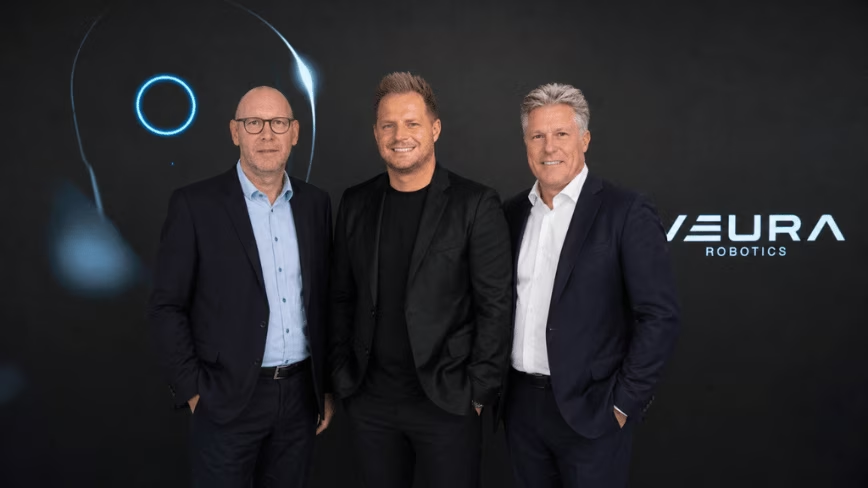
Stefan Erhardt (Adlatus), David Reger (NEURA Robotics), and Andreas Lindemann (NEURA Mobile Robots).
 Credit: NEURA Robotics
NEURA Robotics is buying a company that makes cleaning robots, and says it wants to replace their brains.
The German firm is acquiring 100% of Adlatus Robotics, an Ulm maker of autonomous cleaning and sweeping machines. It announced the deal on Monday, datelined Stuttgart, Hamburg and Ulm.
Neither company disclosed a price.
What Adlatus already has
Adlatus has spent more than 20 years building autonomous cleaning and sweeping robots, Rahul Raj noted for EU-Startups. Its machines work in industry, logistics, healthcare, and commercial and public buildings.
The range is narrow and specific. The CR700C and CR700D handle wet cleaning and wiping, and the SR1300 sweeps and vacuums. Each has its own docking and service station, so the robots empty and refill themselves between runs.
The company markets the SR1300 for night shifts in car parks and the CR700 line for warehouse floors. Its slogan is Designed to Serve.
It has hundreds of systems in the field and writes its own navigation software. That installed base is the point. NEURA is not buying a prototype.
What NEURA wants to change
Today those machines follow a route. NEURA says it will add sensors and AI, then connect them to its Neuraverse platform.
The goal is a cleaning robot that recognises different surfaces and types of dirt, reads the situation in front of it, picks a cleaning strategy and learns from the job rather than repeating a fixed path.
“We’re not buying ADLATUS just to add another cleaning robot to our portfolio. We want to give machines like this a new brain,” said David Reger, NEURA’s founder and chief executive.
Cleaning is a large global labour market and a good demonstration of what physical AI can change, he said.
Which arm did the buying
The deal went through NEURA Mobile Robots, the group’s logistics and automated vehicle arm. It sells under the ek robotics brand, which NEURA brought into the group in 2025.
It is not small. More than 300 people work there, across Hamburg, Reutlingen, Milan, Prague and Buckingham.
“Our aim is to expand mobile robotics beyond traditional material handling,” said Andreas Lindemann, its managing director. Autonomous cleaning is the logical next step, he said.
He wants the machines inside NEURA’s Fleet Manager eventually, as their own product family.
The second deal this month
NEURA Mobile Robots agreed to buy the ACTIVE Shuttle automated guided vehicle business from Bosch Rexroth earlier this month, Cate Lawrence reported for tech.eu. That was eleven days ago.
That brought Bosch Rexroth’s ACTIVE Fleet Manager and its ROKIT navigation software into the group. NEURA plans to offer both as tools inside the Neuraverse.
Bosch is also a NEURA investor, and separately agreed this summer to manufacture at scale for a London robotics startup.
What each side gets
Adlatus gains access to NEURA’s manufacturing, its international sales network and the platform itself.
NEURA gets the part that is hard to build from scratch. Adlatus brings years of experience with real cleaning operations, established customers and knowledge of how the work actually goes wrong.
Neuraverse is designed to absorb that. It takes in different AI models, sensor feeds and capabilities, and the company’s pitch is that this turns a single-purpose machine into an agent inside a wider system.
NEURA also makes an argument about why the installed base matters. Physical AI, unlike generative AI, depends on data and experience from the real world, it says. Machines have to learn how physical tasks are actually carried out.
Adlatus therefore becomes two things at once. A product line, and a testbed.
They had already been working together
NEURA and Adlatus announced a strategic partnership on 22 September 2025, timed to the CMS cleaning trade fair in Berlin. The acquisition converts that arrangement into ownership eleven months later.
NEURA also notes that Adlatus is Latin for helper, which it says fits its own founding line. We serve humanity.
The money behind the shopping
NEURA raised a Series C of up to €1.2bn in June, about $1.4bn, which it called the largest round ever raised by a full-stack robotics company.
The backers were an unusual mix. Tether, Qualcomm, Amazon and Nvidia joined imec.xpand, Bosch, Schaeffler, the European Investment Bank, Lingotto Horizon and InterAlpen Partners.
The company said its order book and deployment pipeline already exceeded €864.8m at the time.
What the round was meant to fund
NEURA said the money would scale manufacturing towards several million robots in production by 2030.
It also earmarked funds for its NEURA Gyms, real-world environments where cognitive robots are trained.
Two acquisitions in a month suggest buying working fleets is now part of that plan.
What the company builds
Founded in 2019 and based in Metzingen, NEURA makes the MAiRA and LARA robotic arms, the MAV mobile platform and MiPA, which it sells as an intelligent robotic assistant.
At the top sits 4NE1, which the company calls Europe’s first production-ready humanoid, running its own AI system named AURA. A smaller 4NE1 Mini and a four-legged explorer robot are open for reservation rather than sale.
Around all of it sits the Neuraverse, which the company describes as a platform and community where thousands of developers and partners make its robots smarter.
It says that combination of robotics, sensors, edge compute and learning infrastructure is what separates it from firms building isolated machines.
The argument underneath all of it
Reger frames the buying spree as an industrial policy rather than a shopping list.
“Europe has an incredible amount of industrial knowledge. We don’t need to reinvent everything, we need to combine the best of what already exists with artificial intelligence and scale it much faster,” he said.
Companies like Adlatus bring decades of experience from the physical world, he said, and NEURA brings the infrastructure. Combine the two and you can build a new industry out of Europe.
The company is not trying to replace European technology, it says, but to connect it.
The platform is meant to stay open
NEURA says the acquisition does not close the Neuraverse to other manufacturers. Rival makers of cleaning and mobile robots should be able to plug their own machines in.
“Physical AI will only truly scale if it becomes an ecosystem,” Reger said.
The competition it is buying against
Physical AI has become an acquisition category. onsemi agreed to buy Synaptics for $7bn in June on the same thesis.
The money is moving faster in Asia. XPENG’s robotics arm raised more than $900m this month ahead of a humanoid production run.
China now builds almost every humanoid robot shipped worldwide. Unitree listed in Shanghai this month after record demand, and DeepSeek is buying into robot makers alongside its own $8bn raise.
NEURA is one of the few European companies raising at that scale. Its answer to the volume gap is a platform other manufacturers use rather than a factory that outbuilds them.
What has not been said
Neither company gave a purchase price, and neither said what happens to the Adlatus workforce or brand.
NEURA has not said when the first Adlatus machines will run on the Neuraverse, or which of the new abilities arrive first.
It has also not said whether more acquisitions are coming, having now made two in a month.
Get the TNW newsletter
Get the most important tech news in your inbox each week.


