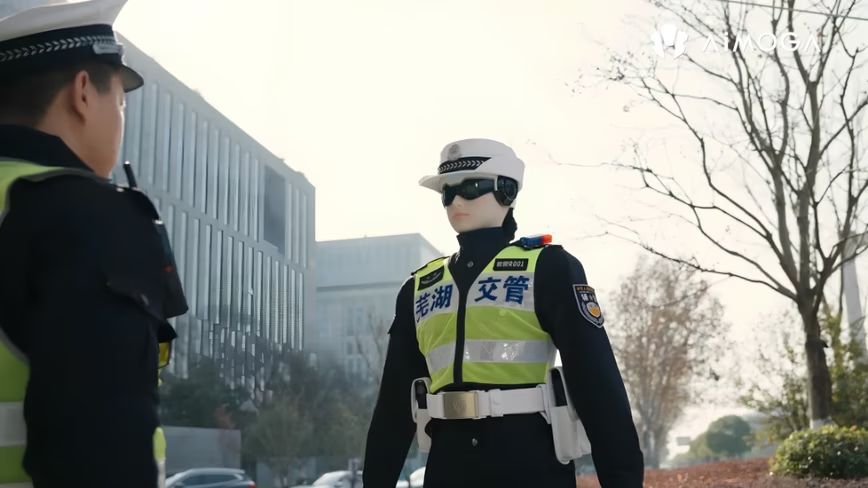
Intelligent Police Unit R001 – a police robot in China

China’s robot traffic police can direct cars, scold jaywalkers, and give a lost tourist directions to the nearest metro station. What they cannot do is stop anybody, and that limitation is written into the design rather than left to the machine’s discretion.
The clearest deployment sits in Hangzhou, where the local traffic police put 15 humanoid robots on duty around the West Lake scenic area on 1 May, timed for the Labour Day crowds.
Chinese state media described it as the country’s first robot traffic police squad, working alongside human officers rather than in place of them, which is the framing every Chinese city has used since the first AI-run police station was announced.
The job description is narrower than the word RoboCop suggests. The machines guide pedestrians and riders of non-motorised vehicles away from violations, help manage traffic flow, and answer navigation questions from tourists using large speech models plumbed into live traffic data.
They also watch. Visual recognition picks up violations as they happen, and the robots perform traffic command gestures synchronised with the signal cycle, which is the sort of detail that only becomes impressive once you consider how badly a machine can misread a junction.
The enforcement gap is the interesting part. When a robot spots an infraction, it does not issue anything, and it certainly does not detain anyone: it records what it saw and forwards the file to the traffic police bureau’s early warning centre, where a human decides what happens next.
That arrangement leaves the robots as very expensive witnesses with excellent posture.
It also keeps the deployment on the right side of Chinese policing law, which vests coercive powers in officers rather than equipment, and it sidesteps the question of what happens when an autonomous system gets an identification wrong.
Endurance is the other constraint. The Hangzhou units run for eight to nine hours a day, which is a shift rather than the always-on surveillance layer that early coverage of the programme implied.
The pattern is spreading. Xinhua reported in January that AI-powered robots had begun taking up traffic duties across several Chinese cities, and by the May holiday, the same outlet was describing robot police patrols as a feature of urban management rather than a pilot.
What makes this more than a novelty is who is supplying the hardware. China shipped tens of thousands of humanoids in the first half of this year, and municipal contracts are one of the few places where those machines have a paying customer, a point that sits underneath Unitree’s Shanghai listing and the sector’s valuations more generally.
Robotics companies in China have struggled to find commercial demand outside laboratories, and the commercialisation problem has not gone away just because a city bought 15 units. Public procurement, though, is patient in a way that consumers are not.
Whether the machines are useful is harder to establish than whether they exist. State media accounts are the primary source for the Hangzhou deployment; no independent audit of violation-detection accuracy has been published, and the traffic bureau has not said how many of the robots’ referrals resulted in a penalty.
China has also learned recently how a fleet of autonomous systems fails in public, after more than 100 Baidu robotaxis froze mid-traffic in Wuhan. A robot that can only file a report is, by that standard, a conservative piece of engineering.
There is a public-relations dimension that Beijing has not tried very hard to hide. Putting humanoids in uniform on a tourist promenade is an unusually cheap way to make a domestic industrial programme visible to ordinary people, and West Lake on a public holiday is about as visible as China gets.
It works in the other direction too. Every hour a robot spends waving traffic through a junction is an hour of real-world data collected in conditions no laboratory reproduces, which is precisely the input the sector says it lacks.
More cities are expected to follow Hangzhou, and the units in service now are effectively a field trial of what the public will accept. The arrest powers stay with the humans, at least for the moment.
Get the TNW newsletter
Get the most important tech news in your inbox each week.


