Samsung Smartthings
 Credit: Samsung
In short: Samsung has updated SmartThings with family care features that use connected appliances and wearables to monitor elderly relatives remotely, including fall detection via robot vacuum camera, cognitive decline screening through behavioural pattern analysis, environmental safety alerts, and activity tracking. The update also adds Galaxy AI-powered routine creation, millimetre-wave ambient sensing with local processing, and Matter camera support across the 500-million-user SmartThings platform.
Samsung has updated SmartThings with a set of family care features that use its connected appliance ecosystem to monitor elderly relatives, detect falls, track cognitive decline, and alert caregivers when something seems wrong. The update turns Samsung’s smart home platform into something closer to a remote care system, using the data that refrigerators, air conditioners, robot vacuums, and wearables already collect to build a picture of whether someone is safe at home.
The features are rolling out alongside Samsung’s broader SmartThings strategy for 2026, which includes Galaxy AI-powered routine creation, ambient sensing through millimetre-wave radar, Matter camera support, and energy management tools. But the family care capabilities are the most consequential addition, because they reframe the smart home not as a convenience product but as a health and safety infrastructure.
What the care features do
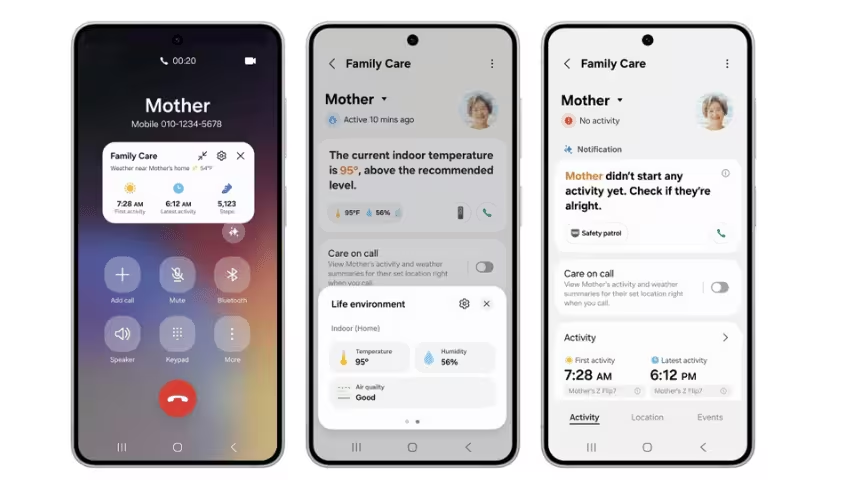
Care on Call displays a pop-up before a phone call with a family member who is being monitored, showing their first activity of the day, most recent activity, step count, and local weather. It is a simple feature, but it gives a caregiver immediate context before a conversation: did they get out of bed? Have they been moving? The data comes from SmartThings-connected devices and Galaxy wearables.
Reassurance Patrol uses Samsung’s 2026 Bespoke AI Steam Ultra robot vacuum as a mobile monitoring platform. If no activity is detected in the home for a set period, the vacuum sends an alert. Its built-in camera can detect a person lying on the floor, and it supports two-way conversation through its speaker and microphone, letting a family member check in remotely. The vacuum can be activated from a distance, turning a cleaning appliance into an on-demand surveillance and communication device.
Care Insight analyses temperature and humidity from connected appliances, air conditioners, purifiers, and humidifiers, and alerts caregivers if environmental conditions fall outside safe ranges. It also tracks patterns in connected device usage and activity levels, flagging significant changes compared to the previous week. A sudden drop in refrigerator door openings or a change in daily movement patterns can indicate a health problem before it becomes an emergency.
The most ambitious feature is cognitive decline detection. Samsung says SmartThings can analyse lifestyle patterns through mobile and wearable devices, monitoring speech, typing, walking, sleep, and gait to identify early signs of cognitive deterioration. When changes are detected, alerts are sent to designated caregivers. The feature draws on the kind of longitudinal behavioural data that clinical researchers have long identified as potentially predictive of conditions like dementia, but which has been difficult to collect outside controlled studies.
The ambient sensing layer
Underpinning the care features is Samsung’s ambient sensing technology, which uses millimetre-wave radar combined with sound sensors embedded in Samsung TVs, refrigerators, and other appliances. The system can detect different activities, distinguishing between someone exercising, sleeping, working at a desk, or simply moving through a room, without using cameras in most cases.
Samsung says all sensor data is processed and stored locally on the SmartThings hub, not in the cloud, a privacy architecture that addresses the most obvious objection to putting radar sensors in someone’s living room. The local processing approach means the system can build a detailed picture of household activity patterns without transmitting that data to Samsung’s servers, though the care alert features necessarily involve sharing some information with designated family members.
Map View, SmartThings’ spatial interface, is also being enhanced with generative AI. Users can photograph their rooms to create more accurate floor plans, and the system uses furniture location data alongside ambient sensing to understand context: whether someone is in bed, at a table, or on the floor.
The platform play
Samsung’s advantage in this category is scale. SmartThings has more than 500 million users, and Samsung’s appliance ecosystem means that many households already have the hardware infrastructure the care features require. A Samsung refrigerator, washing machine, air conditioner, TV, robot vacuum, and Galaxy Watch, taken together, generate enough behavioural and environmental data to construct a reasonably detailed model of daily life.
The company is also pushing interoperability. SmartThings is the first major smart home platform to support Matter-compatible cameras as a full device category, working with partners including Aqara, Eve, and Xthings. The new SmartThings hub integrates Thread, Zigbee 3.0, Wi-Fi 6E, Bluetooth 5.3, and Matter control, and doubles as a 15-watt Qi2 wireless charger for Galaxy phones. The open ecosystem approach means the care features can, in principle, extend beyond Samsung hardware to any Matter-compatible device.
Galaxy AI integration adds another layer. SmartThings now learns routines automatically using sensor data from Galaxy phones, and a Routine Creation Assistant powered by large language models lets users build automations with natural-language commands. These automations feed into the care system: a routine that detects when a family member has not turned on a light by their usual time can trigger a check-in alert.
The questions it raises
Remote monitoring of elderly relatives is a category with genuine demand and genuine ethical complexity. The features Samsung is building address a real problem: adult children who live far from ageing parents and worry about their safety. But they also create a surveillance infrastructure inside someone’s home, operated by family members who may have good intentions but imperfect judgment about when monitoring crosses into intrusion.
Samsung says the system is opt-in, and the person being monitored must consent. But consent in family care situations is rarely as clean as a checkbox suggests. An elderly parent who is beginning to experience cognitive decline may feel pressured to accept monitoring by well-meaning children, and may not fully understand what the system can see, hear, and infer about their daily life.
The cognitive decline detection feature raises particular questions. Clinical-grade cognitive assessment requires controlled conditions, validated instruments, and medical expertise. Samsung’s system uses passive behavioural signals, changes in gait, typing speed, sleep patterns, and speech, that research has correlated with cognitive decline, but the accuracy, false positive rate, and clinical validity of a consumer device performing this kind of screening have not been publicly disclosed. A false positive could cause unnecessary alarm; a false negative could provide false reassurance.
None of these concerns are unique to Samsung. Apple, Google, and Amazon are all building health and care features into their device ecosystems, and the same ethical questions apply to all of them. Samsung’s advantage is that its appliance ecosystem gives it more touchpoints inside the home than any phone or speaker-based platform can offer. Whether that advantage translates into better care or just more comprehensive surveillance depends on how thoughtfully the features are designed and how honestly the limitations are communicated to the families who use them.
The elder care features are expected to roll out alongside the Galaxy S26 launch later in 2026. SmartThings Pro, a separate offering for HVAC professionals, and energy management upgrades are available now. Samsung has not disclosed pricing for the care features or whether they will require a subscription beyond existing SmartThings plans.
Get the TNW newsletter
Get the most important tech news in your inbox each week.
Also tagged with


