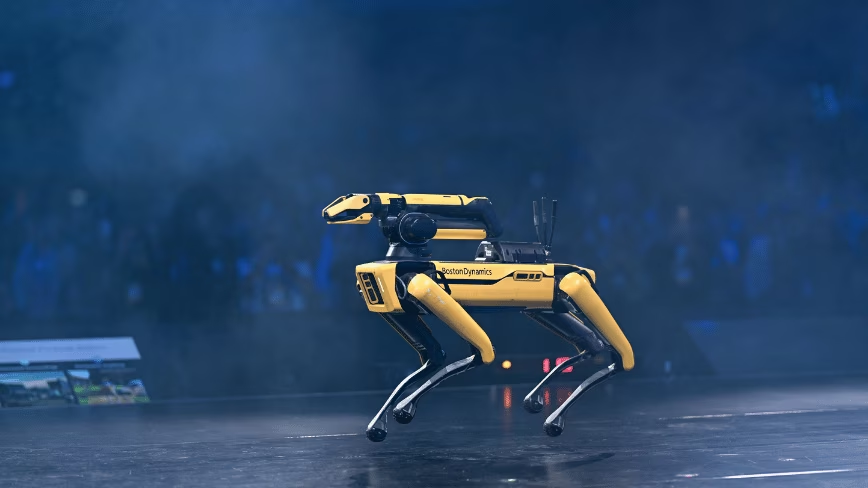
Spot on Centre Stage at Web Summit 2025 in Lisbon, in November last year.

US Immigration and Customs Enforcement has posted plans to buy a fleet of Boston Dynamics robot dogs. The listing puts the spend at $1m to $2m. It also says ICE does not intend to compete the purchase.
Joseph Cox found the plan for 404 Media on Friday. It sits in the Department of Homeland Security’s Acquisition Planning Forecast System. That is a public database where federal buyers flag what they intend to purchase, months before they go out to market.
Anyone can read it. Almost nobody does.
ICE published the record on 27 August, under the title “Boston Dynamics SPOT Robots Procurement”.
What the record actually says
ICE wants the robots for “inspection, situational awareness, and hazard assessment in environments that may pose risks to personnel”. The capability “helps improve officer safety”, the record says. It lets the agency reach “dangerous, confined, unstable, or difficult-to-access areas”.
Three fields in the record did not make the coverage.
The competition field reads NO. ICE plans to buy these without a tender, under FAR Subpart 13.5. That is a simplified route for commercial off-the-shelf items, and it exists to spare buyers a full competition on routine kit. The record files the robots under miscellaneous general purpose machinery.
The place of performance is Fort Benning, Georgia. That is an Army installation, not a border sector or a field office, and the record does not explain the choice.
The third detail is the status. This is a forecast, not a contract. The solicitation was due out on 4 September. An award should follow in the last quarter of this financial year, and the work wraps in April 2027. ICE has flagged it as a firm fixed price deal, which means the agency has a number in mind already.
Spot units have carried a list price near $75,000. That puts ICE’s range somewhere in the low tens of machines, though the record covers accessories and support as well as the robots.
The second purchase that week
The robots are not the only thing ICE has been buying. Ryan J. Foley reported for the Associated Press that the agency awarded a $16.7m contract for 6,000 pairs of gloves that deliver electric shocks. The notice went up the same week.
That deal also went out without competition, to Compliant Technologies, a Kentucky manufacturer. The gloves work as ordinary patrol gloves until an officer presses a button, and they have to touch bare skin to deliver the shock.
Officers would use the gloves in “high-tension environments”, ICE said. Its notice listed arrests, transporting combative detainees, and responding to disturbances outside detention facilities.
Sixteen senators led by Catherine Cortez Masto had written to ICE’s acting director hours earlier, asking it to drop the purchase. They questioned whether the agency could deploy the devices safely.
Their letter pointed at “the blatant and tragic misuse of force in Los Angeles, Chicago, Minneapolis, Houston, Maine, and other locations around the country”. ICE published the award notice anyway.
The agency’s own case for the gloves runs the other way. Its notice said the point was to avoid reaching for “more severe force”, firearms included, and to gain control quickly enough to prevent injuries on both sides.
DHS answered its critics in a statement. “Sanctuary politicians attempting to ban our federal law enforcement from any safety equipment is despicable,” it said.
Police have bought Spot before, and given it back
Spot walks on four legs, climbs stairs and carries sensors. Operators drive it by remote or send it along a mapped route. TNW watched Boston Dynamics test it as a parcel delivery robot in July, walking packages from the van to the doorstep.
Police departments got there first. Their record with the robot is mixed. The New York Police Department cancelled its Spot contract in 2021 after public objection. Honolulu police used one to interact with homeless residents, a deployment Vice reported at the time.
Robot dogs are becoming ordinary in security work. TNW reported in June on the machines securing the 2026 World Cup, and in August on robots filling gaps left by security guards quitting at twice the rate of other workers.
What they cannot generally do is exercise authority. China put robot traffic police on the streets this month that can do almost everything except stop you.
The manufacturer drew one line itself
Boston Dynamics led six robotics companies into an open letter in 2022, pledging not to weaponise their machines. The pledge reaches customers as well. The signatories said they would not support anyone else arming the robots either, and called on the rest of the industry to match it.
Nothing in the ICE record suggests weapons. It describes inspection and situational awareness, which is what Spot is sold to do.
The oversight question is the old one
Civil rights advocates have said ICE officers already face criticism over use of force, with little oversight or accountability, the AP reported. That is the backdrop for both purchases.
Neither buy needed a competitive process. Both cleared without one.
Surveillance hardware bought for one stated purpose tends to find others. TNW has tracked that with licence plate readers. Flock’s cameras spread across thousands of American towns before this summer’s backlash. Officers have since faced charges for running searches on people they knew.
Boston Dynamics has not said publicly whether it will take the order.
The Spot listing is still only a listing. Whether ICE buys, how many it takes, and what the robots end up doing at Fort Benning are all questions the forecast leaves open.
Get the TNW newsletter
Get the most important tech news in your inbox each week.


