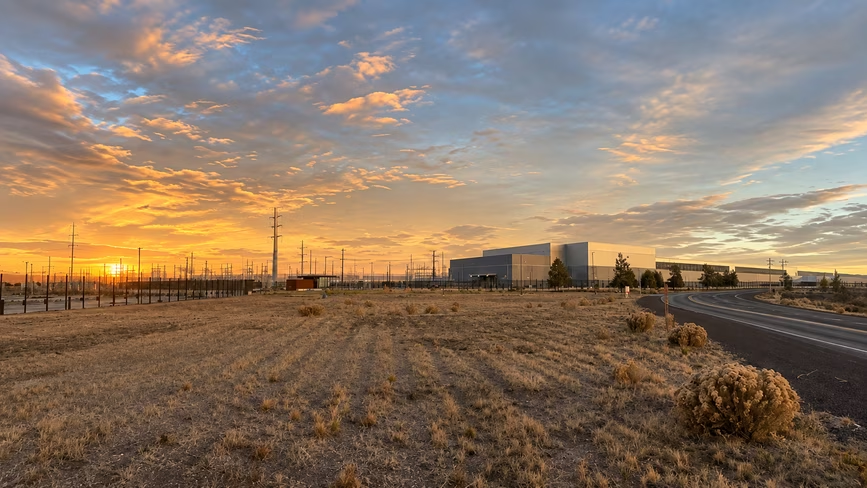
Data center facility Texas
 Credit: GoodPeak
On 22 July 2026, the Texas grid set an all-time record. Demand reached about 91 gigawatts on a punishing summer evening and the system met it, roughly half from natural gas and a third from solar. Nothing broke.
Yet much of the discussion around artificial intelligence and electricity suggests a looming shortage. American data centers used about 176 terawatt-hours in 2023, or 4.4 percent of all US electricity. That share is growing quickly. It is not, by itself, a shortage.
The real constraint is narrower. It is not how much electricity exists. It is how many specific places can receive a great deal of it; on a date somebody will lend against. That distinction is quietly repricing American land and creating a kind of developer that does not yet have a settled name.
The question is never “is there power”
A megawatt in the abstract is not useful to anyone. What a large industrial user needs is a defined quantity of power, delivered to one point on the map, by a date, in a way that survives the loss of a piece of equipment. Every one of those qualifiers narrows the map further.
The commercial property market has already noticed. JLL now reports that “speed to power is the primary criteria driving site selection”, and that average waits for a grid connection in major markets exceed four years. CBRE finds that sites offering power within 18 to 36 months are so sought after that buyers are pushing into smaller, less obvious markets to find them.
Everything else follows from that gap: four years to connect, 18 to 36 months to be worth buying.

This is not a story about computing
It is tempting to file all of this under artificial intelligence. That is the mistake that makes most commentary on the subject useless.
In a survey of corporate site-selection decision-makers published in early 2026, 98.5 percent rated “electric power availability at scale” as important, and 82.6 percent rated it very important, the highest intensity score of any factor in the infrastructure category. Those respondents are not all building data centers. They are also developing chemical plants, battery factories and distribution centers.
ERCOT’s own transmission plan projects 2030 summer peak demand above 150 gigawatts, including roughly 50 gigawatts of large-load growth attributed to data centers, hydrogen manufacturing, crypto mining and electrification, without breaking out the contribution of each sector. Separately, electrifying oil and gas production in the Permian Basin required its own reliability plan, approved by state regulators in October 2024, with import projects estimated to cost between $7.7 billion and $9.1 billion. None of that demand comes from training a language model.
What this does to land
The consequence is that two adjacent parcels with the same soil, zoning and highway access can now fall into entirely different categories because one can host a class of user that the other cannot.
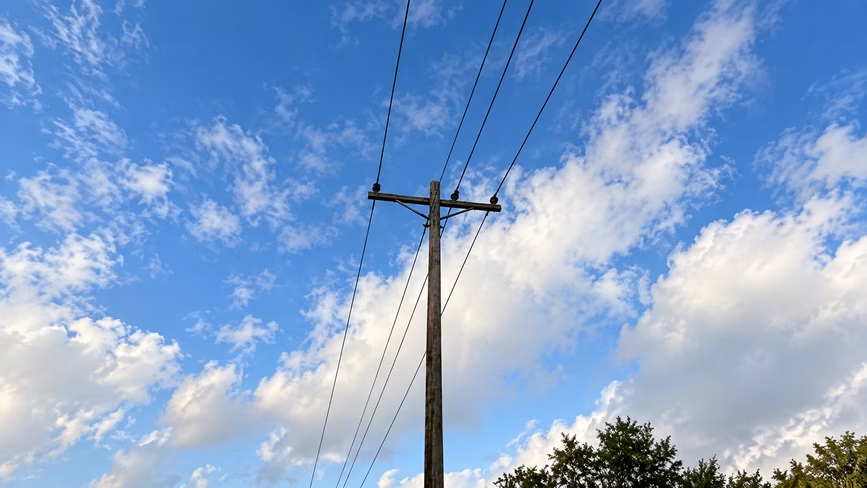
The variable doing the sorting is old. High-voltage corridors and large-diameter pipelines were routed decades ago to serve refineries, towns and industries that have since changed shape. Nobody who drew those lines was thinking about this.
Vicente Garrido, chief financial officer at GoodPeak, a Texas power infrastructure developer, has seen this dynamic play out firsthand.
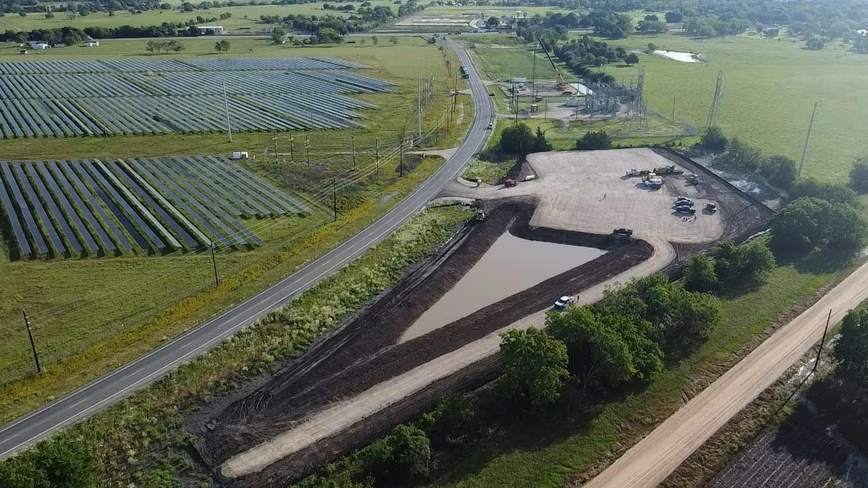
“Our Houston campus started with greenfield development for battery storage,” he says. “As we worked through the site, we realized it also had access to 138 and 345 kV transmission, a major gas pipeline, and dark fiber. That’s when we started looking at the land differently.”
That sequence is more informative than the tidier version. The infrastructure was not sought; it was found. That means the mechanism separating winners from losers in this market is not simply developer foresight. It is the map, and the map was drawn long before the demand arrived.
What “powered” ought to mean
A vocabulary is forming around this, and it is being diluted about as fast as it is being coined. “Powered land” and “powered site” now appear routinely in listings. The major research houses that track this market publish a great deal about power availability and timelines, and remarkably little defining the category itself.
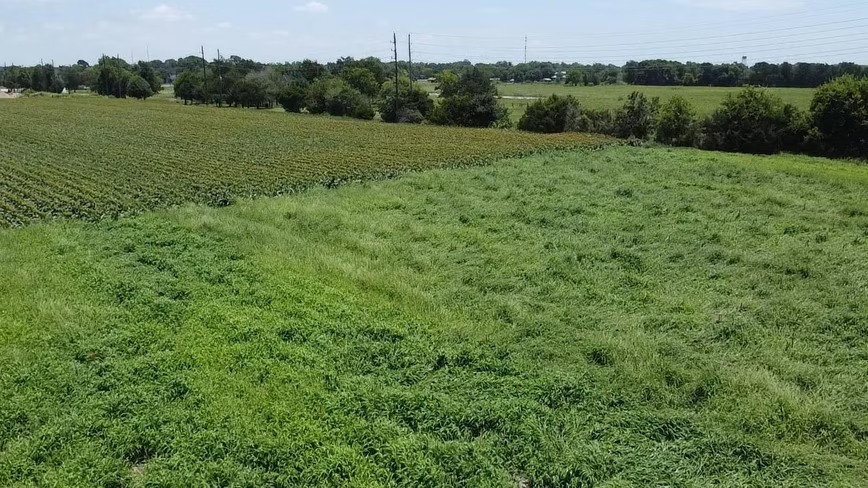
“Powered land should mean more than proximity to infrastructure,” Garrido says. “It should mean a site with a credible path to a defined amount of power on a reasonably clear timeline. The more certainty around capacity and timing, the more mature the asset.”
The useful version of that test is narrow. A capacity figure means very little unless it comes with three things a listing rarely provides: a contracted quantity, a named counterparty, and a delivery date.
Measured that way, much of what is marketed as powered is not yet power. Acreage is not power. The voltage class of a line running past the property is not power. Pipeline diameter is not power. Neither is “third-party validated capacity” when the validation is a power flow study rather than an executed agreement. It is a distinction the industry often blurs, even among experienced participants.
Gas makes the distinction obvious
Natural gas is where the gap between proximity and entitlement is easiest to see. Converting the first into the second takes an executed transportation agreement with a specific daily quantity, defined delivery points and a term; firm rather than interruptible service, a difference Texas learned the cost of during Winter Storm Uri; and a clear position in the operator’s curtailment order relative to homes and utilities.
“A pipeline crossing the property makes access easier,” Garrido says. “But it doesn’t tell you how much gas is available, what it will cost, or how reliable that supply will be.”
Time is the unit of value
Which points at the thing most models get wrong.
The instinct, when a project’s energization date slips, is to treat it as a discount-rate problem: push the cash flows out, apply the discount, move on. Garrido thinks that instinct is structurally mistaken.
“Delay in this business isn’t always linear,” he says. “Projects move through a series of gates and missing one can have broader consequences than simply adding months to the schedule. It may move a project into a different study cohort, change the underlying assumptions or required upgrades, or, in some cases, create contractual termination rights.”
That last mechanism is the sharpest. Large offtake agreements carry delivery-date rights. Past a certain slip, value does not decay gradually. The anchor customer may leave for a site that remains on schedule, returning the project to a speculative position. Queue position, meanwhile, is not a fixed asset. It is a claim on a moving allocation, improving or deteriorating according to whether other people’s projects survive.
Identical acreage, identical megawatts, a different energization year: a different asset entirely.
Why the queue filled up with options
There is one more reason places are scarce, and it is a matter of rate design rather than physics.
Texas recovers the cost of its transmission network from electricity users generally, allocated by their share of demand during four peak summer hours, rather than from the particular project whose request triggered an upgrade. Filing an interconnection request is therefore close to free for the filer, while the eventual network cost is spread across everyone else.
The result looks as economists would predict. ERCOT reported over 438,000 megawatts of large-load requests in June 2026, roughly 89 percent from data centers; by August, more than 1,800 projects representing over 474 gigawatts were in the queue. Against that, fewer than 9,000 megawatts had approval to energize. Something on the order of two percent of what has been requested has reached the point of being switched on.
Independent forecasts put the plausible figure well below the interconnection queue. Ascend Analytics projects ERCOT peak demand of roughly 120 gigawatts by 2030, compared with ERCOT’s adjusted forecast of 138 gigawatts and roughly 208 gigawatts reported by transmission providers. It also estimates that more than 80 percent of new large loads seeking interconnection will not have matching generation online by then.
“The ability of the grid to add new generation is much, much smaller than the demand,” Ascend’s Robert LaFaso told Utility Dive.
Garrido is careful not to reduce the queue to a single variable. Position in line has option value regardless of how costs are allocated. A meaningful share of the inflation also comes from the same project being filed across multiple sites and territories, which is why Texas’s 2025 grid legislation now requires applicants to disclose substantially similar requests elsewhere.
What that legislation and the interconnection reforms that followed did was not change who gets studied first. They made holding a position more costly: $50,000 per megawatt of financial security, verified site control and disclosure requirements. On a 1-gigawatt site that is $50 million committed before anything is built , a meaningful threshold for a speculative applicant.
The risk nobody underwrites
Which leaves one category that no amount of diligence resolves.
“You can diligence the land, the gas, the credit, and even the wires,” Garrido says. “What’s harder to diligence is how long a new process will actually take. That can end up mattering just as much.”
Batch processes, audits and verification regimes are new here. They are being built while several hundred gigawatts of requests move through them, by organizations doing it for the first time. That is not a criticism of anyone; it is what novelty at scale looks like. But it is a risk that appears on no checklist, prices into no model, and sits outside any developer’s control.
The category forming here still has no name, and the people in it are not landowners, utilities, generators or end users. They are whoever is holding land, interconnection, fuel and capital simultaneously, before anyone signs anything.
Whatever it ends up being called, the test will not be how many megawatts anyone claims. It will be whether those megawatts can arrive on a timeline somebody is willing to underwrite. Until then, much of the value remains contingent on the interconnection process.
Get the TNW newsletter
Get the most important tech news in your inbox each week.
Contributed article. Not produced by the TNW newsroom and does not reflect the editorial stance of TNW.


