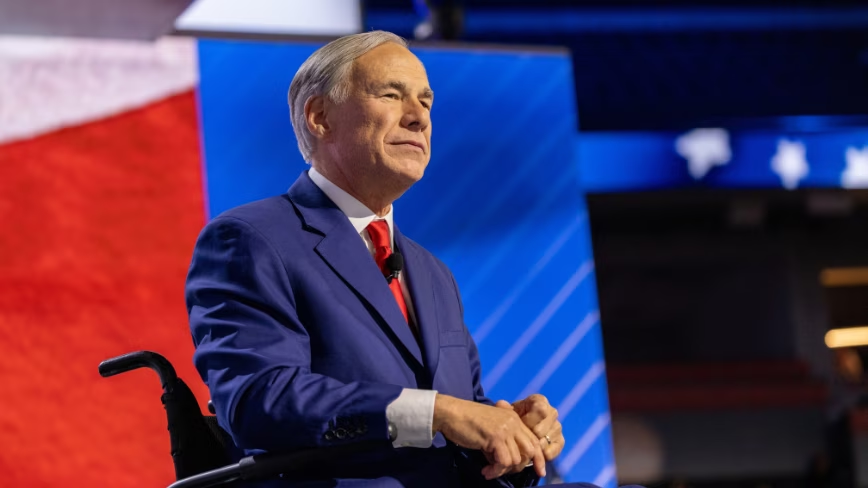
Texas Governor Greg Abbott at the Republican National Convention.
 Credit: Maxim Elramsisy via Shutterstock.com
Texas spent a decade telling data centre developers they were welcome. Now its Republicans are competing over who can regulate them most aggressively, a shift that Reuters reports has put Big Tech on notice in the state that hosts more data centres than any other.
The change is showing up on the ballot. Data centres have become a major issue in the races for governor and a US Senate seat, in a state where the industry was until recently seen primarily as an economic development success rather than a political problem.
Ken Paxton, the attorney general running for Senate, published a four-point Texas First Data Center Plan last month. It calls for a federal DATA Act, closed-loop water systems, a ban on Chinese technology inside data centres and criminal liability for AI safety violations.
His Democratic opponent has arrived at a similar position. James Talarico’s Hold Data Centers Accountable Plan would end the state sales tax incentives that helped attract the industry, establish federal minimum standards, give local communities more control over projects and require closed-loop water systems.
The overlap is revealing. Candidates from opposite parties have independently landed on the same water policy, which is usually a sign that an issue has stopped being about ideology and started being about what people see on their utility bills.
Greg Abbott is campaigning on the measures he has already introduced. “What I have done is working. The guidelines and guardrails I’ve established are now universally adopted across the state of Texas,” the governor said, pointing to requirements that data centres avoid taking water needed by communities and putting excessive pressure on the grid.
That position is more recent than it might sound. Abbott ordered a pause on new grid connections pending an audit in August, after championing a $40bn Google investment in the state just nine months earlier.
The numbers help explain the change. Texas had 474GW of interconnection requests, about 90% of them from data centres and more than five times the state’s record peak demand, without a reliable way to determine which proposed projects were actually going to be built.
The industry has not exactly made the regulatory case easier. When Texas asked companies about their water and electricity use, only 28 of 377 responded, a response rate unlikely to inspire much trust from regulators.
Abbott’s Democratic challenger says the existing guardrails are not enough. Gina Hinojosa is calling for a moratorium and a special legislative session, arguing that developers “have all descended into our communities, into our neighborhoods, and there are no rules”.
Abbott has rejected the idea of a special session. He has said the grid operator’s data is incomplete and that lawmakers can address the issue when they return in January, leaving the audit as the main binding constraint until the election.
He has also started addressing the costs. Abbott directed the Public Utility Commission and ERCOT to protect residential ratepayers from the infrastructure spending required by data centres, effectively accepting one of the central arguments from his opponents: that households have been paying part of the price for the expansion.
The national Republican Party is seeing the same shift in public opinion. Opposition to having a data centre built locally has reached 61% of Americans, up from 49% in March, while the Republican senatorial committee has warned AI companies that the backlash could threaten a Senate seat in Ohio.
Trump is taking the opposite position. He has argued that communities turning away data centres are making a mistake, while Abbott has said the companies “dug their own grave”, creating an unusually visible disagreement between a president and a governor from the same party.
The industry has noticed the change. Its response has so far been a charm offensive built around community funds and local hiring promises, aimed at a problem that has moved beyond planning meetings and into election campaigns.
What Texas decides will matter well beyond Texas. It has one of the country’s most permissive power markets and the largest concentration of data centre projects, so if the state starts tightening the rules, other states will have a model for doing the same.
Get the TNW newsletter
Get the most important tech news in your inbox each week.


