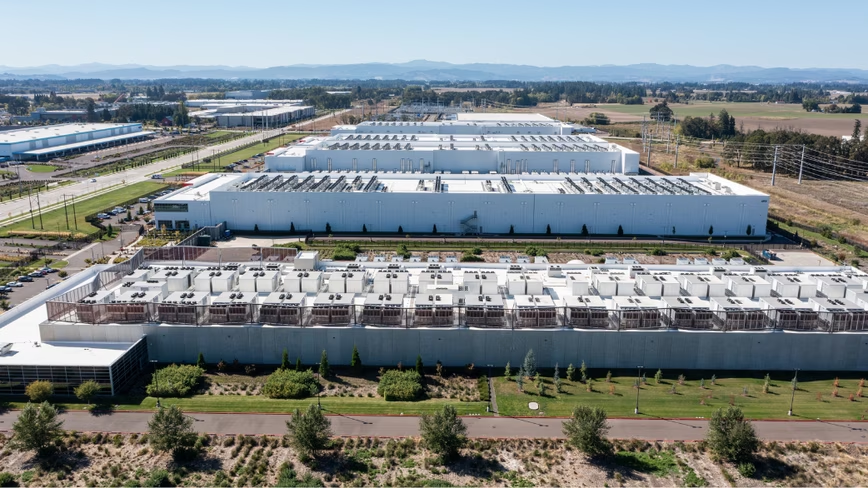
QTS Hillsboro data center buildings, Hillsboro, OR, USA
 Credit: Hrach Hovhannisyan via Shutterstock.com
Texas has 474 gigawatts of requests from data centre developers waiting to connect to its power grid, more than five times the state’s record peak demand.
In 2023, the figure was just 48 gigawatts, and the difference clearly does not represent hundreds of gigawatts of new data centres that are actually going to be built.
The industry has a name for this phenomenon, “ghost demand”, and a Reuters analysis published Tuesday shows how large the gap has become. Across the Midwest, Mid-Atlantic and South, data centre connection requests now exceed 700 gigawatts, more than ten times current estimates of US data centre electricity consumption.
The problem is less about developers deliberately misleading grid operators than about the incentives built into the connection process.
A developer can submit requests for several potential sites, keeping multiple options open at relatively little cost, and ultimately build only one of them. From the developer’s perspective, it makes sense to secure a place in the queue before deciding which project will actually go ahead.
“When you don’t know what is real, you really don’t know how to build the infrastructure for it,” said Thomas Gleeson, chairman of the Texas Public Utility Commission.
Grid operators have to plan generation and transmission infrastructure years in advance, but the numbers they are planning around can include projects that are still little more than possibilities.
There is also a good reason for developers to file early. Queue position can determine who gets connected first, so a company that waits until its project is fully funded and ready to build may find that another developer filed a speculative request two years earlier and now has priority.
One way to separate serious projects from speculative ones is to make the applications more expensive. Exelon introduced stricter collateral requirements, after which its pipeline of high-probability data centre demand fell by 40%, to 11 gigawatts.
Ohio saw a similar effect after introducing grid connection study fees of up to $100,000.
AEP Ohio’s pipeline subsequently fell by more than half, suggesting that at least part of the apparent demand had never been attached to projects ready to move forward.
Pennsylvania provides an even clearer example of the gap between proposed projects and actual construction. More than 100 data centres have been proposed in the state, but only 20 have applied for permits, while most of the remaining projects have neither secured electricity nor identified a customer.
Governor Josh Shapiro signed an executive order on August 18 requiring stricter permitting for projects above 25 megawatts, along with more information about who will ultimately use the facilities.
Texas ordered its own audit in early August, looking at ownership, tax incentives, water use and plans for generating power.
Neither state has moved to prohibit data centre development. Instead, the new rules ask developers to provide more evidence that their projects are serious, and the experience so far suggests that a significant portion of the proposed demand cannot yet meet that test.
The consequences of getting the numbers wrong extend well beyond developers and grid operators. PJM Interconnection, which manages the largest electricity grid in the US, has seen capacity costs increase by $29.4 billion across roughly four auctions, costs that ultimately feed into electricity bills paid by households and businesses.
At the same time, the underlying demand for electricity from data centres is real and growing, which makes it difficult for grid operators to simply dismiss the queues.
“The reality is that the load is showing up, and generation is not at the pace we need it,” said Jeff Shields of PJM.
Grid operators therefore have to distinguish between a company that genuinely intends to build a data centre and one that is effectively holding a development option, often without having access to the information needed to make that distinction. That lack of transparency is one of the problems the new state rules are designed to address.
“The entities that rushed into the space are maybe now learning just how difficult some of this is to construct,” said Daniel Farris, an attorney at Foley & Lardner.
Tyson Slocum of Public Citizen described Texas as trying to bring more structure to an industry that still resembles the Wild West.
There is a risk in going too far in the other direction, however. If grid operators start discounting connection requests too aggressively, they could underinvest in generation and transmission and eventually make it harder for legitimate projects to connect.
That is the other side of the problem Shields is describing: real demand is arriving, even if the queue makes it difficult to see exactly how much is coming.
Europe has been confronting a similar problem through a different approach. Denmark paused new grid connections for data centres, while 63% of new European data centre capacity is now being developed outside the continent’s five established hubs, largely because those locations have increasingly long connection queues.
For European operators, the US figures are a useful warning about what those queues can represent.
A pipeline that appears to show overwhelming demand may include the same development strategy repeated across several potential sites, and building grid infrastructure around those numbers can leave operators overbuilding in some places while still failing to meet genuine demand elsewhere.
The incentive structure is similar on both sides of the Atlantic. As long as submitting a speculative connection request costs almost nothing, developers have little reason to withdraw projects that may never be built.
Once grid operators start requiring money, permits, and evidence of a real customer, a large part of the queue tends to disappear.
Get the TNW newsletter
Get the most important tech news in your inbox each week.


