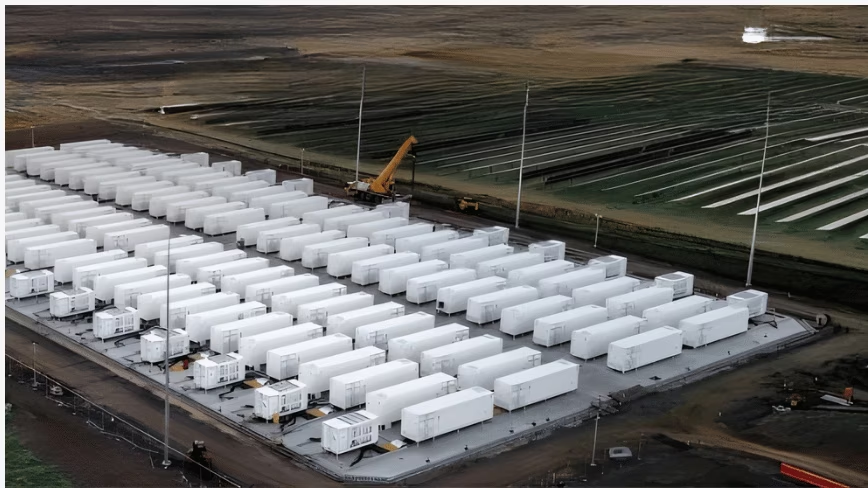

In the sprawl north of Dallas, where data centres are multiplying and the Texas grid groans under record demand, Energy Vault has placed a new bet on battery storage, and on the idea that the companies powering AI’s insatiable appetite for electricity will need far more of it, far faster.
The California-based energy storage company announced on Monday that it has acquired the McMurtre Battery Energy Storage System (BESS), a 175 MW / 350 MWh project near Dallas, from greenfield developer Belltown Power. The deal advances Energy Vault’s plan, first outlined at its 2025 Investor and Analyst Day, to deploy an initial 1,500 MW of battery storage capacity across the United States and beyond.
Why ERCOT North, and why now
The McMurtre project sits in the ERCOT North market, a region that has become one of the most contested patches of real estate in American energy. Rapid data centre construction near Dallas has driven sustained demand for grid stability and new generation capacity, and power price dynamics in the region remain among the strongest in the country. Energy Vault says it selected the interconnection point specifically for its revenue projections and proximity to that expanding compute infrastructure.
The project already holds an executed Small Generator Interconnection Agreement (SGIA) and full site control, two milestones that significantly de-risk the path to construction. Energy Vault expects to receive Notice to Proceed in the fourth quarter of 2026, with commercial operation targeted for December 2027.
The financial picture
According to the company, McMurtre is expected to generate between $15 million and $20 million in average annual revenues over its technical life, translating to an estimated $350 million to $375 million or more in total lifetime revenues. These are forward-looking projections, however, and remain subject to the usual caveats around market conditions, permitting, and execution risk.
Energy Vault intends to contribute the project to its Asset Vault platform, a fully consolidated subsidiary that develops, builds, owns, and operates energy storage assets globally, once it reaches Ready-to-Build status. The company’s $300 million preferred equity investment commitment is designed to support projects like McMurtre as they advance through development and into construction, enabling over $1 billion in total project capital expenditure across the portfolio.
Three asset classes, one thesis
McMurtre is not just a standalone battery project. It fits into a broader strategic architecture that Energy Vault has been assembling around three complementary asset classes: battery energy storage systems, “powered land,” and “powered shells,” the latter referring to modular data centre infrastructure deployed close to energy assets.
That strategy took concrete shape in February 2026, when Energy Vault announced a framework agreement with Crusoe Energy Systems to deploy Crusoe’s Spark modular AI factory units at Energy Vault sites, starting with a 25 MW deployment in Snyder, Texas. The partnership marked the company’s formal entry into AI compute infrastructure and signalled that battery storage, in Energy Vault’s view, is not merely a grid-balancing tool but the foundational layer for a new class of energy-adjacent digital infrastructure.
Robert Piconi, Energy Vault’s chairman and chief executive, framed the acquisition in those terms. The company is building battery assets that enable powered shell deployments, which in turn serve the booming demand for AI compute capacity. McMurtre, he indicated, strengthens that foundation.
A growing portfolio
The acquisition brings Energy Vault’s total owned assets, whether acquired, under construction, or in operation, to 715 MW across all asset classes within its Asset Vault platform. Other projects in the pipeline include the 150 MW / 300 MWh SOSA Energy Center in Texas, the 57 MW / 114 MWh Cross Trails BESS in Texas, an 8.5 MW / 293 MWh resiliency centre in Calistoga, California, and two long-duration storage projects in New South Wales, Australia: the 125 MW / 1.0 GWh Stoney Creek BESS and the 100 MW / 870 MWh Ebor BESS.
The McMurtre system will use Energy Vault’s B-VAULT AC Technology Platform 3, the company’s latest battery product. Globally, the B-VAULT portfolio now exceeds 3 GWh of deployed or contracted systems across Europe, North America, and Australia.
The bigger question
Energy Vault’s wager is ultimately a bet on convergence: that the companies racing to build AI infrastructure will pay a premium for co-located, reliable power, and that vertically integrated storage operators are better positioned than anyone to deliver it. Whether that thesis holds will depend on execution, on ERCOT’s continued growth trajectory, and on whether the AI data centre buildout sustains its current ferocious pace.
For now, the McMurtre deal adds another tile to a mosaic that Energy Vault is assembling across three continents and, increasingly, across the boundary between energy and compute. The grid, it seems, is no longer just about keeping the lights on. It is becoming the scaffolding for something much larger.
Get the TNW newsletter
Get the most important tech news in your inbox each week.


