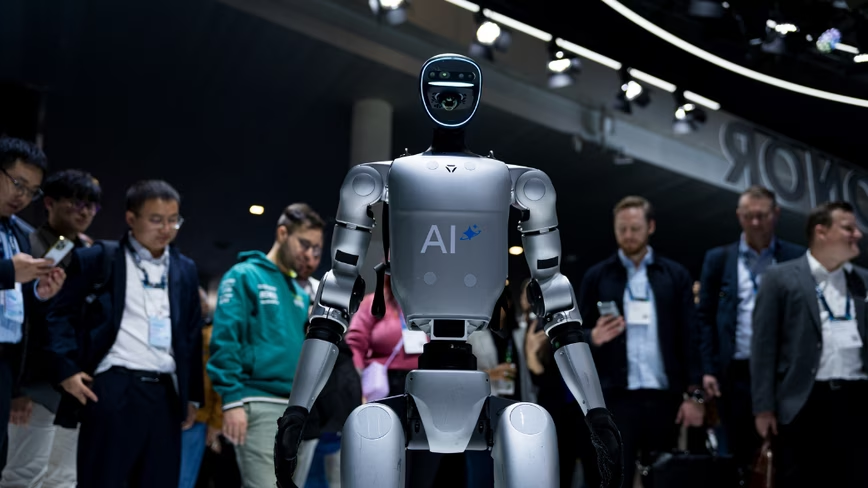
A humanoid robot by the company Unitree is seen at the Mobile World Congress 2025 (MWC) at the Fira de Barcelona.
 Credit: Davide Bonaldo via Shutterstock
Unitree’s shares have fallen roughly 45% from the peak they hit on their first day of trading in Shanghai. The slide has turned a national success story into an argument about how China prices its listings.
The stock steadied on Tuesday after three consecutive days of decline, Reuters reported. The valuation of the Hangzhou humanoid robot maker reached $66bn at one point. It has since dropped by $30bn.
Unitree finished its debut up 460%. Newly listed Chinese stocks have gained an average of 226% on their first day over the past three years. Even in a market used to opening-day surges, that stood out.
The gap between the price and the debut
Unitree listed on 19 August at 150.8 yuan a share, valuing the company near $9bn. The $66bn peak came later, intraday, once the market had its say.
Dong Baozhen chairs the Beijing asset manager Lingtong Shengtai. The distance between the offer price and the debut means “either one of them must be wrong”, he told Reuters. He thinks the debut was the mispriced one.
Debut performance is the barometer of market mood, Dong said, and exuberant mood breeds bubbles. The technology revolution narrative carried investors away. All bubbles are doomed to burst, he added.
What the company earns
Unitree’s adjusted net profit fell 53% in the first three months of 2026, to 40mn yuan, or about $5.95mn. The figure comes from the company’s own prospectus.
Its machines are famous for running, dancing and performing martial arts. One of them beat Usain Bolt’s 100m record at the World Humanoid Robot Games in Beijing this month. Roboticists were quick to qualify that result.
Broader commercial applications have been harder to come by. Analysts had put the company’s likely worth at $7bn or more in the weeks before the float.
The company competes with Tesla and with Boston Dynamics, which Hyundai Motor Group owns. Its backers include Tencent, Alibaba and the AI developer DeepSeek. Founder Wang Xingxing holds about a third of the shares.
The mechanism behind the swing
Chinese stock exchanges vet listing candidates. They also guide IPO pricing, which limits how far bankers can move to meet feverish demand. Analysts told Reuters that this distorts prices.
Two other features compound it. Regulators carry a duty to shield small investors from harm, and rules restrict short-selling. An overpriced listing therefore meets no immediate pushback from anyone betting against it. Bankers described that combination to Reuters.
Unitree’s fast-tracked listing on the STAR Market carried its own signal. The board takes only hard-tech companies in China’s national strategic industries. Analysts read a place on it as government blessing.
Who was left holding it
Abraham Zhang chairs the venture capital firm China Europe Capital. He told Reuters that a desire to pump up the shares and dump them later at lofty prices drove the debut, rather than any rosy prospect.
Loopholes in the IPO system let major shareholders cash in, Zhang said. The risk then moves to small investors buying in the secondary market. Those who won allocations walked away with smiles, he added.
Yuan Yuwei, a hedge fund manager at Trinity Synergy Investments, put it more bluntly. A stock worth 10 yuan can open at 100 yuan and then slide for years. He called it a rip-off.
Restricted short-selling is what makes those schemes possible in the first place, Yuan said.
Retail demand for the offer had been extraordinary. Small investors oversubscribed it more than 8,000 times, a STAR Market record, which left an allocation rate near 0.018%. Almost everyone who wanted the stock had to buy it after trading opened.
One retail investor who lost money wrote in a blog post that he supports Chinese innovation. He also wrote that the rapid concentration of wealth cannot be built on the pains of retail investors.
The case for patience
Not everyone reads the fall as a verdict on robotics. Gao Xingkun manages a fund at China Southern Asset Management, and he told an online roadshow that judging these companies on profit alone is unfair.
Many robot makers spend heavily on research while commercial orders are not yet in sight, Gao said. He compared the moment to the early years of China’s electric vehicle industry, which now dominates its category.
Unitree’s founder Wang Xingxing has made a version of the same argument. Robots are approaching a ‘ChatGPT moment’, he said last week, days after the listing.
Unitree is not the only one
The memory chipmaker CXMT saw its shares climb 466% on its own Shanghai debut last month, a near-identical pattern in a different strategic industry.
Scarcity plays a part. Only 21 companies went public in Shanghai during the first seven months of this year, against 104 in Hong Kong, because of tight regulatory scrutiny.
Yuan said investors chase what few opportunities there are. There are not many good companies in China’s stock market, he told Reuters.
A queue of domestic rivals is preparing to list, and Unitree’s debut was meant to set the tone for them. It still may, though not in the way those companies would have chosen.
What Europe is watching
European robotics has no comparable listing to point to, and its builders are earlier. UMA, founded by an ex-Tesla Optimus scientist, is building Europe’s humanoid from a much smaller base of capital.
Most accounts call that gap a European weakness. The past week offers a reading in which slower capital is not only a handicap. A listing that swings by $30bn in three sessions tells a founder very little about demand for the product.
The question the Shanghai market is now asking is whether the demonstrations that made Unitree famous convert into recurring orders. Zhang expects more of these episodes, saying the capital drama at Unitree is not the first in China and will not be the last.
Get the TNW newsletter
Get the most important tech news in your inbox each week.


