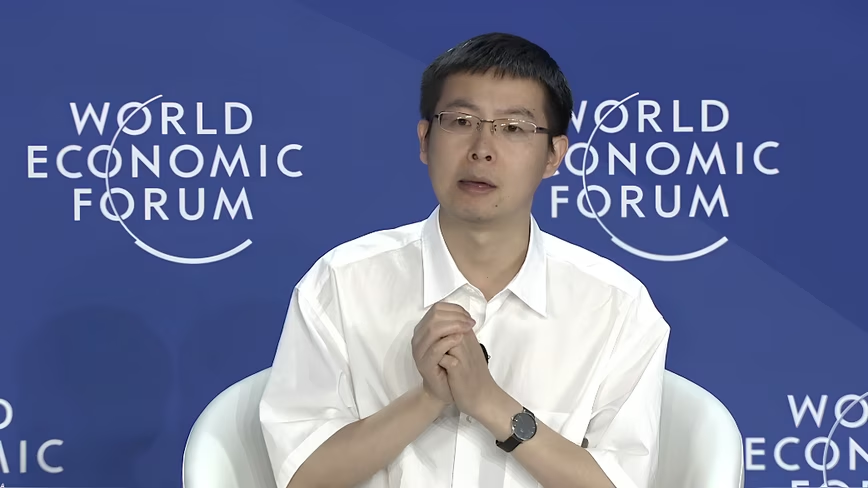
Wang Xingxing, Unitree founder speaking at
World Economic Forum
 Credit: Wang Xingxing, Unitree founder speaking at World Economic Forum Video
Wang Xingxing spent Thursday morning at the World Robot Conference in Beijing telling the room that humanoid robots are approaching their “ChatGPT moment”. He spent another part of the same appearance explaining why that moment might still be a decade away.
The Unitree founder and chief executive was speaking the day after his company’s Shanghai listing, where the shares climbed almost sixfold on debut before giving back 11% on Thursday. It is not the usual thing for a chief executive to spend the morning after a blockbuster float lowering expectations, which is roughly what he did.
“We are marching towards a ‘ChatGPT moment’ in embodied intelligence,” Wang said, according to accounts of his remarks at the conference. What he means by the phrase is unusually specific for a sector that trades heavily on vagueness.
The test, as he set it out, is a robot introduced into a household it has never seen before, taking instructions by voice or text, and completing roughly 80% of what it is asked to do.
Wang called that threshold an important tipping point for the industry, and he has been refining the formulation for some time: at the Hongqiao forum in Shanghai last November, he pinned it to a double target of 80% of tasks across 80% of unfamiliar scenes, with no scene-specific training beforehand.
What has changed since then is the timeline. Wang told the Beijing audience that the necessary software breakthroughs could arrive in two to three years if things go well, or in five to 10 if they do not, a spread wide enough to accommodate almost any outcome. Last year, he was talking about two years.
That caution sits awkwardly beside the money now moving through the sector. Chinese manufacturers shipped more than 40,000 humanoids in the first half of 2026, close to the whole of the global total, and yet the industry’s commercialisation problem has barely shifted, with universities and research institutes still making up the bulk of the customer base.
The listing itself gave the sector its clearest price signal yet. Unitree came to market in Shanghai on Wednesday after demand that Chinese brokers described as unprecedented for a robotics name, and the debut valued a company whose flagship products are quadrupeds and a humanoid that competitors still mostly buy for their own laboratories. Thursday’s 11% fall was the first correction to that enthusiasm, and it arrived within a day.
Wang is not alone in putting a date on it. Wang He, the founder of the Beijing robotics company Galbot, told the same conference he expects the sector’s breakthrough around 2028, at which point he thinks robots will manage 70% to 80% of everyday tasks without bespoke training.
Two of China’s better-known robotics founders converging on the same percentage band is either a sign of genuine engineering consensus or of a phrase that has hardened into an industry talking point.
Unitree itself remains the most visible name in the field. It is the world’s largest maker of robot dogs and the second-largest producer of humanoids by shipments, and Wang said the company is pouring capital and staff into world models, the systems that let a machine predict how a physical environment will behave before it acts in it.
That is the layer where the 80% figure will be won or lost, and it is also the layer where Nvidia has been courting alternatives to Unitree.
For now, the hardware runs ahead of the software, which is the reliable pattern of the past three years. Morgan Stanley has doubled its forecast for Chinese humanoid output this year, and the machines those factories turn out still cannot be trusted to load a dishwasher they have not met.
Wang did not say what Unitree would do differently if the longer end of his estimate turns out to be the right one, and nobody at the conference appeared to ask. The company has not published a target date of its own for the household robot it described.
Get the TNW newsletter
Get the most important tech news in your inbox each week.


