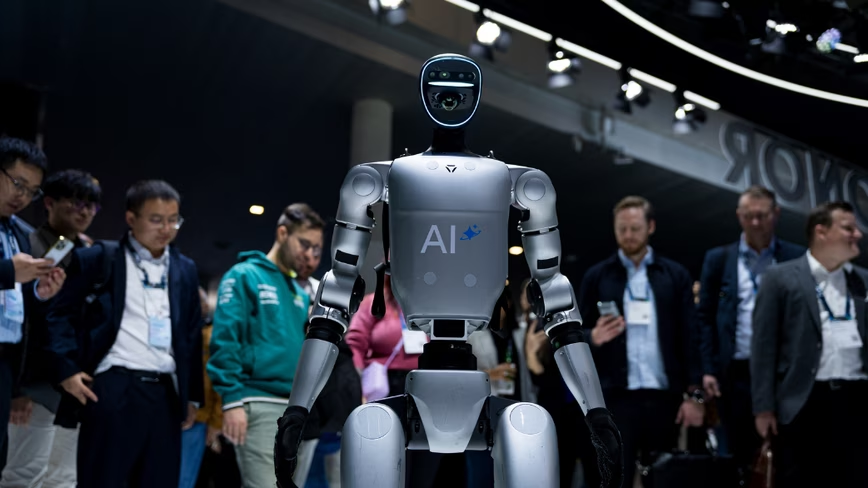
A humanoid robot by the company Unitree is seen at the Mobile World Congress 2025 (MWC) at the Fira de Barcelona.
 Credit: Davide Bonaldo via Shutterstock
Unitree Robotics, the Hangzhou company that has done more than anyone else to turn Chinese humanoid robots into a spectator sport, is due to begin trading on Shanghai’s STAR Market on 19 August, according to Reuters.
The listing makes it the first general-purpose humanoid maker to go public on the mainland, and it arrives having already cleared the paperwork: China’s securities regulator signed off on the registration earlier in the year, when the numbers looked far more modest.
Unitree priced its shares at 150.8 yuan apiece, selling roughly 40mn new shares, about a tenth of the enlarged company, to raise some 6.1bn yuan, or around $900mn.
That values the business at close to 61bn yuan, near $9bn, comfortably above the 42bn yuan the market had pencilled in only weeks earlier and well beyond the $7bn figure floated during the run-up.
For a firm that was barely a household name a few years ago, and one that still sells more robot dogs than androids, it is a startling repricing.
Retail investors oversubscribed the offer by more than 8,000 times, a record for the STAR Market, and the overall book was covered several thousand times over, leaving an allocation rate of roughly 0.018 percent.
Grey-market pricing has pointed to first-day gains of triple to quadruple the offer price, which is less a valuation than a mood. Chinese new listings returned an average of 233 percent on debut in the first half of 2026, so exuberance is, for now, simply the baseline.
Also, on Monday, two days before the float and timed to the opening of the World Robot Conference in Beijing, Unitree unveiled a new high-speed humanoid nicknamed “Superman”, built, it says, in little over three months and able to jump two metres from standing and hit 12.66 metres per second, quicker over the ground than Usain Bolt at his peak.
Video: Unitree Robotics / YouTube
The company freely calls it a work in progress; it also, conveniently, handed investors one more viral clip to pass around in the days before pricing.
What is being bought, underneath the theatre, is real enough. Unitree made its name on nimble quadruped robot dogs before moving into bipeds, and its G1 and H-series humanoids are now fixtures of the internet’s robot-video economy, running, dancing, sparring and picking themselves up after a shove.
The founder, Wang Xingxing, still only in his mid-thirties, holds about a third of the company and is, on paper, China’s first humanoid-robot billionaire; backers include Tencent, Alibaba and the AI upstart DeepSeek.
The financial picture is more nuanced than the queue outside the offering suggests. Revenue has more than quadrupled year on year, and Unitree, unusually for the sector, has been profitable for several years.
Yet its first-quarter net profit fell sharply, by close to half depending on the filing, as research and marketing spending climbed, the familiar shape of a company sprinting to stay ahead of a crowded field rather than coasting on fat margins.
It is also, unmistakably, a national project. Beijing has thrown its weight behind humanoids as a strategic industry, and the debut is read at home as a milestone for Chinese hardware rather than a mere corporate event.
Competition is thickening accordingly, with rivals such as AgiBot, Leju and EngineAI chasing their own listings in Hong Kong and Shenzhen, and whether any can turn viral demonstrations into durable businesses is another matter, on distinctly mixed early evidence.
For all the theatre, the underlying question remains unresolved. Unitree makes machines that can somersault; it has yet to prove that it can somersault into a mass market where buyers stay satisfied and orders recur.
Even Nvidia, whose chips power much of this boom, has been quietly spreading its bets across other robot makers. I
nvestors bidding the stock up thousands of times over are wagering that the demonstrations are a prologue. From 19 August, the market will start, cautiously or otherwise, to find out.
Get the TNW newsletter
Get the most important tech news in your inbox each week.


