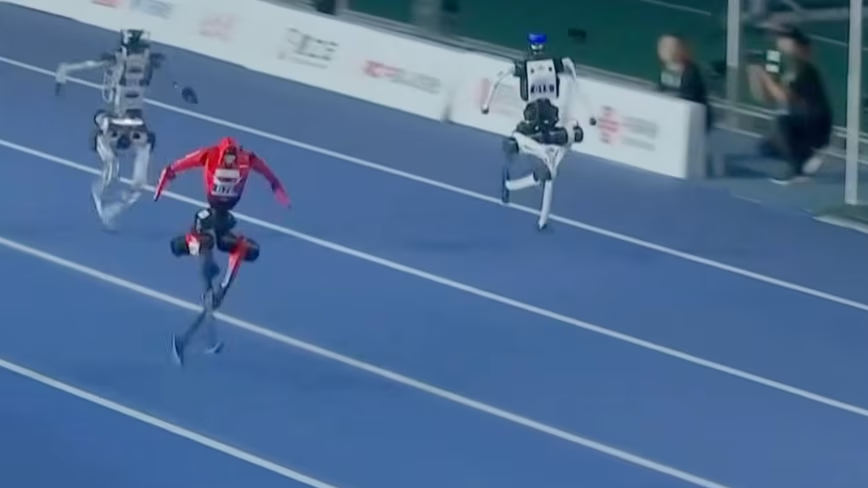
Screenshot of Chinese robot running race at Beijing games
 Credit: Youtube \ Screenshot from BBC News
A robot built by Beijing’s X-Humanoid ran 100 metres in 9.39 seconds at the World Humanoid Robot Games, beating Usain Bolt’s 9.58-second record. Roboticists point out that speed on a known course is far easier for a machine than folding laundry.
A machine has run the 100 metres faster than any person ever has. A robot built by the Beijing company X-Humanoid covered the distance in 9.39 seconds at the second World Humanoid Robot Games, against Usain Bolt’s 9.58 seconds from 2009.
It was not the only human record to fall. The same firm’s robot cleared 2.88 metres in the high jump, well beyond Javier Sotomayor’s 2.45, while a machine from the phone maker Honor was timed at 9.32 seconds in trials.
The event is enormous. More than 2,000 robots from 16 countries are competing across 51 events at Beijing’s Olympic speed skating oval.
The year-on-year jump is where the story starts. At the first games in 2025 Unitree’s H1 won the 400 metres in 88 seconds, against a human record of 43, and much of what the robots did was remote controlled, in a field now being reshaped by China’s smartphone supply chain.
Getting from there to here means building sprinters. Honor lengthened its robot’s legs by 10 centimetres to 1.05 metres before the games, which is a design change aimed at one number.
People who build robots for a living have been blunt about what this shows. Rodney Brooks, the MIT emeritus professor behind iRobot, called an earlier Beijing robot race a “publicity stunt” with “nothing useful that you could use in any application because it shows no safety at all.”
The autonomy figures support him. In that April half marathon, only 38% of entries ran autonomously, the rest were piloted remotely, and even the autonomous ones followed a route they had already been given.
Yanran Ding of the University of Michigan named the trap precisely. People have “a cognitive bias to think that running a half marathon faster than a human is more difficult than folding laundry, which is not true,” and Europe is betting on that gap.
Oregon State’s Alan Fern draws the same line. He puts the gains down to engineering and investment rather than a breakthrough, and says real progress means a robot handling a place it has never seen.
That is roughly the problem European companies have chosen. NEURA Robotics is building gyms to train robots in messy physical environments, while London’s Humanoid raised $152mn with Bosch lined up to manufacture at scale.
None of that will produce a photograph as good as a robot beating Bolt. It is also the only version of the work that ends with a machine doing something a person actually needs done.
Get the TNW newsletter
Get the most important tech news in your inbox each week.


