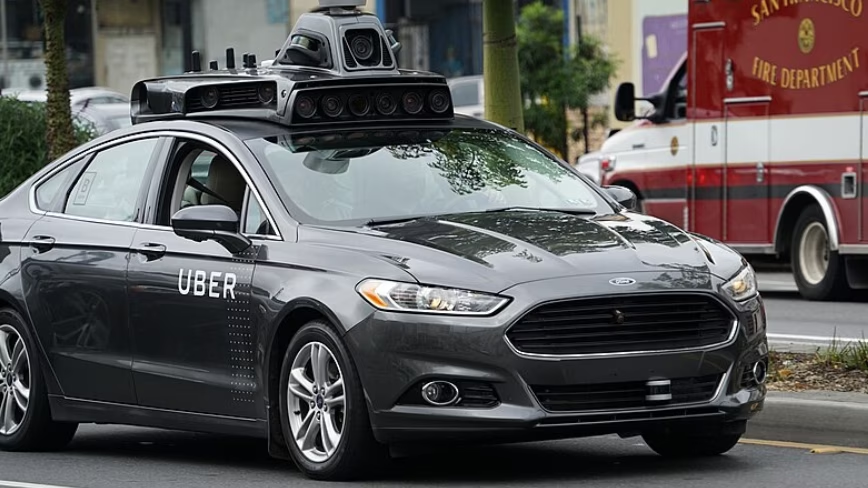
Uber autonomous vehicle prototype spotted in San Francisco
 Credit: Dllu
Uber lost the race to build a self-driving car. Now it wants to write the rules for everyone who did. In two US states it is lobbying for laws that would force robotaxis onto its app, and its own product chief is happy to explain why.
Uber could not win the race to build a robotaxi. It is now trying to win the race to regulate one.
In Washington DC and New Jersey, the company is pushing for what it calls a “hybrid network”, public records show. The idea sounds modest. Any robotaxi service would have to run human drivers on the same platform as its driverless cars. In practice, it would hand Uber a gate that every rival has to pass through.
The reporting comes from Wired’s Aarian Marshall, who obtained the New Jersey documents, and TechCrunch, which detailed the DC fight. In New Jersey, one draft would require human drivers to handle 85% of rides for three years. In DC, Uber is fighting a bill that would let robotaxis run with no safety driver at all.
The hybrid gate
Uber’s case is that an AV-only market would hand Waymo a monopoly and put human drivers out of work. Its policy chief, Javi Correoso, told a DC Council roundtable that one driverless car displaces roughly four drivers. He wants the choice written into law.
“There should be a requirement for consumers to be able to take an Uber that’s driven by a human,” he said.
The bill Uber opposes would do the opposite. It would let DC license fully driverless fleets, funded by a per-mile tax and steep permit fees that critics say would already price out all but the biggest players. Uber has company in disliking parts of it. But its own fix, opponents argue, is worse.
Waymo, which backs the bill, runs more than 500,000 rides a week across 11 cities. It does not want its cars confined to a rival’s app. Greg Rogers, of the think tank The Innovation Majority, called Uber’s plan an attempt at “regulatory capture”. Forcing one business model on a market, he argued, just charges rent on everyone who wants to operate.
The quiet part, said out loud
Uber is not hiding the logic. Its chief product officer, Sachin Kansal, told TechCrunch the company is “not in the race to be an L4 autonomy provider”. Instead, he said, it is “laying down the race tracks so we can work with multiple players”, and it believes in a hybrid network of humans and robots in the same city.
That is where the data comes in. Through a unit called AV Labs, Uber is fitting hundreds of cars with sensors to gather millions of miles of driving data, which it can share with the same AV firms it competes with. Own the road, and you own the data that runs on it.
A very different Uber
The pose is a strange one. The young Uber bulldozed local taxi rules and fought union-backed laws for years. Now it says it has grown up.
“That experience changed us,” chief operating officer Andrew MacDonald wrote in May. “Today, we partner with cities instead of confronting them.”
The two-track strategy is on full display. Even as it lobbies to slow rivals, Uber is lining up to deploy them. It is working with Nvidia on a Level 4 service, and has robotaxi launches planned with Nuro and Lucid in Houston and WeRide in Madrid. It also sold its own self-driving unit to Aurora in 2020. It cannot win the technology race, so it is trying to own the road the winners drive on.
The bigger fight
DC is only the test case. Uber says it will pitch the hybrid model in other states as they write their AV laws.
It is a pattern regulators are already wrestling with. New Jersey has weighed its own robotaxi bill, US safety officials have ordered AV firms to stop blocking first responders, and the same agency wants to delete the steering wheel altogether. Tesla is inching its Cybercab forward, and Waymo is still living down a bad night in San Francisco.
The technology, for now, mostly works. The open question is who controls the dispatch. Uber built an empire by owning the app between rider and driver. It is now betting the same choke point still pays when the driver is a robot.
Get the TNW newsletter
Get the most important tech news in your inbox each week.
Also tagged with


