TL;DR
Florida plans to redirect $198 million in federal EV charger funds to build 32 eVTOL vertiports instead of public charging stations
The state plans to build 32 eVTOL vertiports at luxury apartments, golf courses, and military bases, using federal funds earmarked for electric vehicle chargers
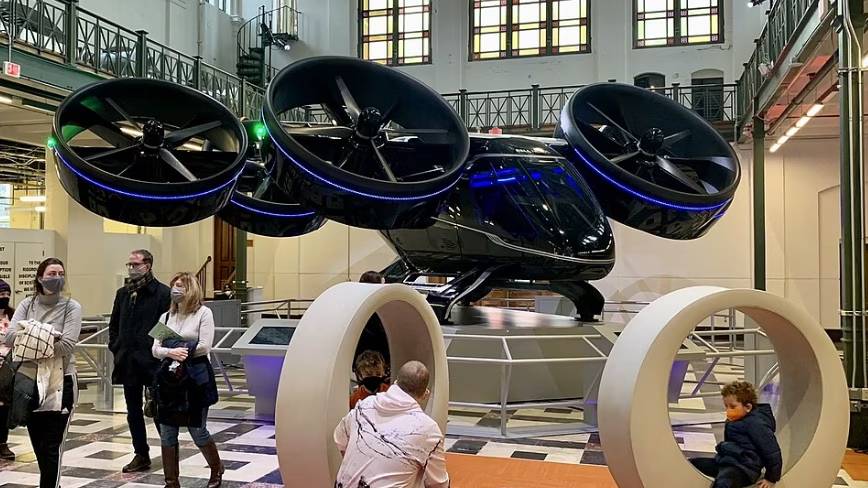
Air-taxi
 Credit: APK
Florida plans to redirect $198 million in federal EV charger funds to build 32 eVTOL vertiports instead of public charging stations
Florida received $198 million from the federal government to build public fast chargers for electric vehicles. Instead, the state wants to spend it on landing pads for electric air taxis that have not yet received FAA certification for commercial service. The plan, uncovered by a Miami Herald investigation, would redirect the state’s entire allocation under the National Electric Vehicle Infrastructure programme to build 32 eVTOL vertiports.
The Florida Department of Transportation is calling the project an “Aerial Highway Network,” framing it as a complement to the state’s existing transport system. Each vertiport would cost roughly six million dollars, and the proposed locations include luxury apartment buildings, golf courses, military bases, and airports. The agency says the network could ease congestion and improve connectivity, though eVTOLs have not carried a single paying passenger anywhere in the United States.
FDOT’s justification is that the private sector has already built out much of Florida’s fast-charging network. The agency noted in planning documents that the number of EV charging ports in the state has doubled over the past four years, and that Florida has 452 fast-charging stations. Tesla, Electrify America, ChargePoint, and newer entrants like Ionna and Walmart have done most of the building.
The argument has a technical basis. Under NEVI rules, once a state fulfils its obligation to build chargers along highway corridors, it can redirect leftover funds to other charging needs. The Federal Highway Administration has reviewed Florida’s major corridors, approved them as fully built out, and is expected to greenlight the redirect, though final approval has not been confirmed.
But NEVI was designed to fill gaps the private sector overlooks, particularly in rural areas where charging stations may not turn quick profits. Several states have used the programme to do exactly that, with New York deploying federally funded fast chargers across the Adirondacks and Finger Lakes where coverage had been sparse. Florida, by contrast, largely left its NEVI funds untouched while other states moved from planning to deployment.
The political context is hard to ignore. FDOT built a website that labels pro-EV policies as “greenhouse gaslighting” and asks why the government would want to eliminate “one of the greatest inventions like the combustion engine.” State leaders have repeatedly portrayed electric vehicles as part of a political agenda, falsely claiming that Americans were being forced to buy them.
The irony is that Florida is America’s second-largest EV market. The state trails only California in total registrations, with well over 400,000 electric vehicles on its roads. Those drivers would benefit from a denser, more reliable public charging network, the kind NEVI was built to fund.
The eVTOL industry, meanwhile, is still in its pre-commercial phase. Joby Aviation flew demonstration routes across New York City in April and has cleared four of the FAA’s five certification stages, but its type certificate is not expected until late this year at the earliest, and no eVTOL company has received full FAA approval to carry paying passengers on scheduled routes. Florida signed a separate state law in April authorising FDOT to fund vertiports, setting a December target for commercial air taxi service that the federal certification timeline may not support.
The proposed vertiport locations raise their own questions. Luxury apartments and golf courses suggest the early beneficiaries would be a narrow, wealthy segment of the population rather than the everyday Floridians the state claims to be serving. The infrastructure needed to coordinate eVTOL traffic at scale is still being developed, and the aircraft themselves remain years away from the kind of mass deployment that would justify a statewide network of landing pads.
Florida is betting nearly $200 million of federal money on a technology that does not yet have commercial approval, for a service that would initially reach a fraction of its population, while its existing EV drivers navigate a charging network the state chose not to expand. The FHWA’s decision on whether to approve the redirect will determine whether that bet stands.
Get the most important tech news in your inbox each week.


