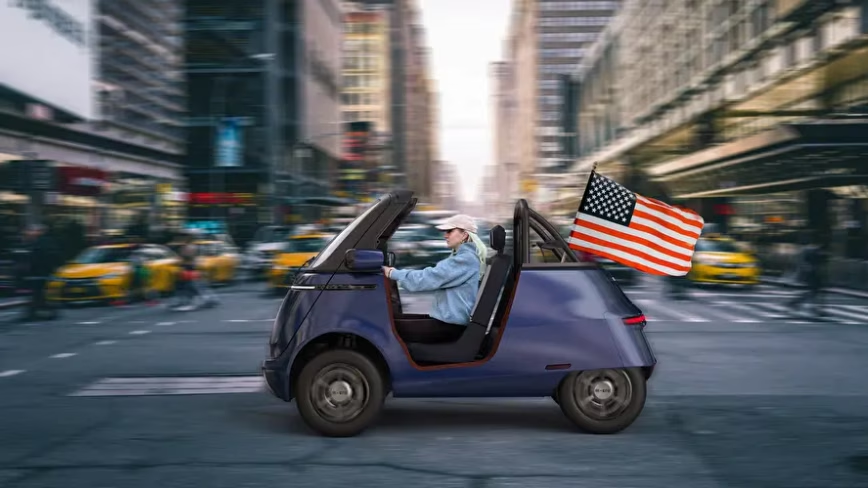
Microlino-car
 Credit: Microlino
The US golf cart market has grown from roughly one billion dollars before the pandemic to about five billion, according to The Wall Street Journal, with street-legal carts spreading well beyond golf courses into suburban neighbourhoods where residents use them for school runs, grocery trips, and short commutes. At the same time, e-bike imports topped an estimated two million units in 2025, and established carmakers are now launching vehicles designed to occupy the space between a bicycle and a conventional car.
Fiat brought its Topolino to the United States in July with a starting price of just under $14,000, making it the cheapest new vehicle Stellantis sells in the country. The two-seat electric quadricycle has a five-kilowatt-hour battery and a top speed of 19 miles per hour, with an optional street-legal conversion kit that raises the limit to 25 miles per hour. Under federal rules, that qualifies it as a low-speed vehicle, legal on roads with speed limits of 35 miles per hour or less.
None of this means Americans are abandoning large vehicles. The EPA’s 2025 Automotive Trends Report found SUVs accounted for 60 percent of all vehicles produced in the US in model year 2024, and Cox Automotive’s June 2026 sales forecast showed full-size pickups and midsize SUVs still claiming more than 30 percent of the market.
But the more revealing trend is what is growing alongside them. Compact SUVs became the country’s best-selling vehicle type in 2020 and have continued gaining ground, according to Kelley Blue Book. Three compact models, the Toyota RAV4, Tesla Model Y, and Honda CR-V, outsold Ram’s full-size pickup in 2025.
Fortune reported that compact SUVs were rising in popularity because affordability is forcing buyers to reconsider how much vehicle they actually need.
The Washington Post reported that roughly 80 percent of daily US trips are under ten miles, a distance well within the range of even the most basic electric micro vehicle. Federal rules already recognise low-speed vehicles as a distinct category: four-wheeled machines capable of speeds between 20 and 25 miles per hour. States and local authorities set additional rules about where they can operate.
That regulatory framework helps explain the golf cart boom. Modern street-focused carts increasingly come with seat belts, headlights, turn signals, navigation screens, and sound systems. These are not the featureless boxes that ferry clubs around a course.
Microcars and quadricycles have been gaining traction in shared mobility for years, but the US consumer market is now catching up.
Swiss company Micro, which makes the Microlino bubble car, has gone further by designing its open-top Spider model specifically for American buyers. The company’s founder described it as the “antithesis of massive electric pickup trucks,” built for the 95 percent of trips where you drive alone rather than the five percent where you need to haul cargo.
Even Rivian spinoff Also has entered the space, revealing a modular pedal-by-wire e-bike platform called the TM-B alongside a fully electric cargo quadricycle. Its president Chris Yu told TechRadar there is “pent-up demand” for something more convenient than a car on congested American streets. Volkswagen recently put its badge on an e-bike loaded with car-grade safety technology, signalling that traditional automakers see micro-mobility as a real market rather than a novelty.
Fiat has already identified its first US customers for the Topolino: luxury hotel chains that want branded runabouts for guests, and upmarket residential estates looking for a quiet, compact mode of local transport. The vehicle is not trying to replace a highway car. It is designed for gated communities, resort towns, and the kind of short suburban trips that currently get made in vehicles ten times its size.
The question is not whether a micro EV can replace a Ford F-150. It is whether enough Americans are starting to recognise that they do not need a three-row SUV or a full-size pickup for every trip to the supermarket. The golf cart numbers, the e-bike import surge, and the arrival of sub-$14,000 electric quadricycles from major manufacturers suggest the answer is shifting.
Get the TNW newsletter
Get the most important tech news in your inbox each week.


