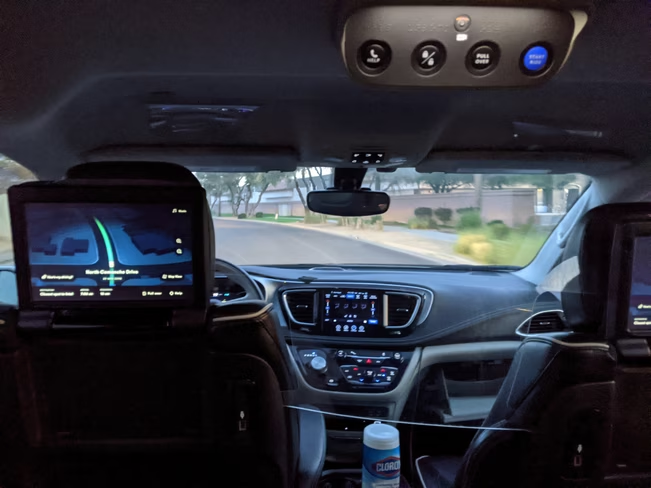
In every Waymo, there is a screen for the passengers which demonstrates how the car “sees” the world. It shows where the car is heading, and aims to give passengers peace of mind.

This week, two of the world’s biggest car regulators looked at the same question and reached opposite answers. The question is simple. What should sit between a human and a moving vehicle?
In the United States, the top auto-safety official floated pulling the steering wheel out altogether. In Europe, new rules took effect that point a camera at the driver’s face and watch it for the whole journey.
One regulator wants to remove the human. The other wants to keep a closer eye on them.
America wants to lose the wheel
Jonathan Morrison runs the National Highway Traffic Safety Administration, the US road-safety regulator. On Thursday, in a CNBC interview, he questioned whether driverless cars should still need manual controls at all.
“If you’re developing a vehicle that is designed never to be driven by a human operator, does it make any sense to require manual control for the vehicle?” he said, as reported by CNET. “I think the answer is pretty clear there.”
The comment lands squarely in Tesla’s favour. Tesla builds its Cybercab with no wheel and no pedals, and robotaxi models from Uber and Lucid are heading the same way. Carmakers have pushed for this since 2019. NHTSA loosened some design rules in 2022, and has recently moved to drop the brake-pedal requirement too.
Morrison framed it as clearing a path, not waving cars through. “The promise that these technologies offer, it’s really undeniable,” he said. “We want to see it succeed. That said, it needs to be done right.”
Europe wants to watch the driver
Brussels spent the same week moving in the opposite direction. New safety rules now require every new car sold in the EU to carry a driver-monitoring system, part of a wider expansion of its General Safety Regulation.
The kit is a small camera, usually set behind the wheel or above the dashboard. It tracks your eyes and face throughout the drive, and sounds an alert if you look away from the road for too long.
We covered the mandate when it landed. The rules also add emergency braking that spots pedestrians and cyclists.
The EU says the data stays inside the car. The camera is meant to run as a closed loop, processing everything locally and never uploading to a server. Critics are not soothed. Some have branded it surveillance dressed up as safety, and note that little detail exists yet on who controls the data.
Two ideas of what safety means
Strip away the detail and the split is philosophical. America is betting that the safest car is one with no human in the loop at all. Take out the wheel, and you take out human error.
Europe is betting the opposite. It assumes a human is still driving, and that the fix is to police their attention. One approach trusts the machine. The other distrusts the person. Both call it safety.
The catch on each side
Neither path is clean. Remove the wheel and pedals, and no one can grab control when a driverless car freezes or a crash looms. That is not hypothetical. Morrison’s own agency has told AV firms to fix cars that block emergency responders. He also flagged unease about the Chinese lidar that most robotaxis rely on.
Europe’s bet carries a privacy bill. A camera trained on your face for every trip is a rich data source. Even if it stays local now, the worry is where it leads, whether to insurers, to courts, or to the same data trade that has made modern cars a surveillance concern already.
Why it matters
The US has no single federal rulebook for driverless cars, so states are writing their own, and the wheel may vanish market by market. Europe is doing the reverse, standardising one rule across the bloc. If you drive, or ride, on either side of the Atlantic, carmakers and regulators are deciding the inside of your next car right now.
On one side it loses a wheel. On the other it gains an eye.
Get the TNW newsletter
Get the most important tech news in your inbox each week.


