TL;DR
Slate Auto priced its EV pickup at $24,950, opened preorders Wednesday, and says every truck will be profitable from day one.
The two-seat electric truck is the cheapest new pickup in America, with crank windows, no connectivity, and a CEO who says every vehicle will be gross margin positive from day one
EV
 Credit: SLATE AUTO
Slate Auto priced its EV pickup at $24,950, opened preorders Wednesday, and says every truck will be profitable from day one.
Slate Auto revealed Wednesday that its electric pickup truck will start at $24,950, making it the cheapest new truck available in the United States. The Bezos-backed startup simultaneously opened preorders, converting more than 180,000 existing reservations into $300 nonrefundable deposits. Deliveries are expected to begin in the fourth quarter of this year.
The price is higher than the “under $20,000” figure the company promoted when it emerged from stealth in April 2025. That original number included the $7,500 federal EV tax credit, which has since been eliminated along with more than a dozen EV models pulled from the US market. Without the credit, Slate raised the sticker price but kept the truck below the threshold where most buyers make purchase decisions.
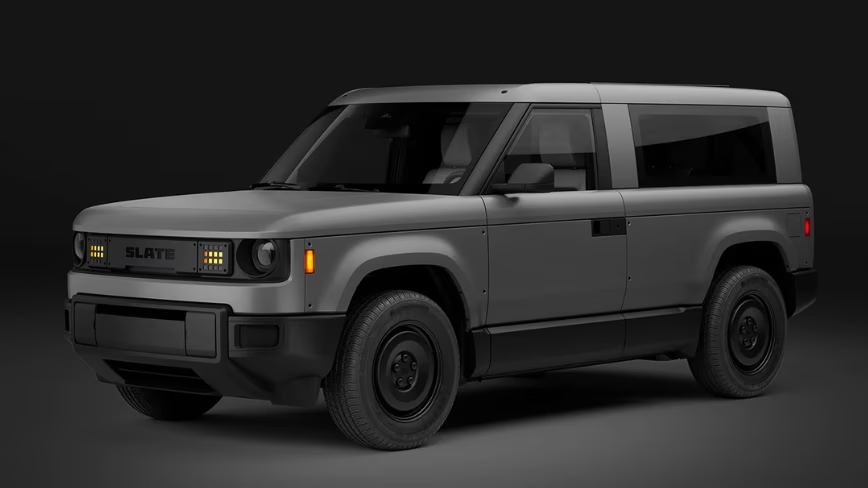
The vehicle itself is deliberately stripped down. It comes with crank windows, no built-in connectivity or modem, and speakers are optional. The two-seat pickup uses injection-molded composite body panels wrapped in vinyl instead of paint, with more than 100 standard wrap colours available for under $500 each.
Buyers can convert the two-seat pickup into a five-passenger SUV for an additional $5,000, bringing the SUV configuration to $29,950. Slate expects the SUV version to account for roughly 60 percent of sales. The company offers more than 175 accessories, with over 80 percent priced below $500.
Under the hood, the truck delivers 181 horsepower and 195 pound-feet of torque through an exclusively rear-wheel-drive powertrain. Range is rated at 205 miles, with a towing capacity of 2,000 pounds and 1,550 pounds of payload. Both figures are modest but adequate for the light-duty work the truck is designed to handle.
CEO Peter Faricy, a former Amazon Marketplace vice president who took over from founding CEO Christine Barman in March, told CNBC that every vehicle will be gross margin positive from day one. He also projected positive free cash flow and EBITDA by 2027, with break-even at roughly 80,000 vehicles per year. Those are ambitious claims for a company that has not yet delivered a single vehicle to a paying customer.
Slate is currently building about three trucks per day by hand at its Warsaw, Indiana factory, a former printing plant that represents a roughly $400 million investment. The company says it will shift to normal production processes by August and is targeting capacity of 150,000 vehicles per year at the facility, which is expected to create more than 2,000 jobs.
The startup has raised roughly one and a half billion dollars across three funding rounds, including a $650 million Series C in April led by TWG Global, the investment firm run by Los Angeles Dodgers owner Mark Walter and Thomas Tull. Other backers include General Catalyst, Slauson and Co, and former Amazon executive Diego Piacentini. Jeff Bezos’s family office has invested, though his board representative departed in May.
Slate still needs federal vehicle validation and certification before it can legally deliver trucks to customers, and the company has not disclosed where it stands in that process. The gap represents a meaningful risk to the Q4 delivery timeline. Faricy told CNBC an IPO is possible but acknowledged that 2027 is probably too soon.
The competitive context is harsh. Rivian laid off hundreds of workers last week after losing more than three and a half billion dollars in 2025 on just 42,247 deliveries, and Lucid has cut 18 percent of its workforce twice in four months. Profitability claims from a pre-production company will be met with earned scepticism given how many EV startups have failed after raising billions.
The two-door-only body style is another risk. When Ford offered the Bronco in both two-door and four-door configurations, just 10 percent of buyers chose two doors. Slate is betting that the low price and SUV conversion option will overcome the format limitation, but the conversion requires buyer effort that a factory-built four-door would not.
Slate’s model is the anti-thesis of every EV startup that failed by building expensive vehicles for a premium market that did not materialise. The truck is cheap, simple, domestic, and sold direct to consumers with no dealership network. Whether the economics actually work, at a price point where margins are thin and certification delays could burn through cash, is the question that 180,000 deposit holders are now paying $300 each to find out.
Get the most important tech news in your inbox each week.


