TL;DR
Rivian cut hundreds of service and customer staff, less than 2% of its workforce, a week after R2 deliveries began. It has never turned a profit.
The cuts affect service and customer teams and represent less than 2% of Rivian's 15,232-person workforce, as the EV maker that lost $3.6 billion last year tries to reach profitability with its new $45,000 SUV
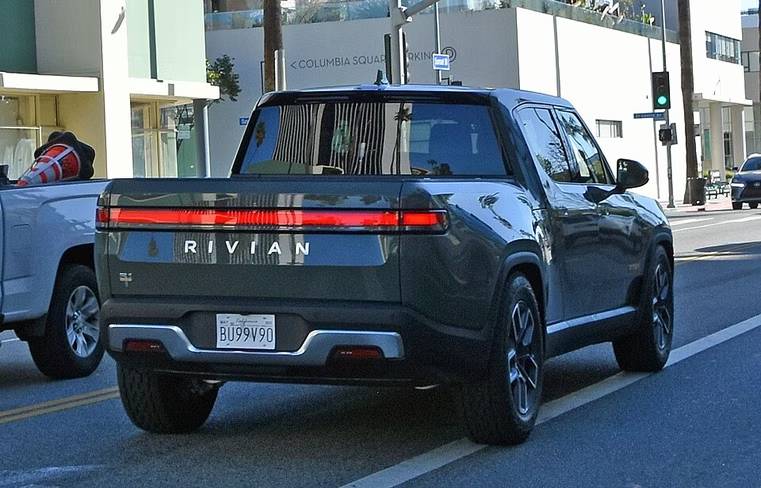
Rivian R1T on Sunset Blvd, rear view
 Credit: Chris Yarzab
Rivian cut hundreds of service and customer staff, less than 2% of its workforce, a week after R2 deliveries began. It has never turned a profit.
Rivian said Tuesday it laid off hundreds of workers, less than 2% of its workforce, as the electric vehicle maker continues trying to narrow losses that have defined its existence as a public company. The cuts affect teams in the service and customer segments, according to a company spokesperson. Rivian had 15,232 employees across North America and Europe at the end of 2025.
“We recently restructured a handful of teams within Rivian as we work to profitably scale our business,” the company said in a statement. The language is familiar. Rivian used nearly identical framing when it cut more than 600 workers in October, roughly 4.5% of its workforce at the time, in a restructuring that hit marketing, vehicle operations, and sales teams.
The timing is notable. Rivian officially launched R2 deliveries on 9 June, one week before announcing the layoffs. The R2, which starts at $45,000 for the base variant arriving in late 2027 and $57,990 for the Performance Launch edition available now, is the vehicle Rivian has said will transform it from a niche luxury EV maker into a mainstream competitor to Tesla. The company is targeting 20,000 to 25,000 R2 deliveries this year within a total delivery target of 62,000 to 67,000 vehicles.
Rivian has never turned an annual profit. The company lost $3.63 billion in 2025 while delivering just 42,247 vehicles, an 18% decline from the prior year driven partly by the elimination of the $7,500 federal EV tax credit after September. Its automotive segment lost approximately $6,000 per vehicle delivered during the first quarter of 2026, when automotive gross profit swung to a $62 million loss from a $92 million profit a year earlier as regulatory credit sales dropped by $100 million.
The broader EV market has not made Rivian’s path easier. The Trump administration’s elimination of federal purchase incentives, combined with 25% import tariffs on vehicles, has compressed demand across the industry. Rivian builds its vehicles domestically in Normal, Illinois, so the tariffs do not directly affect its manufacturing costs. But the removal of the tax credit raises the effective price of every EV for consumers, including Rivian’s.
Despite the layoffs, Rivian has been hiring aggressively in other areas. The company added roughly 1,800 employees in the first five months of 2026, largely to staff R2 production ramp-up and its growing autonomy programme. The net effect of the June cuts is a modest headcount reduction against a much larger expansion earlier in the year.
That autonomy programme is central to Rivian’s long-term financial case. CEO RJ Scaringe said last week that supervised point-to-point self-driving would roll out to all second-generation vehicles and the R2 later this year, with unsupervised driving planned for 2027. A $1.25 billion deal with Uber signed in March commits to 10,000 fully autonomous R2 robotaxis, with commercial deployment in San Francisco and Miami targeted for 2028.
The question is whether Rivian can cut costs fast enough to survive the gap between the R2’s launch and the point at which it generates positive margins at scale. The company achieved its first full-year positive gross profit in 2025 at $144 million, a milestone that disappeared in Q1 2026 when regulatory credit revenue fell. Selling more R2s at lower margins while simultaneously investing in autonomy hardware and software is the kind of financial tightrope that has broken other EV startups. Rivian’s advantage is that it has a vehicle people want to buy, a production line that works, and a partner in Uber willing to bet over a billion dollars that the autonomy roadmap is real.
Get the most important tech news in your inbox each week.


