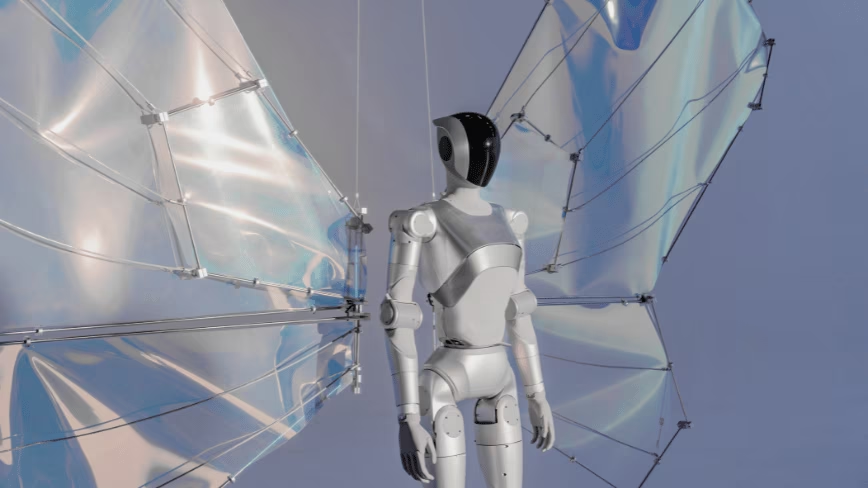
 Credit: LimX Dynamics
China’s humanoid gold rush just minted another contender. LimX Dynamics has raised $200m at a $2.21bn valuation. And its founder says the race to list has become do-or-die.
A Shenzhen humanoid startup has become the latest name in China’s robot boom to command a giant valuation. On Tuesday, LimX Dynamics said it had closed a pre-IPO round at 15 billion yuan, or about $2.21bn, The Information reported. The round raised $200m.
Its backers are unusually global. IDG Capital, the Apple-device supplier Lens Technology and Abu Dhabi’s Stone Venture led the deal. Italy’s GGG and Germany’s Redstone VC also took part, alongside Nio Capital and WestSummit Capital.
‘Listing is a must’
The money comes with urgency. LimX is already preparing an IPO, likely in Hong Kong, and is in a confidential review phase. Founder Will Zhang did not hedge about why.
“Listing is a must”, he told reporters, as CNBC reported. He compared the moment to China’s EV startups Nio, Xpeng and Li Auto. All three listed in the US between 2018 and 2020. Once the technology matures, he argued, a company that fails to list risks vanishing, like the collapsed EV maker WM Motor.
Zhang founded LimX in 2022, during the pandemic, after a spell as a tenured professor at Ohio State University. The company now makes full-size humanoids and multi-form robots. It says it has crossed the “0 to 1” stage of invention. The hard part now, Zhang said, is a product people actually want.
A stampede to the exits
LimX is not racing alone. China now has well over 100 humanoid companies, all riding a national push for “embodied AI”. Investment in the sector hit 47 billion yuan ($6.95bn) in the second quarter. That is more than double the first quarter, and roughly six times a year earlier, per data provider Xiniu.
The result is a scramble to go public. Unitree has been fast-tracked for a Shanghai listing, EngineAI has filed in Hong Kong, and rivals DeepRobot and Leju are lining up too. Morgan Stanley expects China to ship 50,000 humanoids this year.
The orders are coming from abroad
What sets LimX apart is where its demand sits. More than half of its thousands of orders come from overseas, The Information reported. It plans a multi-year push to ship thousands of humanoids to the Middle East. It is already delivering its entertainment robot, Luna, to customers in South Korea.
Europe is well funded too. NEURA Robotics raised up to $1.4bn, and Western firms like 1X are cracking the hardest parts, such as hands. But China’s density of makers, capital and orders is hard to match.
There is a catch to the export success. Washington keeps adding Chinese robotics names to its military-companies list. A firm shipping thousands of humanoids into allied markets is the kind of story that draws scrutiny. For now, though, LimX has the money and the order book.
The open question is the one Zhang named: can the robots do work people will pay for?
Get the TNW newsletter
Get the most important tech news in your inbox each week.


