TL;DR
The Pentagon added Alibaba, Baidu, BYD, and Unitree to its 1260H list, bringing the total to 188 Chinese companies it says aid the military.
The updated 1260H list names 188 entities the Pentagon says support China's military-civil fusion strategy, with DoD contracting bans on direct deals taking effect this month
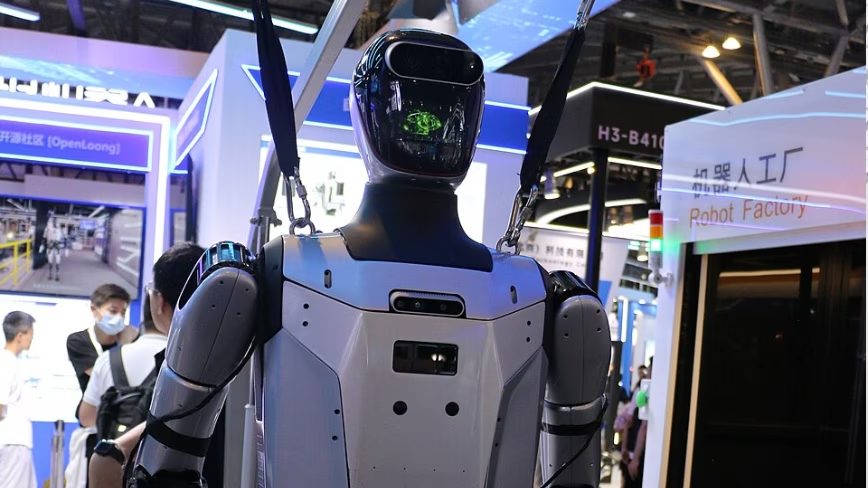
Robot
 Credit: Xuthoria
The Pentagon added Alibaba, Baidu, BYD, and Unitree to its 1260H list, bringing the total to 188 Chinese companies it says aid the military.
The Pentagon has added Alibaba, Baidu, BYD, and robotics company Unitree to a list of entities it says support the Chinese military, the Department of Defense announced on Monday. The updated 1260H list now names 188 companies that the Pentagon identifies as operating in the United States and contributing to China’s military-civil fusion strategy. The designation increases the likelihood that the DoD will restrict US companies from doing business with the listed entities.
The list takes its name from Section 1260H of the 2021 National Defense Authorization Act, which requires the Pentagon to identify Chinese companies with direct or indirect ties to the People’s Liberation Army. While the designation does not impose immediate sanctions, it carries practical consequences. The FY 2024 NDAA prohibits the DoD from entering into or renewing contracts directly with listed entities starting 30 June 2026, with indirect contracting bans following a year later.
This particular update was briefly published in the Federal Register in February before being pulled without explanation, as Bloomberg reported at the time. The South China Morning Post and Kharon confirmed that the February filing included many of the same names. The version released on Monday appears to be the finalised form of that withdrawn document, now expanded to include additional entities.
Most of China’s major artificial intelligence companies are now on the list. Tencent was added in January 2025 alongside battery maker CATL, chipmaker CXMT, and drone manufacturer Autel Robotics. The latest update adds Baidu, one of China’s leading AI and autonomous vehicle companies, and Alibaba, whose cloud computing division powers a significant portion of China’s AI infrastructure. Alibaba and Tencent are both investors in Unitree, the Hangzhou-based robotics company that shipped more humanoid robots than Tesla in 2025 and is filing for a $7 billion IPO on the Shanghai Stock Exchange.
The automotive sector features prominently in the update. BYD, which overtook Tesla as the world’s largest EV seller in 2025, was added alongside Nio, CALB Group, and EVE Energy, a battery manufacturer. Robosense, one of China’s leading lidar sensor makers, joins its rival Hesai, which was already on the list.
BYD faces 100 per cent tariffs on its vehicles in the United States, and its American units filed a legal challenge in the US Court of International Trade in January arguing those duties are invalid. The 1260H designation adds a separate layer of scrutiny to any US entity considering a commercial relationship with the company, even as American consumer interest in Chinese EVs continues to grow through social media despite the trade barriers.
The semiconductor industry is also well represented. CXMT, China’s largest memory chipmaker, was added in the January 2025 round and remains on the list alongside YMTC, the country’s leading NAND flash manufacturer. Both companies are in the middle of what the industry has described as an aggressive capacity expansion, roughly doubling their wafer output. WuXi AppTec, the biotech contract research organisation, was also added in the latest update.
The timing is notable. The list’s publication coincides with President Trump weighing whether the United States should take equity stakes in its top domestic AI companies, a proposal TechCrunch reported on Friday. It also arrives during a period of selective engagement between Washington and Beijing, with the two governments maintaining a fragile trade truce following a May summit while continuing to escalate technology restrictions in parallel. The 1260H list is one of several overlapping mechanisms the US uses to pressure Chinese tech, alongside export controls on semiconductor equipment, tariffs, and the Entity List maintained by the Commerce Department’s Bureau of Industry and Security.
The listed companies have consistently disputed their designations. Tencent called its inclusion “a mistake” when it was added last year, and CATL denied any military involvement. Neither Alibaba, Baidu, BYD, nor Unitree had issued public responses to Monday’s publication at the time of writing.
The designation does not require the Pentagon to present public evidence. The criteria for inclusion, which centre on the concept of military-civil fusion, are broad enough to encompass companies whose primary business is consumer technology.
The practical effect of the 1260H list depends on how aggressively the government enforces the contracting restrictions and whether Congress or the executive branch uses the designations as a basis for further action. For companies like Alibaba and Baidu, whose US operations span cloud services, advertising, and research partnerships, the designation creates compliance risk for every American counterpart that does business with them. For BYD and Unitree, whose products are physical and whose supply chains touch US components and customers, the consequences could be more immediate.
The list does not ban trade. What it does is make every transaction with a listed company a decision that American firms must now evaluate against the risk of doing business with an entity the Pentagon has formally identified as supporting the Chinese military.
Get the most important tech news in your inbox each week.


