TL;DR
NEURA Robotics raised up to $1.4B at a ~$7B valuation. Backed by Nvidia, Amazon, Tether, Bosch, and Qualcomm. Plans millions of robots by 2030.
The German company plans to mass-produce millions of cognitive robots by 2030 and build real-world AI training gyms worldwide
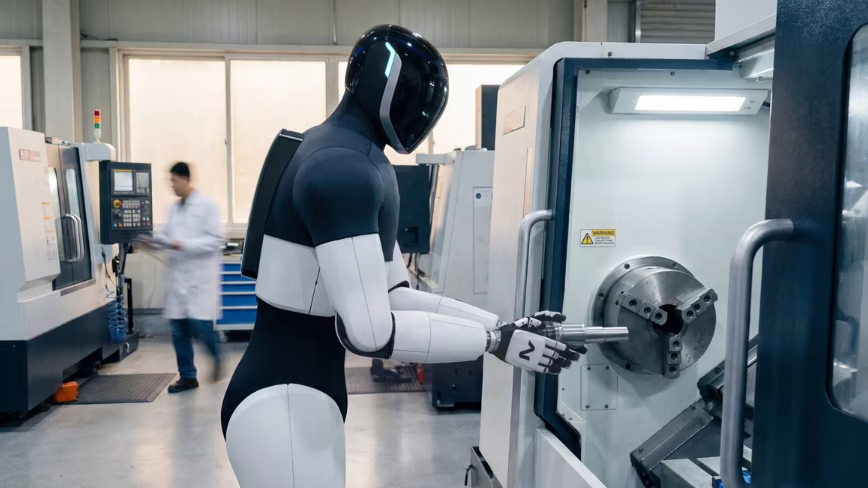
Robot
 Credit: NEURA Robotics
NEURA Robotics raised up to $1.4B at a ~$7B valuation. Backed by Nvidia, Amazon, Tether, Bosch, and Qualcomm. Plans millions of robots by 2030.
German robotics company NEURA Robotics has announced up to $1.4 billion in Series C funding to scale its cognitive robotics platform. The round values the company at approximately $7 billion, according to Bloomberg. NEURA says it is the largest funding round ever raised by a full-stack robotics company.
The investor list spans crypto, chips, cloud, and industrial manufacturing. Tether led the round, with participation from Qualcomm Technologies, Amazon, Nvidia, Bosch, Schaeffler, the European Investment Bank, imec.xpand, Lingotto Horizon, and InterAlpen Partners. That breadth signals how many different sectors see cognitive robotics as a near-term commercial opportunity.
NEURA plans to use the capital to ramp mass production to millions of robots by 2030. It will also accelerate the global rollout of NEURA Gyms, which the company describes as the world’s first real-world training environments for cognitive robots and physical AI. The order backlog and strategic deployment pipeline already exceed $1 billion.
The company’s pitch is that it has built a full-stack platform, called Neuraverse, that combines robotics, AI, sensors, edge computing, and large-scale learning infrastructure into a unified architecture. Unlike traditional industrial automation, which relies on isolated machines programmed for single tasks, NEURA’s robots are designed to learn, collaborate, and operate across environments on a shared intelligent platform.
“The future of AI won’t simply take place on screens,” said David Reger, founder and CEO. “It will move, interact, learn, and work alongside us in the real world.” He called physical AI and cognitive robotics “one of the biggest technological leaps of the coming decades.”
The round comes as Europe positions itself as a serious contender in the humanoid robotics race. Siemens and Nvidia have deployed humanoid robots in German factories. BMW has brought humanoid robots into its manufacturing lines. And startups like Encord are building the data infrastructure layer for physical AI.
NEURA’s strategic partners, including Bosch, Schaeffler, Kawasaki, Qualcomm, Amazon, and Nvidia, position it at the intersection of industrial automation and AI. The Bosch and Schaeffler involvement is particularly notable. Both are tier-one automotive and industrial suppliers, suggesting that NEURA’s robots are being evaluated for deployment in existing manufacturing ecosystems rather than experimental labs.
The Tether investment adds an unusual dimension. The stablecoin issuer has been diversifying aggressively into AI and infrastructure. NEURA mentioned advancing “decentralised AI architectures” and “machine-native economic systems” among its goals, hinting at a future where robots transact autonomously. Whether that materialises or stays marketing language, the $1.4 billion is real, and so is the race to build the platform that physical AI runs on.
Get the most important tech news in your inbox each week.


