 Credit: Canva
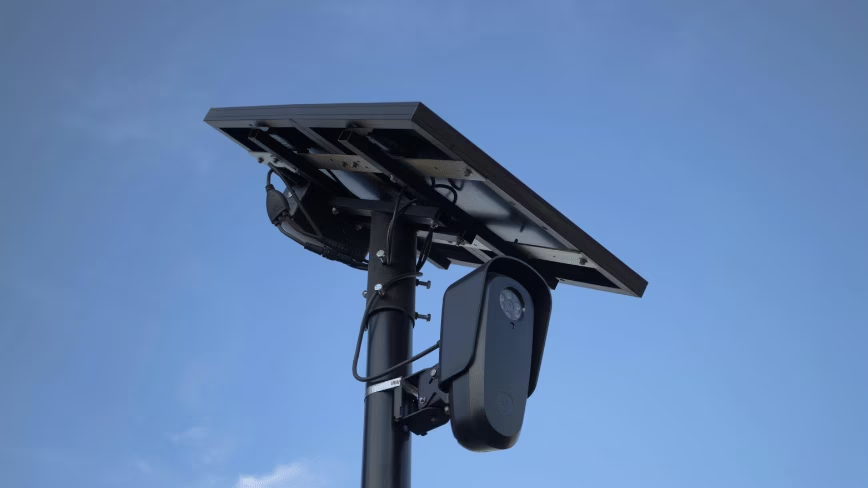
Most people call them automated licence plate readers, or ALPRs. They sit beside roads and log every car that passes. Flock Safety dominates the market. Engadget reports that Flock makes the vast majority of the 100,000-plus readers now blanketing the US.
Calling them licence plate readers undersells them. Reading plates is the main job, but the system can hunt for almost anything.
More than licence plate readers
Each Flock camera is a small computer running a modified version of Android. It streams footage to a database, where AI tags everything for natural-language search. An officer can type “green sedan with an American flag bumper sticker” and pull up matches in seconds.
Flock also sells AI cameras that track people, mobile camera trailers and quadcopter drones. Many police forces join a national network, so a department in Texas can search footage gathered in Massachusetts. Immigration and Customs Enforcement often gains access through data-sharing deals with local police. In Denver, the ACLU found local officers had run more than 1,400 searches on ICE’s behalf. The model echoes other private camera networks that feed police, such as Amazon’s Ring.
A string of security holes
Flock insists its cameras are secure. The record says otherwise. Benn Jordan, a musician and YouTuber with no formal security training, found many of the worst flaws.
In December 2025, Jordan found at least 70 Flock cameras exposed to the open internet. Anyone could watch live feeds of children in parks and people in private moments, no password required. With physical access, he and a fellow researcher pressed a button, connected over Wi-Fi, gained root access and even installed malware. Rather than thank him, Flock smeared such researchers as activists who want to “defund the police”.
Cops have abused it
The bigger risk may be the people with legitimate access. As 404 Media reported, officers have used Flock dozens of times to track ex-partners and other private individuals. Victims often found out only after searching their own plate in a tool called HaveIBeenFlocked.
Flock said just “15 incidents of abuse” had surfaced, crediting its own accountability features. The known cases cover only the officers who got caught. In one report, Flock staff watched children at a Jewish community centre pool and used the feed in a sales demo.
Innocent people caught out
Even without abuse, the cameras misfire. In Denver, which installed dozens of readers, police served financial adviser Chrisanna Elser a summons for stealing a package. She cleared her name only because her Rivian truck had filmed her driving straight through the area.
Police pulled others over as suspects when a reader misread a zero as the letter O. One driver said police could not remove him from their alert list, so a camera pings officers every time it spots his car. “You can’t get a breath of fresh air in or out of that place without us knowing,” one officer said.
Now the poles arrive unannounced
The reach keeps growing, sometimes literally overnight. Kat Vaughn of Roanoke, Virginia, came home to find a Flock audio-detection pole planted in the strip in front of her house. WSLS 10 reported that she got no letter and no email.
The device turned out to be a Flock Raven, the firm’s answer to ShotSpotter gunshot sensors. As Futurism noted, even the responding officer was unsure what it was. The city had approved 75 such sensors, but her spot was not on the list, and the units were not due to go live until July. The police department’s reply was simply: “we are working on this.”
Hard to switch off
Removing the cameras is its own battle. When Dayton, Ohio, and Evanston, Illinois, wanted out, they were unsure whether taking the cameras down would breach their contracts. Both ended up covering them with bin bags instead.
Denver eventually cancelled its deal after a packed town hall, then handed the contract to Axon, the body-camera firm. There is little hard evidence that the cameras cut crime, yet they keep spreading. A constant sense of being watched is becoming the default in American towns, and residents rarely get a vote. For now, the clearest way to find a reader near you is a campaigner-built map called DeFlock.
Get the TNW newsletter
Get the most important tech news in your inbox each week.


