TL;DR
Boston Dynamics is testing Spot with a conveyor belt payload to deliver packages from vans to doorsteps, targeting the last 50 feet of delivery.
The robot dog rides in delivery trucks and hops out to carry packages the last 50 feet, which the company calls the "porch gap" in logistics automation
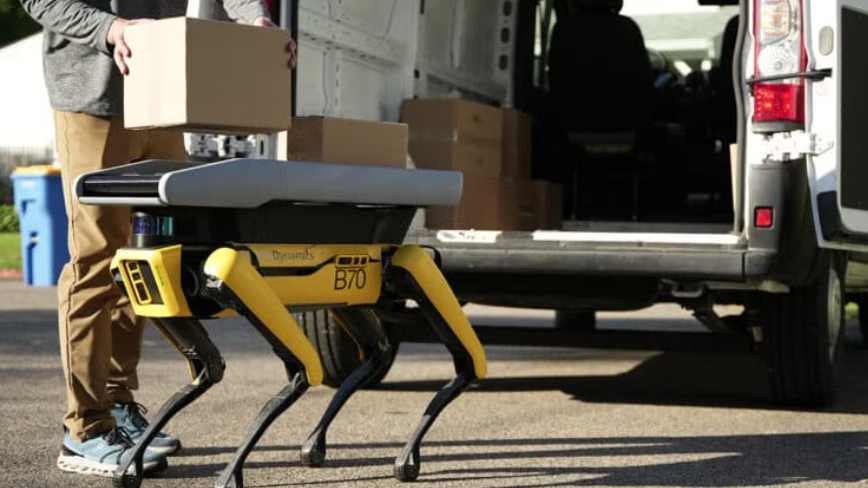
Robot-dog
 Credit: Boston Dynamics
Boston Dynamics is testing Spot with a conveyor belt payload to deliver packages from vans to doorsteps, targeting the last 50 feet of delivery.
Boston Dynamics is testing Spot, its four-legged robot, as a delivery worker that rides along in trucks and hops out to carry packages to customers’ doorsteps. The company posted a video on Tuesday showing a human driver loading packages onto a conveyor belt mounted on Spot’s back, followed by the robot walking up to houses and rotating the belt to set them down. It is the latest attempt to automate what Boston Dynamics calls the “porch gap,” the last 50 feet between a delivery van and a front door.
“So much of logistics is already automated, but we believe that the final frontier of logistics automation is that last 50 feet,” Marco da Silva, vice president and general manager for Spot at Boston Dynamics, said in a statement. The company said it is already in talks with major logistics companies to test Spot for last-mile deliveries. Spot has previously been used for security patrols at the World Cup, site inspections, and hazardous material surveys.
Spot’s advantage over wheeled delivery robots and drones is its legs, which let it handle curbs, stairs, gravel, snow, and ice. The conveyor payload includes stop sensors that allow the robot to split a single load into multiple doorstep deliveries, plus a small tray that slows drop speed to set packages down gently. Boston Dynamics says Spot can carry two parcels at a time and estimates that should cover at least 60 percent of the packages in an average delivery van.
The company’s target is a full pilot in which Spot works alongside a driver to deliver 200 packages a day, five days a week. Routes would initially be driven manually, then saved so Spot can repeat them autonomously at known addresses. For every three packages Spot delivers, Boston Dynamics estimates the driver can fit an additional package in the van, increasing throughput without adding headcount.
The porch gap is a problem others are trying to solve. DoorDash has been using Dot, its autonomous delivery robot, for some deliveries in Arizona since late 2025, though the stroller-sized wheeled robot is small enough to fit through doorframes but lacks the ability to climb stairs. DoorDash CEO Tony Xu said last year that loading deliveries into autonomous vehicles and getting them from curbs to doorsteps remain the hardest parts of automating the delivery chain.
Spot costs roughly $75,000, which means the economics of using it for package delivery will depend on how many routes it can handle per day and whether logistics companies are willing to pay a premium to reduce driver fatigue and increase delivery speed. Boston Dynamics, now wholly owned by Hyundai, has been expanding Spot’s commercial applications steadily, but delivery would represent its most consumer-facing role to date.
Get the most important tech news in your inbox each week.


