TL;DR
Security guard turnover hit 89 percent in 2024, and companies are deploying robot dogs and drones to cover posts humans keep leaving
A UC Berkeley study found that turnover in the security industry reached 89 percent in 2024, driven by low pay and dangerous conditions, and companies are deploying autonomous drones and robot dogs to cover the posts that humans keep leaving
Robot-dog
 Credit: Timothy Sandland
Security guard turnover hit 89 percent in 2024, and companies are deploying robot dogs and drones to cover posts humans keep leaving
Annual turnover in the US security guard industry reached 89 percent in 2024, compared with 66 percent across the broader private sector, according to a report from the UC Berkeley Labor Center. The industry employs more than a million people, but the Bureau of Labor Statistics projects employment will remain roughly flat through 2034, with more than 162,000 openings each year almost entirely to replace departing workers. That churn is creating an opening for companies building autonomous security robots.
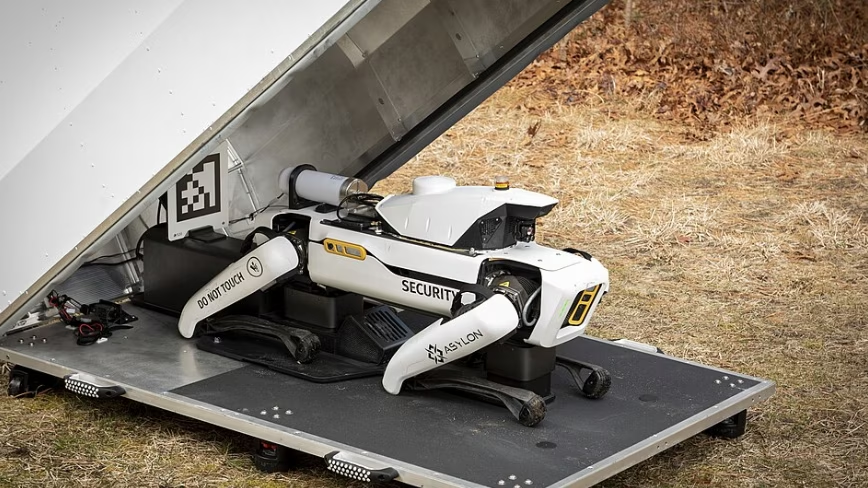
Asylon Robotics, which deploys autonomous drones and robot dogs built on Boston Dynamics hardware, charges between $120,000 and $170,000 a year for what CEO Damon Henry calls a “white glove security service” that includes the robots, maintenance, software, and remote operators. A fully loaded 24/7 human guard shift costs about a quarter of a million dollars at the national average, Henry told Business Insider.
The company has roughly 25 customers with about 50 robot deployments across the country. Some clients have used the robots to leave otherwise vacant guard posts unfilled. The machines make scheduled rounds, stream video to a remote operations centre, and flag unusual activity for a human operator to review before notifying on-site staff.
“I think it’s a retention crisis,” said Enrique Lopezlira, director of the UC Berkeley Labor Center’s Low-Wage Work program and coauthor of the report. Turnover peaked near 99 percent in 2022. The problem is not a shortage of people who could become guards, Lopezlira said, but an inability to retain workers in a job that pays a median of under $19 an hour, where nearly 43 percent lack employer-sponsored health coverage.
The danger compounds the pay problem. Security guards die on the job at more than twice the rate of workers overall, according to the Berkeley report. Nearly two thirds of fatal injuries result from assaults and other violent acts.
Autonomous patrol robots can shift that risk by removing a person from an isolated overnight route.
At Mercedes-Benz Stadium in Atlanta, an Asylon robot dog nicknamed Benzie patrols the exterior of the two million-square-foot venue. Henry said guards previously walked the streets of downtown Atlanta on the third shift. With Benzie handling exterior patrols, guards can remain indoors until a physical response is needed.
Theft and vandalism at the site dropped to zero within the first couple of months and have stayed there since, Henry said.
The robots handle the repetitive work: circling a perimeter, maintaining a visible security presence, and deciding whether an alarm warrants a human response. One Asylon employee at a remote operations centre supervises six to eight robots across multiple sites.
But the technology is not yet a full replacement. Henry estimated that Asylon’s robots can autonomously navigate about 90 percent of a typical patrol, with human operators stepping in at crosswalks, doorways, and other complex spots. Every threat is still verified by a person.
Not every security robot deployment has gone smoothly. San Antonio International Airport experimented with a 420-pound Knightscope K5 robot in 2024, designed to respond to door alarms and inspect workers’ badges.
Airport staff found the robot struggled to navigate crowds, focus its camera on badges, and provide reliable feeds, the San Antonio Express-News reported. The airport ended the trial in about a month.
Even the most reliable robot can only automate part of a guard’s work. Human guards de-escalate conflicts, respond to people in mental health crises, and make the situational judgments that no current autonomous system can replicate. Lopezlira argued that automating the repetitive tasks actually makes the case for better training and working conditions, since the remaining human role will consist entirely of the hardest, highest-stakes parts of the job.
“The realistic near-term effect is not that guards are replaced,” Lopezlira said. “The human role is going to be pushed toward those hardest, higher-stakes parts of the work.“
Get the most important tech news in your inbox each week.


