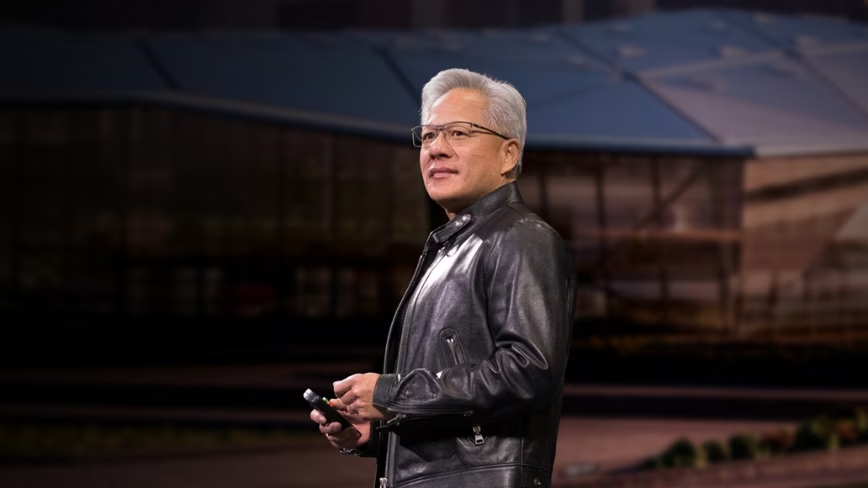
Jensen Huang’s comments at Computex defend the Samsung bonus structure that delivers $400,000 to chip engineers, but land alongside an $80bn Nvidia buyback announced two weeks ago.
Jensen Huang, the Nvidia chief executive, told reporters on the sidelines of Computex in Taipei on Tuesday that workers should be paid “as much as possible,” framing the principle as the response to a question about Samsung Electronics’ new bonus structure that delivers as much as $400,000 to memory chip engineers.
“I pay my employees as much as I can,” Jensen Huang said, before adding, “but it doesn’t make this right,” in an unusual public hedging from a CEO who almost never qualifies his own positions in real time.
The Samsung context is the trigger for the question. The Korean memory firm’s union and management reached a deal earlier this month, after a near-strike that survived an injunction filing from a smaller non-chip union, that allocates 10.5% of semiconductor operating profit to chip-division bonuses, with payouts of up to 600 million won (about $400,000) per memory-division worker contingent on sustained profit targets through 2035.
The arrangement was described in Reuters analysis as the largest single profit-share commitment in major Korean corporate history. Samsung supplies HBM4 to Nvidia for the Vera Rubin platform, which made the question to Huang structurally relevant rather than merely topical.
The harder context is the cash-return commitment Nvidia announced two weeks before Huang’s remarks. The company’s Q1 fiscal 2027 results, released on 18 May, included an $80bn share repurchase authorisation, a quarterly cash-dividend increase from $0.01 to $0.25 per share (a 2,400% lift), and a stated commitment to return at least 50% of free cash flow to shareholders through 2026 and beyond. The company returned a record $20bn to shareholders in the quarter alone.
Nvidia’s $81.6bn quarterly revenue and 85% year-on-year growth comfortably support the return profile, but the arithmetic relationship matters: the buyback alone is larger than Nvidia’s total annual payroll many times over.
The two positions Huang is now publicly holding, that workers should be paid as much as possible and that Nvidia should return half its free cash flow to shareholders, are not strictly in tension. Both can be true; the company has the cash to do both.
But the public framing matters at a moment when corporate AI productivity gains are increasingly accumulating to shareholders rather than to workforces, and when Morgan Stanley’s European-banking forecast last week doubled the projected AI-driven job-loss figure to 20%.
Huang’s instinctive defence of high worker pay, even with the “it doesn’t make this right” hedge, is the closest a major AI-infrastructure CEO has come to publicly acknowledging the labour-and-capital tension the AI build-out is producing.
The other Huang comment from this week’s Computex appearances is worth noting alongside. Huang told a separate audience that Nvidia engineers should be using AI tokens worth roughly half their annual salary every year to remain productive, framing non-use of AI tools as analogous to designing chips with pencil and paper.
That position is, on its own terms, a defence of generous worker compensation in token-purchasing rather than salary terms: if engineers are issued $100,000-$150,000 in annual token budget on top of base pay, the realised compensation package is materially larger than the published salary figure suggests.
It is also a framing that depends entirely on AI-token costs remaining at current pricing rather than continuing to rise on the trajectory Commonwealth Bank’s Matt Comyn flagged this week.
Nvidia employs roughly 36,000 people globally. Average compensation per employee, on the company’s most recent disclosures, runs to several hundred thousand dollars including stock-based compensation. The AI boom has driven Nvidia’s share price up roughly 1,170% over the past five years, which has made meaningful numbers of Nvidia employees who hold restricted-stock units into multi-millionaires through normal vesting cycles.
His remark therefore lands inside an Nvidia compensation reality that has, by the standards of large public technology companies, already been unusually worker-favourable.
Huang is travelling to Seoul this week to meet Samsung Electronics chairman Lee Jae-yong and other Korean industrial leaders. The bonus-structure question will likely come up again. The public position Huang has now taken is harder to walk back than the standard executive non-answer.
Get the TNW newsletter
Get the most important tech news in your inbox each week.


