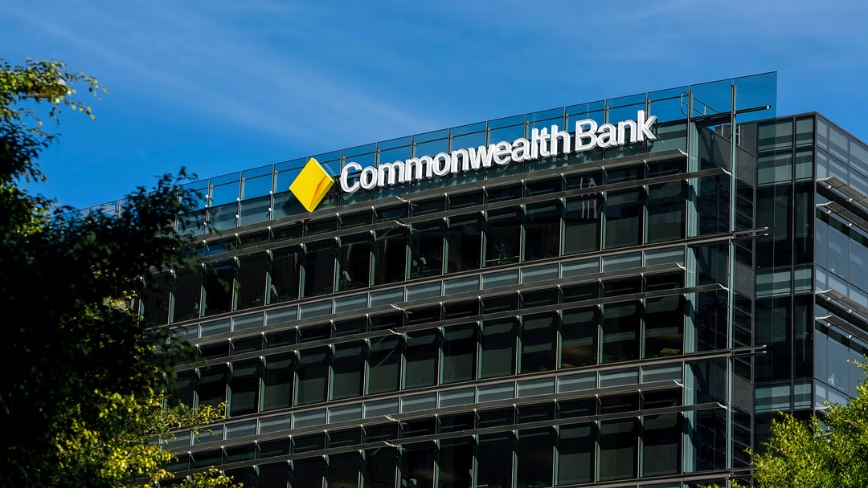

CBA chief executive Matt Comyn used the phrase ‘work slop’ to describe the low-quality AI output now flowing through corporate workflows, as token-billed AI costs scale with task complexity.
Matt Comyn, chief executive of the Commonwealth Bank of Australia, used a speech on Monday to flag two AI-adoption problems large corporate buyers have been working through quietly for several months.
The first is that the cost of running generative AI inside corporate workflows is rising substantially faster than most companies budgeted for as task complexity scales.
The second is what Comyn called “work slop”, the low-quality AI-generated text, code and analysis that flows through internal company systems when employees use AI without sufficient quality control.
The cost framing is the part that will resonate with the corporate-IT-buyer audience. Token-based pricing, the per-character billing model the foundation-model labs use to charge enterprise customers, has scaled in the past 18 months from a modest line item into a meaningful operating-expense category.
Comyn’s point is that the cost compounds faster than expected because token consumption per task rises non-linearly with task complexity: a simple summarisation task might consume 1,000 tokens, but a multi-step reasoning task with tool use can consume 100,000-plus tokens for the same output value. Companies that priced their AI rollouts on the simple-task baseline are now seeing bills that scale on the complex-task curve.
This problem is not specific to CBA. Morgan Stanley doubled its European-banking-AI-job-loss forecast last week partly on evidence that AI cost-benefit ratios are tightening at exactly the moment large institutions had hoped they would loosen. The token-cost-scaling problem Comyn described is the underlying mechanic: the same AI deployment that worked at pilot-stage volumes can produce 10-100x the costs at production-stage complexity.
The result is the corporate-AI procurement squeeze that Comyn predicted will tighten through 2026: businesses tightening scrutiny of AI-related spending as pressure mounts to demonstrate returns on investment.
The “work slop” framing is the more colourful but equally substantive half of the speech. The category Comyn was naming, low-quality AI-generated output that nominally completes a task but actually degrades downstream workflow, is the corporate-knowledge-work analogue of the social-media “AI slop” problem that emerged in 2024 with image-generation tools.
The bank version looks like this: an employee uses ChatGPT to draft a customer email, the email is technically grammatical but factually imprecise, the recipient takes the imprecision as a commitment, and the bank deals with the resulting complaint three weeks later at a substantially higher cost than the original work would have generated unaided.
The CBA-specific context is significant. The bank announced 90 job cuts earlier this year and a further 120 cuts in May explicitly attributed to AI-driven productivity gains, alongside a A$90m AI-workforce reskilling commitment.
Comyn’s remarks therefore land inside a CBA strategy that has visibly committed to AI substitution at scale: the “work slop” framing is not a defensive critique of AI from a bank that has rejected the technology but a sharper inside-baseball read on AI deployment from one of Australia’s largest current adopters.
The wider Australian-bank context is also worth noting. Sam Altman has been arguing over the past month that an AI jobs apocalypse is unlikely at the macro level, and the labour data through March 2026 has so far supported the conservative read.
Comyn’s remarks complicate that picture: the macro labour data does not yet show large-scale displacement, but the operating-margin data inside large corporates is starting to show the AI-cost-and-quality tradeoffs CBA is now naming explicitly.
The substantive implication is that the 2024-2025 AI cost narrative, that token prices were falling so quickly that the deployment-economics question would solve itself, has structurally inverted.
Falling per-token prices have been overwhelmed by rising per-task token consumption as enterprises move from pilot deployments to production use cases. The procurement-discipline phase Comyn is forecasting through 2026 is, on this evidence, the predictable consequence.
Get the TNW newsletter
Get the most important tech news in your inbox each week.


