Samsung strike union

Samsung’s 10.5%-of-profit bonus formula is only the second written profit-share agreement at a major Korean firm. Kakao’s union is already asking for more.
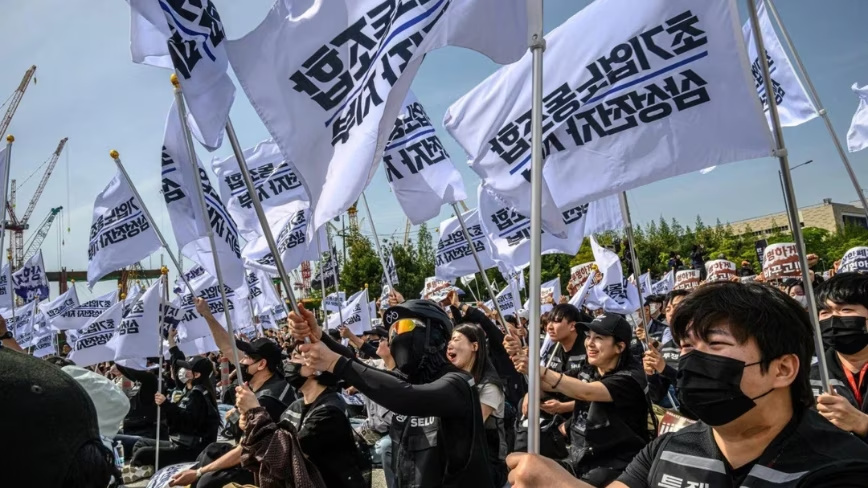
Samsung Electronics’ unionised workforce voted in favour of the government-mediated pay agreement on Wednesday, formally closing the deal that narrowly survived an injunction filing from a smaller non-chip union on Tuesday. The vote settles, in the immediate term, the largest labour dispute in the global semiconductor industry.
The wider effect is more durable: the agreement marks the first major win for a Samsung union in the company’s 56-year history, and it is being read across Korean industry as a structural shift in how labour bargaining works.
The substance of the deal is what makes it unusual. Samsung has agreed in writing to allocate 10.5% of its semiconductor operating profit to special bonuses for chip workers. It is, on Reuters’ count, only the second time a major South Korean company has put a fixed-percentage profit-share commitment into a binding labour agreement.
Some memory-division employees will receive total bonus packages worth around $416,000 over the agreement period. The non-chip Donghaeng union, which had filed the injunction at Suwon District Court, has signalled it intends to keep pressing for a revised allocation regardless of the vote.
The wider Korean labour picture has moved with it. Workers at Kakao and four of its affiliates have threatened to strike if their demands, including a 13–15% profit-share allocation, are not met. Other major Korean employers are reportedly fielding similar requests from their own unions.
The Samsung settlement has, in effect, created a precedent the rest of the chaebol system will now be benchmarked against.
Two structural conditions made the deal possible. The first is the AI-driven memory supercycle. Samsung’s memory division has been generating profits on a scale the company has rarely seen, and the gap between what the division produces and what its workers had been paid was visible to everyone involved.
The second is the loss of workforce to SK Hynix, where the AI-memory boom has been concentrated and where bonuses have been larger for years. According to the Samsung union, chip workers had begun leaving for SK Hynix in numbers that made the bonus gap commercially unsustainable.
The Korean chaebol bargaining model has historically been resistant to fixed-percentage profit-sharing on the grounds that it imports the cyclicality of the underlying business into the labour cost line. The Samsung deal accepts that trade-off: the bonus pool falls automatically when memory profits fall.
Workers, in turn, have agreed to the contingent floor on their payouts (memory must generate at least 200 trillion won between 2026 and 2028 and 100 trillion won between 2029 and 2035 for the full payout). It is a recognisably modern profit-share structure, of the kind Western technology firms have used for years, transplanted onto a chaebol balance sheet for the first time.
The political question is whether this is the start of a structural shift or a memory-cycle-specific anomaly. Korean economists have argued for years that the chaebol system’s relatively weak wage-growth performance during good years was a function of the labour-bargaining frame rather than of profitability.
The Samsung deal tests that argument empirically. If memory profits hold, the formula delivers genuinely large worker payouts and the new pattern spreads. If memory profits revert, the union side’s structural complaint, that a one-off cycle-linked bonus is not a sustainable wage policy, returns with it.
Samsung shares closed up modestly on Wednesday. The Korean labour ministry, which brokered the original agreement, said it expects similar mediated settlements at other major firms within months.
Get the TNW newsletter
Get the most important tech news in your inbox each week.
Also tagged with


