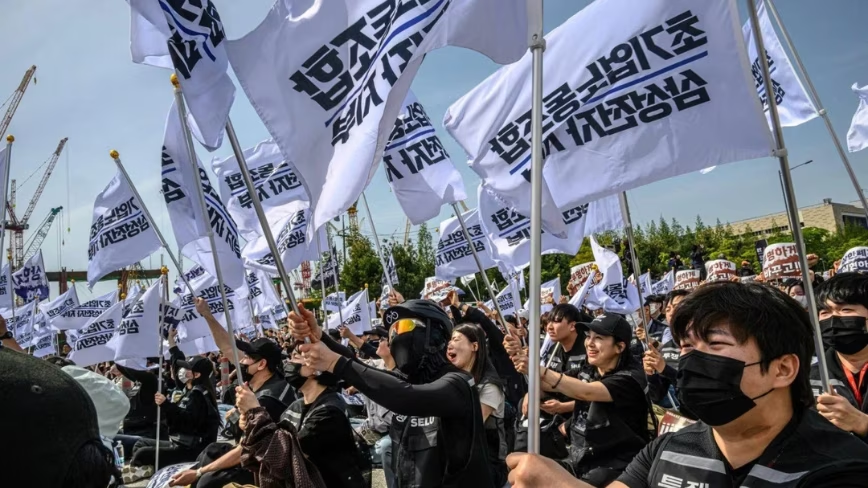
Samsung strike union

A smaller Samsung Electronics union representing roughly 13,000 workers in the company’s smartphones, televisions and home appliances divisions has filed an injunction at South Korea’s Suwon District Court to halt an ongoing companywide vote on a bonus deal that would deliver a windfall to memory chip workers and almost nothing to everyone else.
The injunction was filed on Tuesday by the Donghaeng union, the third-largest union inside Samsung and the one whose members sit furthest from the AI memory boom.
Around 57,000 Samsung workers began voting on Friday on a tentative pay agreement that would, if approved, confirm an average bonus of about 600 million won per person for the memory chip division, while staff in the Device Experience (DX) division, which makes the phones and TVs, receive company shares worth about 6 million won. The disparity is roughly 100 to one.
The Donghaeng union’s objection is procedural as much as financial. According to the Seoul Economic Daily, the union argues it was excluded from the ballot by the larger Cho-Kiup union, which represents the memory workers, because the majority union feared a DX bloc vote would sink the deal.
The non-chip union said it filed the court action only after being told it had no standing to participate.
The pay package itself is the product of a fortnight of brinkmanship. Earlier in May, the 48,000-strong National Samsung Electronics Union signalled an 18-day walkout, which would have been the largest stoppage in the chip industry’s history, before South Korea’s labour ministry brokered a tentative settlement that abolished a long-standing cap on performance bonuses and ringfenced 10.5% of annual operating profit for staff.
Forty per cent of that pool is reserved for the memory division. The remaining 60% is split across every other business unit at Samsung, including the foundry, the smartphone group, and the home appliances arm.
Reuters first reported the injunction filing, citing Korean media, on Tuesday morning. The vote is scheduled to close on 27 May. A ruling from Suwon District Court before then would force Samsung to halt or annul the ballot. A ruling after, or no ruling at all, would let the result stand.
The bonus pool itself is contingent on the memory division’s sustained profitability through the back half of the decade.
The tentative deal ties payouts to memory generating at least 200 trillion won (roughly $133bn) in profit between 2026 and 2028, and another 100 trillion won between 2029 and 2035.
Memory workers, in other words, stand to receive enormous bonuses only so long as the high-bandwidth memory cycle continues to fund them.
The structural complaint from the DX side is that the cycle that funds the bonuses is one their work does not generate.
Samsung’s consumer business has been a drag on group margins for several quarters, while the memory division has captured almost all of the upside from the AI hardware boom.
Whether that upside should be ringfenced for the workers closest to it, or pooled across the company, is the question the Donghaeng filing is asking the court to weigh in on.
A Samsung spokesperson did not immediately respond to a request for comment. The Donghaeng union said in a statement that it would press for revisions to the bonus formula regardless of how the court rules. Voting closes on Wednesday evening.
Get the TNW newsletter
Get the most important tech news in your inbox each week.
Also tagged with


