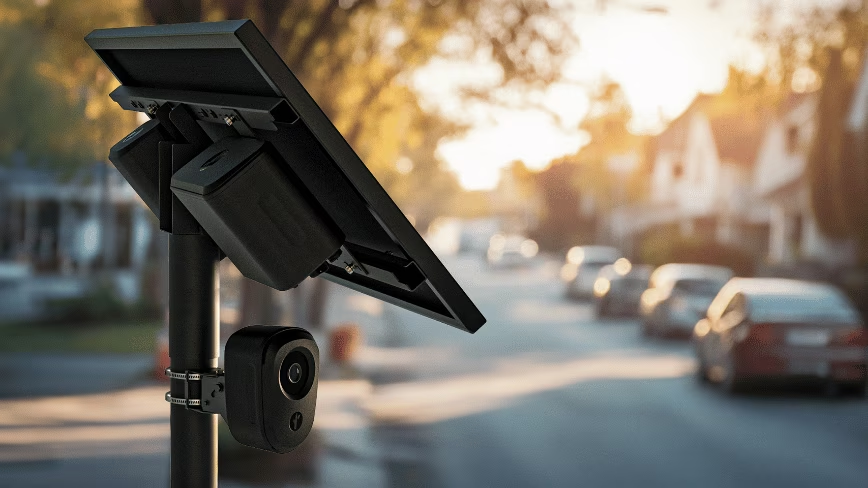

Florida has ordered every automated licence plate reader off its state highways. Agencies have 30 days to take them down. Texas froze state funding for the same cameras four days earlier. Two states run by Republican governors moved against Flock Safety in the space of a week.
Zack Whittaker reported both decisions for TechCrunch on Tuesday. The Florida order arrived as a one-page memo. Will Watts, an assistant secretary at the state Department of Transportation, signed it on Monday.
The memo revokes every existing permit for licence plate readers in the right of way of the State Highway System. It also stops the department issuing new ones. Agencies that miss the 30-day deadline will have the cameras taken down for them.
The reasons it gives are a “recent exponential increase in deployments” alongside “concerning reports of misuse, data privacy concerns, and surveillance schemes”.
A sheriff took it further than the memo asked
Ron DeSantis had called the technology “out of control” at an event five days earlier, and said the legislature would need to act. The memo covers state highway right of way only. It says nothing about cameras owned by local police or sitting on private land.
Several Florida agencies went further anyway. T.K. Waters, the sheriff in Jacksonville, said his office would stop using the readers across Duval County.
“LPR technology has proven to be an enormously valuable investigative tool,” Waters said. “However, given the decision made at the state level and the concerns expressed by members of our community, I have determined that discontinuing the use of this technology is the appropriate course of action at this time.”
Sheriff’s offices in Franklin, Liberty and Putnam counties said the same.
Texans paid for a quarter of their own cameras
Greg Abbott froze Texas state funding on Thursday evening. The Texas Tribune published its investigation into that funding shortly afterwards.
Ayden Runnels traced the money for the Texas Tribune. In 2023 the legislature voted unanimously to add $1 to every Texan’s car insurance policy to fight catalytic converter theft. Lawmakers named the bill for a Harris County deputy shot dead after interrupting thieves in a supermarket car park.
The fee has raised about $81m. A small state agency, the Motor Vehicle Crime Prevention Authority, has put at least $30m of it into Flock cameras. The Tribune counted at least 3,200 of them. The real figure is probably higher, because 124 grants carry no clear record of what they bought.
The anti-surveillance group DeFlock has mapped roughly 13,000 Flock cameras in Texas. On that count, the insurance fee paid for one in four.
Grants ran from $7,000 for two cameras in Bellmead to about $1.7m for 201 in Dallas. The networks in Laredo and El Paso were paid for outright.
“There’s nothing that they can tell us”
Miguel Rodriguez chairs the authority and is also the police chief in Laredo. In 2023 he said he hoped the fee would let the state “cover the entire state” with cameras.
In April he discussed a $15.9m contract to put 1,183 cameras on state land. Rodriguez set out what that meant for towns that had voted the cameras down.
“I think that if for whatever reason you are within those jurisdictions that do not want Flock, let’s get together with DPS, so that, you know, we can put those in state right-of-way,” he said. “And there’s nothing that they can tell us.”
The lawmakers who passed the fee told the Tribune they had no idea. “I did not have that in mind when we passed the bill,” said Carol Alvarado, the Houston Democrat who wrote it. Brian Harrison, a Midlothian Republican who voted for it, said he could not have contemplated funding what he called warrantless surveillance.
Cancellations went parabolic in August
Secure Justice, an Oakland advocacy group, counts 214 cities and counties that have dropped Flock since 2021. Cyrus Farivar reported for Ars Technica that 93 of them left in August alone. That is roughly four times July’s figure, or about three a day.
“Looking at that image, it’s gone parabolic,” Brian Hofer, the group’s executive director, told Ars.
The politics stopped splitting along party lines some time ago. Tempe, Arizona switched its cameras off last Wednesday, and the more conservative town of Cave Creek did the same three hours later. Josh Hawley opened a Senate investigation into Flock the same day, giving the company until 8 September to hand over documents. Bernie Sanders said he would introduce legislation against AI mass surveillance.
What the officers were doing with it
Abbott’s office pointed to Lufkin, in east Texas. A grand jury there indicted an officer on 24 August on 100 felony counts of misusing official information.
Chron reviewed his search history on Have I Been Flocked, a public database built from records requests. It shows 45,318 searches over about 210 days, roughly 74 a day. One licence plate comes up 3,470 times. The reason he entered for each search was “investigation”.
A Washington Post investigation this month found more than 50 officers accused, charged or disciplined over licence plate readers, several of them for tracking former partners. TNW reported the pattern when Flock cut its data retention to seven days in response.
Flock says the business is still growing
Paris Lewbel, a Flock spokesperson, said the technology had helped find missing children and arrest a murder suspect in Florida in recent weeks.
“Rather than banning a critical public safety tool, we support thoughtful legislation and strong privacy, transparency, and accountability guardrails,” Lewbel said.
Another spokesperson told Ars that new city partnerships had outpaced non-renewals this year by about ten to one. She declined to give a number. Flock did not respond to TechCrunch or Business Insider, and has not said publicly whether it will take the Florida cameras down.
The company runs about 120,000 cameras across 49 states. TNW has covered the network as it grew: its spread across the US, the pitch to enlist Uber and Lyft drivers, the AI tool that searches by how you drive, and a California city buying drones that answer 911.
TechCrunch also asked whether Flock would reinstall the cameras. Three towns that cancelled their contracts, in Illinois, Massachusetts and Oregon, reported that it put theirs back.
Get the TNW newsletter
Get the most important tech news in your inbox each week.


