TL;DR
Stockton approved $3.15M for Flock police drones that respond to 911 calls in 30 seconds. Council voted 7-0 despite major public opposition over surveillance.
Stockton voted unanimously for Flock's drone-as-first-responder system despite an hour of public opposition over surveillance, immigration, and data sharing
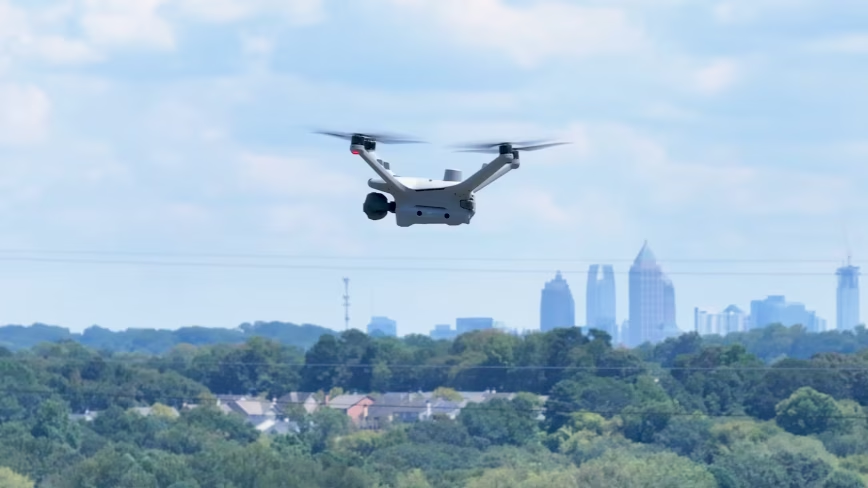
Drone
Stockton approved $3.15M for Flock police drones that respond to 911 calls in 30 seconds. Council voted 7-0 despite major public opposition over surveillance.
Stockton, California, has approved a $3.15 million investment in police drones that can respond to 911 calls in as little as 30 seconds. The city council voted 7-0 to expand its contract with Flock Safety, adding a drone-as-first-responder platform to the automatic licence plate readers the company already supplies. The total contract value now exceeds $5.4 million over five years.
The drones will be stationed across the city and can cover more than 75% of Stockton’s area. They give police eyes on a scene before officers arrive, with response times ranging from 30 seconds to four minutes. “It’ll really enhance what we already have, in that we get quick deployments, real-time updates for officers on scene,” said Police Lt David Padula.
The vote was unanimous. The public opposition was not. More than an hour of testimony focused on privacy, immigration enforcement, and mass surveillance. Residents questioned not just how the drones would be used, but how the data they collect would be stored and shared.
“It sends the wrong message,” said local activist group The Stockton Community Check-In Booth. “While our residents continue to struggle under the financial impacts of this administration and economy, Stockton continues to invest in militarisation and surveillance.”
Republican congressional candidate John McBride called the programme “a total invasion of privacy.” He pointed out that Flock’s cameras are privately owned, meaning citizens cannot use freedom of information requests to find out what data the company holds about them. Flock says local agencies remain in control of the data and that drone flights are logged on a public dashboard.
Flock’s track record has fuelled the concerns. The company was found sharing licence plate reader data with US Customs and Border Protection in Colorado and Illinois, though it says those practices have stopped. In Texas, police used a Flock camera network to track the movements of a woman who had an abortion. In Mountain View, California, a Flock camera network was scrapped over concerns about unauthorised access.
Flock says it does not work with ICE and that federal agencies are blocked from discovering or requesting data held by Stockton. Stockton police will own 100% of the data they collect. But the gap between company policy and field practice is what worries critics. More than 100,000 Flock licence plate readers are already in use across the US.
Stockton joins a growing number of US cities deploying drone-based response systems, including Chula Vista, Fremont, and Louisville. Active programmes also exist in Texas, Indiana, and Connecticut. The technology is pitched as a way to improve officer safety and reduce response times. The question cities have not answered is what happens when the data from thousands of autonomous flights over residential neighbourhoods ends up in the wrong hands, as it already has elsewhere.
Get the most important tech news in your inbox each week.


