The 10 best autonomous pentesting tools, ranked by proof of exploit (2026)
Tech Linked Design Technology
Credit: Canva
TL;DR
This ranking judges autonomous pentesting tools by proof over volume. Astra Security tops the list with dual agents that chain findings into real attack paths and a walled-off validator that re-exploits each one before triage. NodeZero and Pentera own internal-network and cloud paths. XBOW proves web exploitation at scale. Picus and Cymulate are BAS tools that validate controls, not exploit vulnerabilities. Comparison matrix, honest limitations, and buyer guidance included.
How the leading autonomous penetration testing platforms validate every exploit before it reaches your dashboard
Security teams seldom lose because a scanner missed a bug. They lose because the dashboard fills with findings nobody has proven. Astra Security has provided a comprehensive State of Pentesting 2026 report which built on 6.8 million findings across 8,000-plus engagements in 70 countries, logged a new critical vulnerability every 48 seconds through 2025, and found that 91% of critical issues have no CVE and no vendor patch, leaving teams with no remediation playbook to follow. Signature-based scanning alone can struggle to surface those contextual risks. That gap is why the best autonomous pentesting tools now get judged on proof, not alert count.
So this ranking rewards proof over volume. A genuine autonomous pentester won’t stop at spotting a weakness; it exploits the weakness and chains it into a real attack path with reproduction steps. Judged that way, Astra’s autonomous platform takes the top spot, because a validator walled off from discovery re-exploits every finding before it reaches your queue.
Below are ten platforms compared on autonomy, attack-chain depth, coverage, and how each one proves its findings, along with a capability matrix and the criteria behind the ordering. Some run true autonomous pentests. A couple validates controls instead, and the list flags the difference.
Autonomous pentesting tools compared at a glance
The matrix maps each platform against the capabilities that separate a proof-driven pentest from a scan. Yes means the capability ships today, and No means it’s out of scope; Partial marks where it’s limited or still maturing.
Tool
Autonomous exploitation
Attack chain discovery
Independent validation
Web + API business logic
Network / cloud infra
Continuous + retest
Astra Security
Yes
Yes
Yes
Yes
Yes
Yes
NodeZero
Yes
Yes
Yes
No
Yes
Yes
XBOW
Yes
Yes
Yes
Yes
No
Partial
Pentera
Partial
Yes
Yes
Partial
Yes
Yes
Aikido Security
Yes
Partial
Partial
Yes
Partial
Yes
Hadrian
Yes
Partial
Yes
No
Partial
Yes
RidgeBot
Yes
Partial
Yes
Yes
Partial
Yes
Ethiack
Yes
Yes
Yes
Yes
Partial
Yes
Picus Security
No
Partial
No
No
Partial
Yes
Cymulate
No
Partial
No
No
Partial
Yes
The 10 best autonomous pentesting platforms, ranked
Astra Security
Credit: Astra Security
Astra Security’s autonomous pentesting platform, pairs two agent modes that chain findings into real attack paths: a Structured Pentest that covers the surface method by method, like an elite human bug bounty hunter going wherever the trail leads. A separate AI Validator, walled off from discovery, then re-exploits each finding before it reaches your dashboard, which helps Astra deliver quality proof over just a list of never ending alerts, with AI auto fixes (directly into your IDE). The engine builds on 5,000+ real-world pentests and the OWASP APTS standard Astra co-authored.
Best for: teams shipping web apps and APIs that want each finding exploited and proven before triage.
Honest limitation: autonomous coverage reaches web apps and APIs today, and cloud-infrastructure testing stays on the roadmap, so network attack paths need another tool for now.
NodeZero
Credit: NodeZero
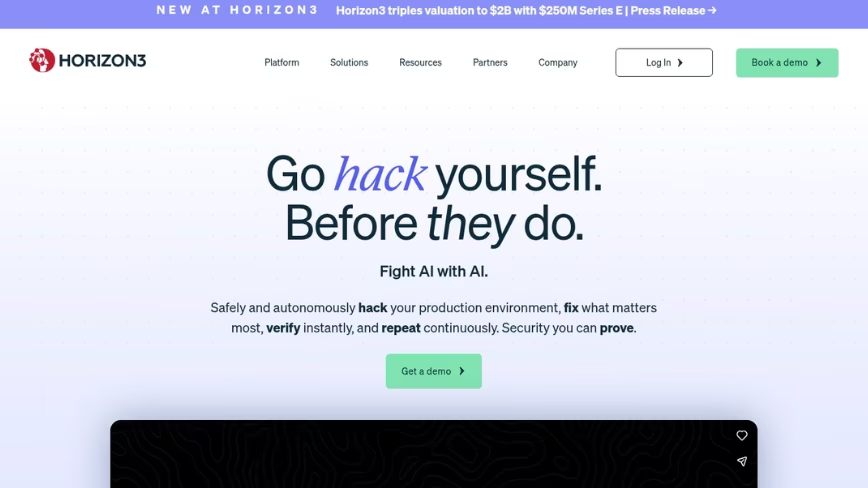
NodeZero, from Horizon3.ai, appears on every autonomous pentesting list, and for network work it earns the spot. The self-directed agent runs internal, external, cloud, and Kubernetes tests with no pre-staged credentials, harvesting credentials and chaining weaknesses across hosts into proof-of-exploit that goes well past a CVE list. It holds FedRAMP High authorization and has run hundreds of thousands of production tests, with one-click Quick Verify to recheck a fix.
Best for: security teams that need deep internal-network and cloud attack-path validation, Active Directory included.
Honest limitation: web and API testing still sits in Early Access, reviewers call the platform heavyweight for smaller teams, pricing is quote-only, and internal runs need an on-network Docker host.
XBOW
Credit: XBOW
XBOW put autonomous offensive security on the map when its system topped HackerOne’s US leaderboard above every human researcher. A coordinator spins up hundreds of short-lived agents, one per attack vector, that map the surface and chain vulnerabilities to exploit in parallel; a deterministic validator confirms each finding, so every result arrives as a full case file with a working exploit. Teams wire it into a release gate through the API.
Best for: engineering teams that want web and API exploitation proven at scale before release.
Honest limitation: coverage stops at web apps and APIs, and black-box-first runs test one credential set per pass, so cross-role IDOR and BOLA flaws can slip through, and it caps retests at one per 30-day window.
Pentera
Credit: Pentera
Pentera calls its category automated security validation rather than pentesting, and the distinction is real. The agentless engine emulates attacks across internal and external networks, plus identity and cloud, adapting payloads in real time and replaying ransomware playbooks from crews like Cl0p and LockBit. Pentera Resolve turns each validated exposure into an assigned, re-checked remediation task. It crossed $100M ARR in early 2026 and leads Frost Radar for the category.
Best for:enterprises that want repeatable, production-safe validation of internal-network and identity exposure.
Honest limitation: a deterministic core with an AI layer won’t surface novel non-playbook paths, and there’s no deep authenticated web or API business-logic testing.
Aikido Security
Credit: Aikido Security
Aikido folds AI pentesting into an all-in-one AppSec platform spanning SAST, SCA, IaC, secrets, and runtime. Its Attack module runs hundreds of autonomous agents that reason like red-teamers, and because it reads source it works white-box as well as black-box; Aikido Infinite fires a pentest on every deploy, and AutoFix opens remediation pull requests. Transparent public pricing and a strong developer experience keep it on shortlists.
Best for: developer-first teams that want pentesting to live beside the rest of their code-to-runtime security stack.
Honest limitation: the AI pentest is one module inside a broad suite rather than the headline product, and by default it stops at a confirmed finding, leaving deeper chained exploitation for a human to trigger.
Hadrian
Credit: Hadrian
Hadrian watches your external attack surface and fires tests the moment something changes: a new subdomain, a config drift, an exposed service. Its Nova add-on, launched in early 2026, deploys agents trained by security researchers that find internet-facing assets and chain vulnerabilities with proof-of-concept and reproduction steps.
Best for: teams that want perimeter exposure caught and validated as their attack surface shifts.
Honest limitation: Nova tests the external surface only, with no internal-network or deep authenticated web-app coverage, and the module is new enough to have little track record.
Ridge Security aims RidgeBot at cost-sensitive teams and service providers that still want real exploitation rather than a scan. It fires payload-based exploits on a continuous or scheduled cadence and maps results to frameworks like PCI and HIPAA. For a network-first tool it handles web-app OWASP Top 10 and business logic well, and Ridge cites an 88% score on the DEFCON 2025 Benchmark Bakeoff, a vendor-reported figure.
Best for: smaller teams and MSSPs that want scheduled, exploit-based testing at a lower price band.
Honest limitation: G2 reviewers flag documentation gaps, and Active Directory depth reaches only moderate.
Ethiack
Credit: Ethiack
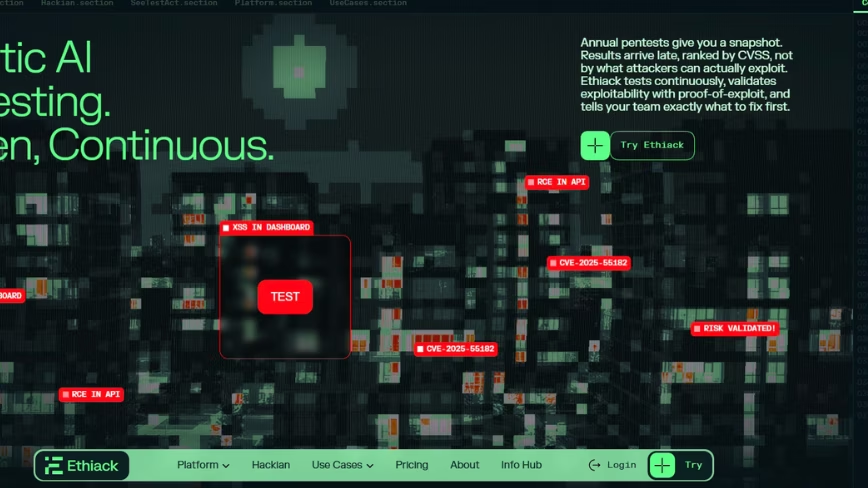
Ethiack runs autonomous pentesting through Hackian. The agent maps the attack surface and executes real exploitation routines. It can also chain weaknesses into attack paths before delivering proof-of-exploit for confirmed risks. Continuous tests can trigger after code pushes or infrastructure changes. Ethiack also supports internal network testing through its Beacon.
Hackian goes beyond common vulnerability checks when testing web applications. It can map business workflows and test with multiple user identities. This lets it probe access-control boundaries that conventional scanners can miss. Ethiack has also published research where Hackian autonomously found an account takeover path that led to remote code execution.
Best for: teams that want continuous autonomous testing with proof-of-exploit across web applications and internal assets.
Honest limitation: Ethiack has a smaller public review footprint than several established platforms in this ranking. Some performance figures are also vendor-reported. Teams should test Hackian against their own assets before treating those figures as typical results.
Picus Security
Credit: Picus Security
Picus is a breach-and-attack-simulation platform, and it answers a different question than the tools above: are my controls catching and blocking known attacker techniques? It runs MITRE ATT&CK-aligned simulations on a continuous cadence, adds attack-path mapping, and shows where detection and prevention break down. That makes it a useful complement to autonomous pentesting rather than a replacement.
Best for: SOC teams measuring whether existing controls detect and stop mapped attacker TTPs.
Honest limitation: BAS validates security controls with safe simulations, so it won’t exploit a live application or chain business-logic flaws the way an autonomous pentester does.
Cymulate
Credit: Cymulate
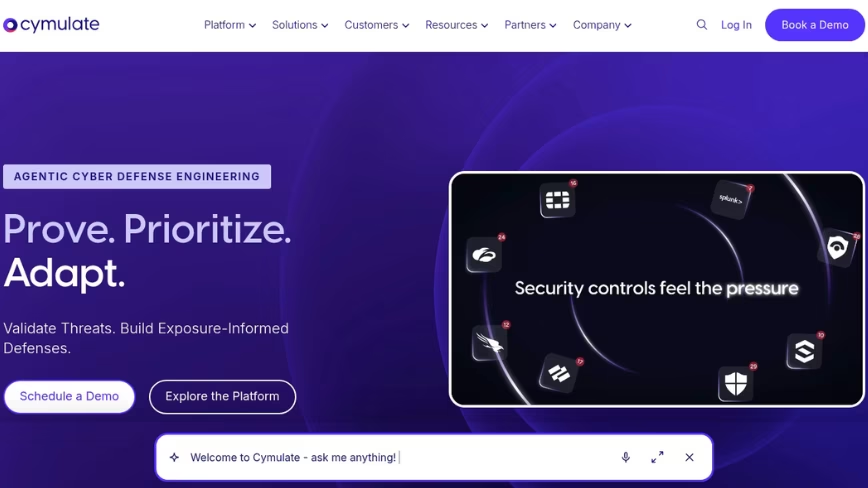
Cymulate sits in the same breach-and-attack-simulation category as Picus, with a focus on continuous adversary simulation and SOC readiness. It runs attacker scenarios against your defenses to score detection and response, and teams use it to rehearse against fresh threats. Like other BAS platforms, it measures control effectiveness rather than proving application-level exploitability.
Best for: security teams that want to rehearse detection and response against evolving attacker playbooks.
Honest limitation: it simulates TTPs to test controls rather than exploiting real vulnerabilities, so it can’t stand in for an autonomous pentest that chains and proves a working attack path.
What counts as autonomous pentesting
Autonomous penetration testing means software plans and runs an attack the way a human tester would, then proves what it finds. An agent maps the surface, decides which attacks are worth trying, exploits the ones that land, and chains them into paths that show real impact. That’s the line between a pentest and a scan: a scanner matches known signatures and reports what might be wrong, while an autonomous pentester runs the attack and shows you it worked, with the request and response that triggered it.
Two neighbors get lumped in and shouldn’t. Breach-and-attack-simulation tools like Picus and Cymulate check whether your controls detect known techniques, a useful but different question. Automated security validation, Pentera’s label, leans on a deterministic engine over open-ended reasoning. Genuine autonomy shows up most in business logic: broken access control across roles and IDOR in nested API paths a fixed checklist never reaches.
How we evaluated these tools
Six questions shaped the order. First, does the tool exploit and prove a finding, or just detect it? Proof-of-exploit with reproduction is the single dividing line, so it carried the most weight. Second, how much runs without a human driving? True autonomy beats a deterministic engine with an AI label bolted on. Third, how far does coverage reach across web apps, APIs, networks, cloud, and identity, and where does it stop? The web/API-versus-network split is real, and no tool leads everywhere.
Fourth, how deep does business-logic testing go, since broken authorization and multi-step abuse are where scanners give up. Fifth, does the platform run on a continuous cadence and retest a fix, or deliver a once-a-year snapshot. Sixth, governance: can the tool run against production without causing harm, and does the vendor engage with the OWASP Autonomous Penetration Testing Standard?
Compliance-grade reporting broke ties, and every benchmark here is the vendor’s own.
How to choose based on your team
Match the tool to the surface you’re defending and the pace you ship at. If your risk lives in web apps and APIs and you release often, prioritize a platform that exploits business-logic flaws and proves them, then retests on the next deploy. Astra and XBOW both fit that shape, with Astra adding human offensive-security depth and audit-ready reporting for teams under SOC 2 or PCI pressure.
If internal networks and cloud infrastructure are where your risk sits, NodeZero and Pentera reach Active Directory and identity paths a web-first agent won’t. Budget-conscious teams and service providers can look at RidgeBot for scheduled, exploit-based runs. Teams with a mature SOC use BAS platforms like Picus or Cymulate to confirm their controls catch what these pentesters throw. Most programs end up layering: autonomous pentesting for continuous proof, human experts for the hardest business logic.
FAQ
What is autonomous penetration testing?
Autonomous penetration testing uses AI agents to run an attack end to end. They map the target, plan which attacks to attempt, exploit the weaknesses that land, and chain them into paths that show real impact. Unlike a scan that reports possible issues, an autonomous pentest confirms exploitability and captures reproduction steps. It runs on demand or on a continuous cadence, so teams can test with every release instead of once a year.
Is pentesting being replaced by AI?
No. AI is changing how pentesting runs, not retiring the people who do it. Autonomous agents cover more surface more often and prove findings faster than a human working alone, closing the gap between annual engagements. Human testers still lead on complex business logic and the judgment calls audits expect. The pattern is augmentation: agents handle breadth and speed, experts handle depth. Most mature programs run both.
How is AI penetration testing different from vulnerability scanning?
A scanner matches traffic and code against a signature database and reports what might be vulnerable, leaving your team to triage a long list of maybes. An AI penetration test goes further: it exploits the weakness, chains it with others, and shows the working attack and how to reproduce it. The output is proof rather than a probability score. That’s why platforms like Astra route every finding through a separate validation step before it reaches a dashboard.
Can autonomous pentesting tools satisfy SOC 2 and PCI DSS audits?
Often yes, with a caveat. Many platforms produce reports mapped to SOC 2, ISO 27001, PCI DSS, and HIPAA, with the reproducible evidence auditors want. PCI DSS 4.0 still expects human-led exploitation in places, so autonomous output tends to supplement a human engagement rather than replace it for that requirement. Check that the vendor’s report format and evidence trail match your framework before you buy.
How do autonomous pentesting tools handle false positives?
The stronger platforms add a validation layer that re-exploits each finding before reporting it, so the tool proves a result before you see it. Astra, for example, runs a validator walled off from the agents that made the discovery and uses a separate validation layer to confirm findings rather than claiming a perfect record. Ask any vendor for its false-positive rate on a production-like benchmark, and to walk you through the data behind it.
How much does autonomous pentesting cost in 2026?
Pricing splits by model. App-focused platforms often publish per-test or subscription rates, around $4,000 to $8,000 per test at the entry end, while infrastructure players like NodeZero and Pentera stay quote-only and land in five or six figures a year. Astra publishes self-serve tiers and cites up to 80x faster time-to-first-finding than a two-week manual pentest, a benchmark drawn from its own engagements. Match the pricing model to how many targets you test and how often.
Final verdict on the best autonomous pentesting tools
The autonomous pentesting market splits along one line: tools that raise alerts and tools that prove them. That’s why Astra Security leads this ranking. Its dual agents chain findings the way an attacker would, and a walled-off validator exploits each one before it reaches your queue, so the output is evidence instead of a to-do list. Web apps and APIs are its home ground today, and the OWASP APTS work plus a 5,000+ pentest foundation give it a track record most 2026 entrants can’t match. NodeZero and Pentera still own internal-network and cloud attack paths, XBOW proves web exploitation at scale, and BAS tools like Picus and Cymulate keep your controls honest. Pick for the surface you’re defending and the pace you ship, and weigh proof over alert count. On that measure, Astra is the one to beat.
Get the TNW newsletter
Get the most important tech news in your inbox each week.
Sponsored content. Not produced by the TNW newsroom and does not reflect the editorial stance of TNW. This listing is not an independent editorial ranking.



 Credit: Canva