 Credit: Jakub Żerdzicki on Unsplash
Most companies hand sensitive data to dozens of outside vendors, from payroll providers to cloud hosts. When one of those vendors gets breached, the company that hired it still answers for the damage. Third party risk management software gives security and compliance teams one place to vet each vendor before signing and keep watch on it afterwards.
Regulators now check for this. Since January 2025, the EU’s DORA rules have required financial firms such as banks and insurers to keep a register of every contract they hold with a technology supplier. In the US, the banking regulators issued joint guidance in 2023 that covers vendors from selection through to exit. SOC 2 and ISO 27001 auditors ask a similar question: which vendors hold your data, and how do you know they’re safe?
A spreadsheet can track a handful of vendors. Past that, it falls behind. Newer tools use AI to read vendor security reports and flag weak questionnaire answers, while a person still makes the final call. This list ranks the 10 best third party risk management software platforms for 2026 on two things: how much of the review work the AI takes off your team, and whether the results count as evidence in the audits you already run.
Why regulators hold you responsible for your vendors
Handing work to a vendor doesn’t hand over the responsibility.
The US guidance says a bank that relies on outside firms is still on the hook for running a safe and sound business. Article 28 of DORA keeps EU financial firms responsible for anything they outsource. SOC 2 and ISO 27001 audits work the same way: if a vendor holds your customers’ data, your security controls have to cover that vendor.
That makes vendor review an ongoing job with a named owner and deadlines. It doesn’t stop once you sign the contract.
What third party risk management software does
Third party risk management software gives a risk or security team one system of record for every outside party that touches its data or systems. It holds the vendor inventory, runs due diligence, scores risk, tracks fixes and keeps the evidence trail an examiner or auditor reviews.
Capabilities worth paying for
Vendor inventory and tiering: One register of suppliers and service providers, each with an owner and a criticality tier that sets review depth. A payroll processor lands in a higher tier than a design tool.
Intake and due diligence: Onboarding that routes each new vendor to the right questionnaire and collects SOC 2 reports or ISO 27001 certificates before anyone signs off.
Document and questionnaire review: Most platforms now apply AI at this step, pulling findings from audit reports and flagging thin or contradictory answers.
Risk scoring: Inherent risk before controls and residual risk after them, recalculated as new information arrives.
Outside-in monitoring: Security ratings and breach alerts between reviews, sometimes extended to fourth parties.
Remediation tracking: Owners and due dates for each gap, with vendor follow-ups until it closes.
Contract and exit records: Security clauses, plus the steps for returning data and revoking access when a relationship ends.
Framework mapping and reporting: Links between vendor findings and SOC 2 or ISO 27001 controls, with reports a board or auditor can follow.
The five stages of a TPRM program
A third-party risk management program is the policy and routine wrapped around those tools. The US Interagency Guidance frames it as a life cycle with five stages: planning, due diligence and third-party selection, contract negotiation, ongoing monitoring, and termination, with board oversight and documentation running alongside.
The program is risk-based: relationships that support critical activities warrant more planning and deeper monitoring, and reassessment frequency follows the same rule. NYDFS Part 500 ties periodic assessment to each provider’s risk.
The CPA firm Linford & Company recommends that SOC 2 clients assess vendors at least once a year.
Third-party risk management vs vendor risk management
Vendor risk management covers the suppliers a company pays and leans toward delivery and cost. Third-party risk management is the wider discipline: every outside party with access to systems or data, paid or not, assessed for security, privacy, compliance and reputational risk across the whole relationship.
A data-sharing partner never sends an invoice and still counts. Most vendor risk management software now markets itself as TPRM, so the ranking below treats the two as one buying decision with the broader scope.
AI third party risk management: what the software automates
AI now does much of the legwork in a vendor review. Here’s what that looks like, starting with the platform at the top of this list.
Inside Scytale’s AI GRC platform, AI GRC agents run the vendor program in the background. They pick up new vendors as they appear in your single sign-on and connected tools, collect each vendor’s security documents, such as SOC 2 reports and data processing agreements, and turn what they find into a risk score. That score changes when new information arrives.
When a vendor sends back a questionnaire, the AI points out answers that are vague or raise a concern. Dedicated GRC experts then review the AI’s work. The finished review becomes evidence for your SOC 2 or ISO 27001 controls, so the vendor program and the audit share the same records.
Other platforms on this list automate parts of the same job. Vanta finds vendors through procurement tools and pulls documents from their trust centers, while Drata fills in vendor profiles with company and risk data.
Bitsight and ProcessUnity use AI to pull the key findings out of vendors’ SOC 2 reports. SecurityScorecard compares questionnaire answers with what it can see of a vendor’s systems from the outside, then drafts a fix-it plan for the vendor.
Every platform that documents these features keeps a person on the final call. Treat the AI’s output as a first draft, and plan for someone to review it, whether that’s your own team or, with Scytale, a GRC expert.
How this ranking was built
Seven criteria set the order, and the first two carry the most weight:
- AI review depth: the due diligence tasks each vendor documents its AI performing, and whether a person signs off.
- Tie to the compliance program: whether vendor findings map to controls such as SOC 2 CC9.2 and ISO 27001 Annex A, so one review doubles as audit evidence.
- Lifecycle coverage: support for all five Interagency Guidance stages, exit included.
- Outside-in monitoring: security ratings and incident alerts between formal reviews.
- Regulatory fit: documented support for DORA, NIS2 and US banking expectations.
- User sentiment: G2 ratings and recurring review themes, with thin samples flagged.
- Market presence: how often the vendor appears in 20 published ranking articles for this search term.
The assessment draws on vendor documentation, G2 review themes and those 20 ranking articles, all checked in September 2026, and not on hands-on testing. Treat each pros and cons list as a starting point to confirm in a demo. List prices played no part in the order.
The best third party risk management software, ranked
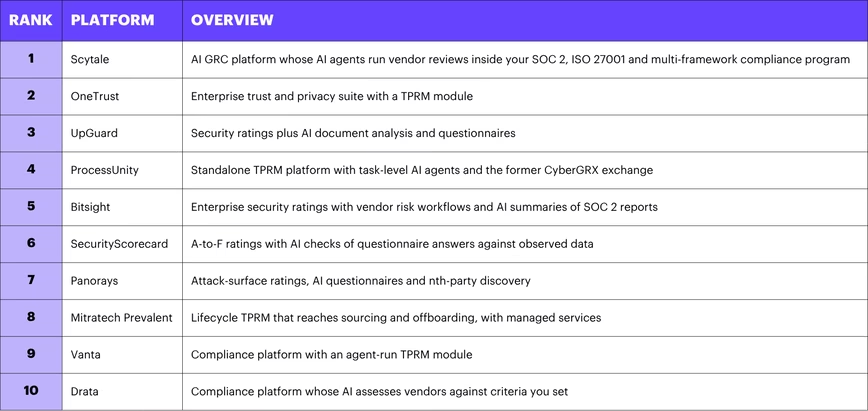
1. Scytale: vendor reviews inside the compliance program
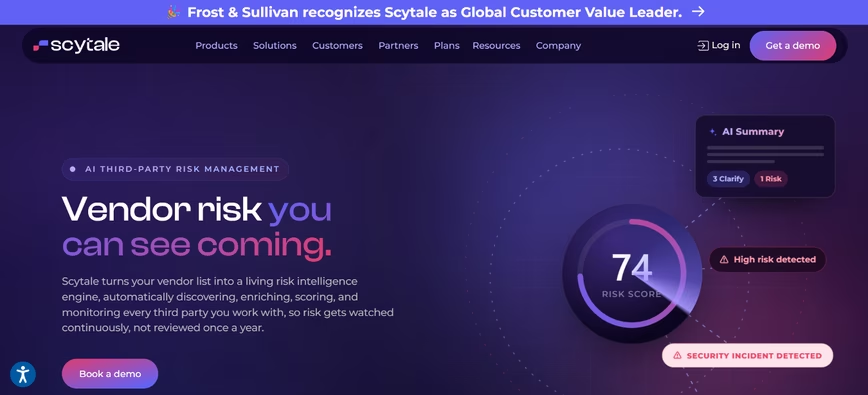
Scytale is an AI GRC platform that runs third-party risk management inside the same program as your controls and evidence, so every vendor review also supports your audits. AI GRC agents handle vendor onboarding, risk assessments and mitigation tracking, while vendors answer questionnaires through a branded portal.
The agents build and score each vendor profile, and the results feed the risk register and the compliance status Scytale tracks across SOC 2, ISO 27001 and 80+ other frameworks through cross-framework mapping. Dedicated GRC experts review the AI’s output before it becomes compliance evidence. Pricing is tiered by plan and available through a custom quote.
Key capabilities
- Uses AI agents to find vendors across connected systems, assign security reviews, and set risk tiers automatically
- Builds vendor profiles from Trust Centers, SOC 2 reports, ISO registries, DPAs, and public disclosures
- Reviews questionnaire responses and flags vague, incomplete, or risky answers
- Continuously monitors vendor risk, logs security incidents, and prompts reassessment as risk scores change
- Tracks mitigation to closure and creates evidence-backed vendor reports, while a customizable Trust Center shows customers how you manage third-party risk
- Connects with 150+ integrations, plus custom options, to pull vendor data and monitor controls in real time
Pros
- Cross-mapping lets one vendor review support SOC 2, ISO 27001, GDPR, and HIPAA controls, reducing duplicate work
- Dedicated GRC experts review AI output and guide your team from vendor onboarding through audit
- Rated 4.8/5 on G2 across 700+ reviews, with users highlighting helpfulness and ease of use
Cons
- No public price list, so costs come out of a sales conversation
- Some features need a higher-tier plan
2. OneTrust: TPRM within a privacy and trust suite
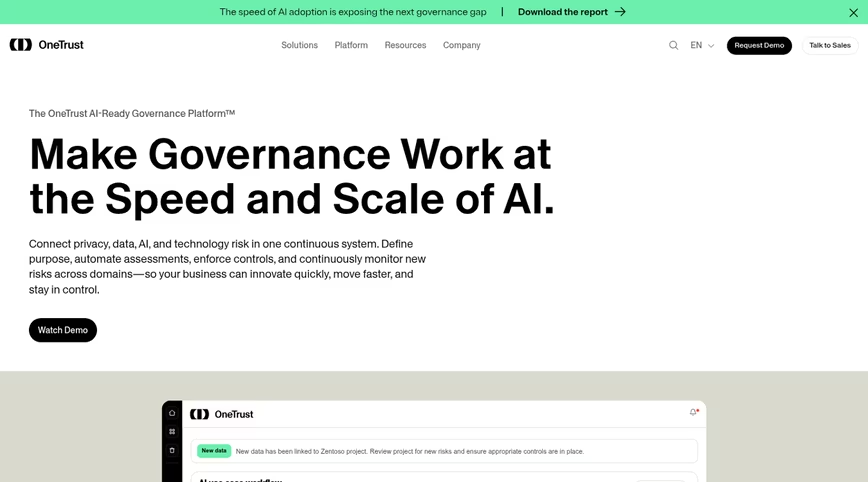
OneTrust runs third-party risk as one module in a broad trust suite that also covers privacy, consent and AI governance. Its TPRM product keeps a configurable inventory with one editable profile per third party and sends assessments that adapt to earlier answers, drawing on 50+ built-in control frameworks.
Rules-based triggers launch workflows and assign risks, and monitoring rules prompt reassessment when something changes. OneTrust sells through quotes, and its third-party management listing on G2 holds just six reviews (4.3 out of 5).
Pros
- Vendor records share a platform with privacy and data governance programs
- Adaptive assessments draw on 50+ built-in control frameworks
- Rules-based triggers automate risk assignment and reassessment
Cons
- A small number of G2 reviewers call the interface complex and report building hard work
- Reviewers mention awkward navigation and limited role-based access
3. UpGuard: ratings with AI document analysis
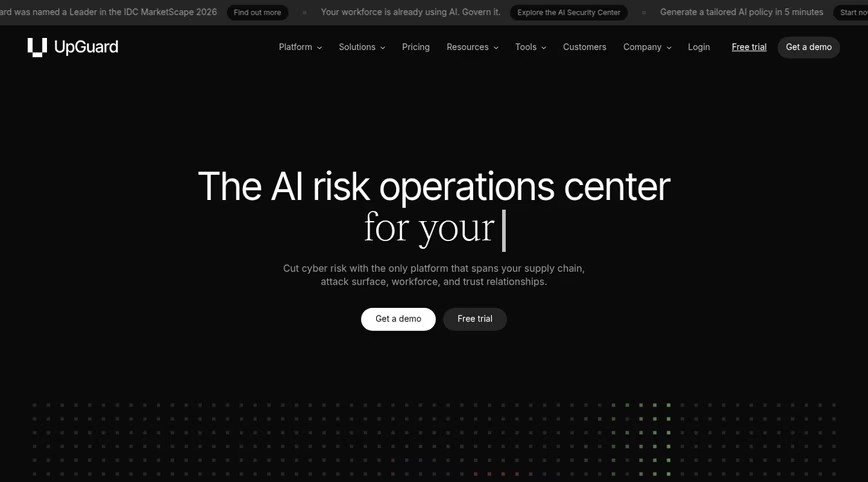
UpGuard pairs outside-in security ratings with reviews of each vendor’s own documents. Ratings refresh several times a day. Its AI-powered Security Profile combines scan results with AI parsing of vendor documents to show which controls pass or fail against frameworks such as ISO 27001 and NIST CSF.
A questionnaire library spans NIST, ISO and SIG, and AI drafts point-in-time risk assessment reports. UpGuard publishes its entry pricing, and its Vendor Risk product holds 4.5 out of 5 on G2 from 746 reviews.
Pros
- Ease of use leads the G2 praise, with 252 mentions
- Dynamic scoring helps teams decide which vendors to chase first
- Ratings and questionnaires live in one workflow
Cons
- Remediation recommendations lack clarity for some reviewers (52 mentions)
- Smaller organizations find it expensive (38 mentions)
- False positives need manual cleanup (26 mentions)
4. ProcessUnity: standalone TPRM with the CyberGRX exchange
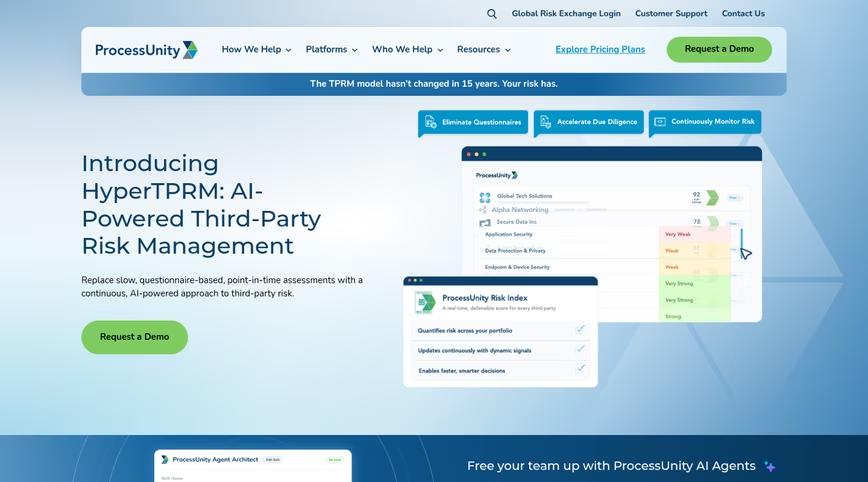
ProcessUnity is a standalone TPRM platform for programs that run vendor risk as their own function. Each of its AI agents handles a single task. Intake agents pre-screen vendors and catch duplicates, while due diligence agents analyze SOC 2 reports; others draft remediation messages. Every run logs its sources and a confidence score, and the team confirms each judgment call.
ProcessUnity acquired CyberGRX in July 2023, and its Global Risk Exchange supplies shared vendor profiles, 370,000+ by the company’s own count. Pricing comes through a demo, and G2 shows 4.5 out of 5 across 54 reviews.
Pros
- Every AI run leaves a sourced log a reviewer can check
- Configurable assessments and risk models suit mature programs
- Exchange data gives assessments of common vendors a head start
Cons
- G2 reviewers report slow loading and weak performance
- Contract-management capabilities draw complaints
- A steep learning curve comes up in reviews
5. Bitsight: enterprise ratings and SOC 2 report summaries
Bitsight built its name on security ratings and now wraps vendor risk management around them. Teams send tiered questionnaire sets such as SIG and CAIQ by vendor criticality. AI-automated assessments map responses to frameworks including NIST CSF 2.0 and ISO 27001. A separate AI feature summarizes vendors’ SOC 2 reports, and distinct scores split inherent impact from residual risk.
Daily ratings and automatic fourth-party discovery keep watch between reviews, and vulnerability detection finds vendors exposed to a new zero-day. Pricing depends on company size and usage. G2 rates it 4.5 out of 5 from 76 reviews.
Pros
- Reviewers value the broad view of supplier security posture
- Inherent and residual scores stay separate
- Fourth-party discovery comes built in
Cons
- Reviewers want stronger questionnaire management and clearer scoring (6 mentions)
- Some find the findings and scoring methodology hard to follow
- Reports of delayed notifications and slow loading
6. SecurityScorecard: A-to-F ratings checked against answers
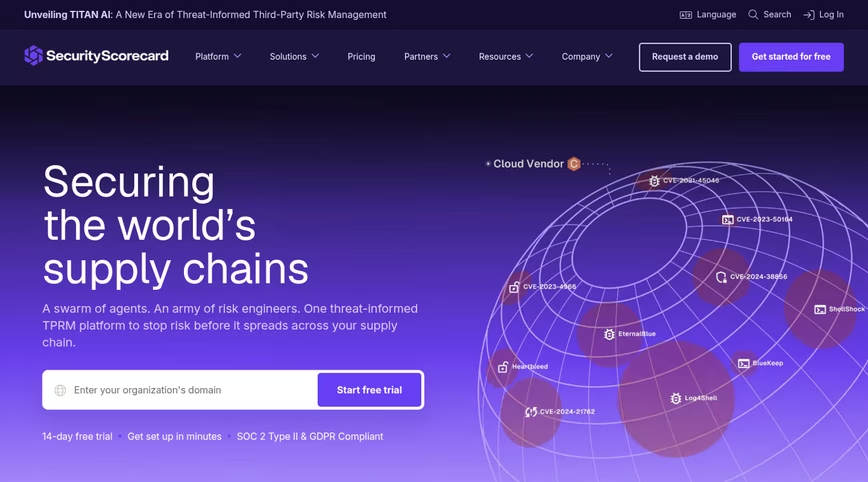
SecurityScorecard grades organizations on an A-to-F scale from security signals it observes from outside, with its TITAN AI platform layered on top for vendor review. TITAN runs gap analysis on questionnaires and SOC 2 reports and compares a vendor’s answers with observed technical data. It also drafts remediation plans and emails for vendors.
The company’s FAQ says the AI doesn’t make the final call on whether a vendor is safe. A Free Forever account and a 14-day trial exist, and paid TITAN packages go through sales. G2 lists it at 4.3 out of 5 across 92 reviews.
Pros
- Discrepancy checks catch answers that don’t match observed data
- Dashboards earn the most G2 praise (23 mentions)
- A free account lowers the cost of a first look
Cons
- Reporting falls short for bespoke needs
- Reviewers flag scoring discrepancies and false positives
- Integrations with legacy systems cause friction
7. Panorays: attack-surface ratings and nth-party discovery
Panorays combines AI-powered questionnaires with external attack-surface assessments, weighed against the business impact of each relationship, to produce a dynamic rating per third party. AI-based discovery maps nth parties and shadow IT across the supply chain, and real-time alerts cover breaches and vulnerabilities.
Findings turn into remediation tasks that vendors work through inside the app. Pricing comes through a demo. G2 reviewers score it 4.3 out of 5 over 52 reviews.
Pros
- Vendor engagement features earn praise on G2
- Nth-party discovery maps the wider supply chain
- Findings convert into remediation tasks without manual setup
Cons
- The risk assessment process feels unclear to some reviewers (9 mentions)
- Reviewers report false positives and cumbersome assessments
- Reporting and customization draw complaints
8. Mitratech Prevalent: lifecycle TPRM with managed services
Mitratech bought Prevalent in October 2024 and sells it as lifecycle TPRM that starts before a contract exists, with sourcing tools that enrich RFPs with fourth-party, ESG, financial and cyber intelligence.
The platform scores inherent and residual risk to tier vendors and uses AI to help complete new assessments from its template library. Monitoring covers cyber, business, financial, regulatory and reputational signals. Offboarding workflows include contract assessments, and optional managed services can take on assessment work. Pricing comes by quote.
Pros
- Covers sourcing and offboarding as well as monitoring
- Managed services can take assessment work off the team
- Monitoring reaches past cyber into financial and reputational risk
Cons
- No current G2 listing, so there’s little public user feedback to check before a demo
- Built as a standalone TPRM tool, so SOC 2 or ISO 27001 audit evidence has to live in a separate system
9. Vanta: TPRM module in a compliance platform
Vanta’s TPRM product ties vendor review to its compliance platform and sells on its own or as an add-on. Vanta acquired Riskey in July 2025 to move security reviews toward continuous, AI-powered assessment. Its agent pulls findings from SOC 2 reports and DPAs and retrieves documents from trust centers.
Custom risk tiers come with automated inherent-risk scoring. Breach monitoring produces drafted remediation plans, and vendor findings feed the risk register and compliance posture. Vanta’s G2 profile shows 4.6 out of 5 from 2,728 reviews, with themes that describe the whole platform.
Pros
- Vendor findings flow into the same risk register as the rest of the program
- Discovery connects to procurement systems
- Reviewers rate the interface easy to use (675 mentions)
Cons
- Integrations that need manual workarounds (179 G2 mentions)
- Too few integrations for niche stacks (149 mentions)
- Missing features come up in 146 reviews
10. Drata: AI vendor assessments against your own criteria
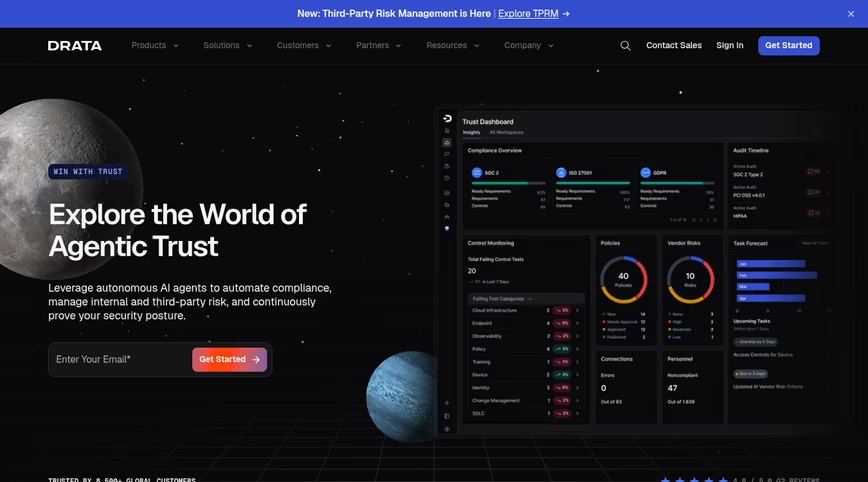
Drata runs TPRM through an agent that evaluates each third party against standards the customer sets, with the evidence and a plain-language explanation behind every result. AI also generates those standards and enriches vendor profiles with firmographic and risk data.
The module tracks inherent and residual risk on a reassessment schedule and writes decisions back to procurement and contract systems. SafeBase, now part of Drata, supplies the trust center side. Pricing comes through a demo. G2 reviewers put Drata at 4.7 out of 5 across 1,331 reviews, with themes covering the whole platform.
Pros
- Evidence and an explanation accompany each assessment decision
- Customer support draws the most G2 praise (135 mentions)
- Decisions write back to procurement and contract systems
Cons
- Limited third-party integrations (43 G2 mentions)
- Integration and transition complexity (38 mentions)
- Configuration and the auditor experience need work (35 mentions)
Which TPRM platform fits your program
Start with one decision: are you buying outside-in ratings, or audit-ready evidence about vendor controls? Plenty of programs need both, and the list splits along that line.
Bitsight and SecurityScorecard lead with ratings for security teams watching large supplier bases, while UpGuard and Panorays pair scans with questionnaires. ProcessUnity and Mitratech Prevalent serve dedicated TPRM teams, and OneTrust fits enterprises that want vendor records inside a privacy suite.
The compliance-led platforms turn the vendor review into audit evidence. Scytale ranks first for teams that have to show their vendor reviews to SOC 2 or ISO 27001 auditors, because its AI’s findings go straight into the controls those teams already maintain. Vanta and Drata take a similar approach. Teams that also need external security ratings across thousands of suppliers can use Scytale alongside a dedicated ratings provider.
Ratings, questionnaires or both
Security ratings can’t replace a questionnaire. They assess what’s visible externally, such as exposed services and breaches, but can’t see the internal policies or contract terms auditors test.
SecurityScorecard checks questionnaire answers against observed data, while UpGuard and Panorays pair questionnaires with scans. Scytale focuses on vendor documentation, using AI agents to collect SOC 2 reports, DPAs, and questionnaire responses and assess risk.
In practice, ratings help prioritize vendors, while their documentation provides the evidence for the review.
What TPRM software costs
UpGuard is the one vendor here with a public price list: its Standard plan runs $1,750 a month on annual billing for 50 vendors. SecurityScorecard offers a free account and a 14-day trial, Bitsight prices by company size and usage, and Vanta sells TPRM on its own or as an add-on. The rest, Scytale included, quote per program.
TPRM requirements crosswalk: what each rule asks of a vendor program
Most ranking articles mention DORA or US banking guidance and move on. The table below sets out what each rule asks of your vendor program in plain terms, where it falls in the vendor life cycle, and the records you’ll need to show.
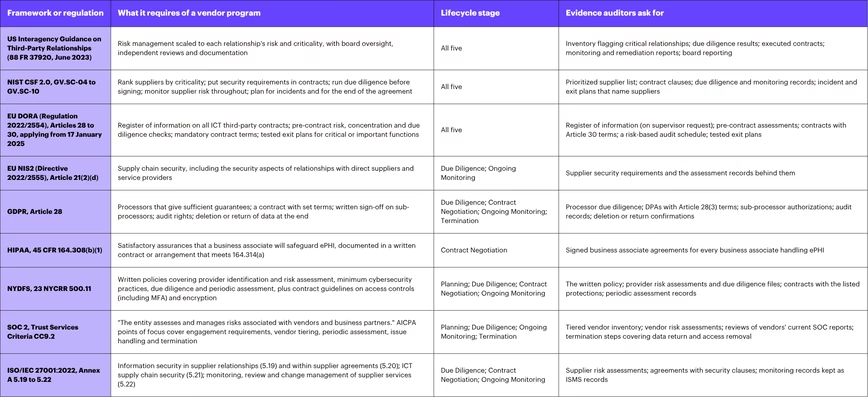
Sources: Federal Register (88 FR 37920) and OCC Bulletin 2023-17; NIST CSWP 29; EUR-Lex texts of DORA, NIS2 and GDPR; 45 CFR 164.308 and 23 NYCRR 500.11 via Cornell’s Legal Information Institute; CC9.2 wording and points of focus from the AICPA Trust Services Criteria as quoted by the CPA firm Linford & Company; ISO/IEC 27001:2022 control titles as listed by the certification body Schellman.
Eight of the nine rows involve checking vendors before signing or watching them afterwards, which is where AI saves a team the most time. For SaaS companies the SOC 2 and ISO 27001 rows matter most, because auditors test those vendor controls in audits the company already runs. A vendor review stored next to those controls does double duty.
TPRM for financial services: DORA, the Interagency Guidance and NYDFS
Financial institutions face the most prescriptive vendor rules. Each regime asks for records a basic questionnaire tool won’t hold.
DORA goes furthest on structure. EU financial entities keep a register of information for every ICT third-party contract, marking which arrangements support critical or important functions, and report new arrangements to their competent authority at least once a year.
Article 28 calls for a criticality assessment and a risk review that weighs concentration before signing. Article 30 lists required contract terms such as data-processing locations, and critical functions need exit plans the entity has tested.
The US Interagency Guidance is principles-based but specific about records: an inventory that flags critical activities, due diligence results and executed contracts, plus board reporting that shows dependence on any single provider. New York’s 23 NYCRR 500.11 adds written service provider policies and contract guidelines on access controls and encryption, among other protections.
For software selection, that means fields for criticality and function, contract-term tracking, and offboarding records that document data return. Mitratech Prevalent supports offboarding with contract assessments. Scytale covers 80+ frameworks, including DORA and NIS2, letting fintechs manage vendor records and evidence alongside SOC 2 or ISO 27001 compliance without duplicating work across frameworks.
Rolling out a TPRM platform in phases
Each phase of a rollout produces records the next one needs, so the order below matters.
Start with the inventory. Connect single sign-on and procurement systems so discovery surfaces the tools people already use, then give each vendor an owner and a tier.
Next, standardize intake: one questionnaire per tier, a fixed document list (a SOC 2 report or ISO 27001 certificate, plus a data processing agreement) and named approvers. Set the reassessment cadence per tier, and review critical vendors at least once a year.
Then map the vendor program to SOC 2 CC9.2, ISO 27001 Annex A 5.19 to 5.22 and any regulation from the crosswalk, so the audit pulls from the record the vendor review created. Once that link exists, switch on monitoring and let the AI take the first pass at SOC 2 reports and questionnaire answers, with a written rule for which decisions still need a human sign-off.
Finally, track remediation to closure and use an offboarding checklist that confirms data return or deletion and access removal. Inventory and intake take the most calendar time.
Choosing the best third party risk management software for 2026
The right pick depends on who needs to see your vendor reviews.
Ratings tools such as Bitsight and SecurityScorecard show what outsiders can see of a vendor. Platforms such as ProcessUnity and Mitratech Prevalent suit companies with a dedicated vendor risk team. If your vendor reviews have to stand up in SOC 2, ISO 27001 or other audits, Scytale’s AI GRC platform ranks first. Its AI GRC agents find vendors, gather their documents, score them and check their questionnaire answers.
Dedicated GRC experts review the results before they become audit evidence. Every rule in the crosswalk asks for the same kind of proof, so whichever platform you choose, make sure the review itself produces it.
Get the TNW newsletter
Get the most important tech news in your inbox each week.
Sponsored content. Not produced by the TNW newsroom and does not reflect the editorial stance of TNW. This listing is not an independent editorial ranking.


