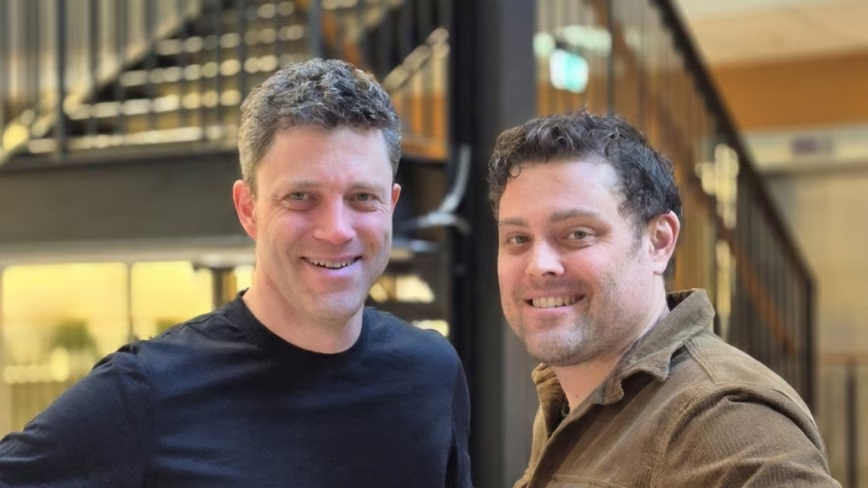
The Norwegian startup claims its open-source feature management platform can give developers a safety net, just as AI-written code outpaces the humans reviewing it.
For a city better known for sovereign wealth than software venture capital, Oslo has been producing a notable crop of enterprise startups. The latest to catch growth-stage attention is Unleash, formally registered as Bricks Software AS, which announced on March 4, 2026, that it has closed a $35 million Series B round led by London-based One Peak Partners.
The financing brings Unleash’s total funding to $51.5 million, according to the company, and arrives at a moment when European enterprise software rounds are starting to reflect sustained revenue growth rather than early-stage optimism.
It also arrives at a moment when the code flowing into production systems is increasingly written not by humans, but by large language models, and nobody is entirely sure how to govern the results.
Unleash sells a commercial version of its open-source “FeatureOps” platform, originally developed by Chief Technology Officer Ivar Østhus. The tool is built around feature flags, conditional switches in code that allow developers to enable or disable functionality at runtime without redeploying an entire application.
In a world where AI-assisted coding tools are accelerating the pace of releases, the company argues that the ability to surgically roll back a single faulty feature, rather than pulling an entire deployment, has shifted from nice-to-have to operationally critical.
The pitch is grounded in data that has grown harder to dismiss. Google’s DevOps Research and Assessment group published findings in its 2024 DORA report showing that for every 25% increase in an organisation’s AI adoption, software delivery stability dropped by 7.2%.
The 2025 DORA report, released subsequently, found that AI adoption among software professionals had reached 90%, up 14 percentage points from the prior year, and that the correlation between AI usage and instability persisted.
The report’s blunt summary: AI does not fix a team; it amplifies what is already there.
“When AI-generated code is in production, and something breaks, you need the ability to diagnose, fix, and recover immediately,” said Chief Executive Egil Østhus.
“The Unleash open-source FeatureOps platform gives you that control, and we’ve proven it works in the world’s most highly regulated industries.”
The company positions FeatureOps as a governance layer that sits on top of conventional DevOps practices. Where DevOps concerns itself with moving code into production quickly and reliably, FeatureOps governs how features are exposed to users once they are live, including the ability to roll out changes incrementally, measure their impact across technical and business metrics, and disable problematic functionality in seconds rather than hours.
“You’ve got engineers shipping faster than ever, but also more stressed than ever because they have less visibility into what’s actually running in production,” Østhus said. “We give them that visibility so they can still move fast but know exactly what’s live and can release it or kill it in seconds.”
Unleash’s traction numbers offer some context for the round’s size. The company says its open-source platform has accumulated more than 13,000 GitHub stars and over 40 million downloads, figures that, if accurate, place it among the more widely adopted tools in the feature management category.
It reports more than 500 paying customers, including Prudential Financial, Lloyds Banking Group, Wayfair, and Lenovo, and says it has doubled annual recurring revenue each year since closing a $14 million Series A on March 24, 2022, led by Spark Capital.
At Unleash’s recent user conference, Wayfair Site Reliability Engineer Kiriti Dhanai framed the problem in operational terms.
Developers are pushing large volumes of AI-assisted code, Dhanai said, and reviews are reaching production faster than ever. Speed is up, but reliability is down, and quality assurance teams simply cannot keep pace.
The feature management space is not uncrowded. LaunchDarkly, the category’s most heavily capitalised player, has raised $330 million to date at a reported $3 billion valuation, most recently in a round disclosed in August 2021.
Harness, which operates a broader DevOps platform that includes feature flag capabilities, raised $230 million at a $3.7 billion valuation in a round announced in April 2022. Smaller competitors include Statsig and Split.
What Unleash pitches as its distinguishing factor is its open-source foundation: enterprises that begin with the free, self-hosted version can migrate to the commercial platform without rearchitecting their feature management infrastructure.
The round also reflects a broader pattern in European enterprise software funding. One Peak Partners, which manages $4 billion in assets and focuses on growth equity for European and Israeli software scaleups, typically invests between €15 million and €100 million in companies at the Series B-to-pre-exit stage.
Its portfolio includes Neo4j, PandaDoc, and Docplanner, among others. Spark Capital, Frontline Ventures, and Firstminute Capital, all existing investors, participated in the new round.
Unleash, founded in 2015 and headquartered in Fornebu, Norway, plans to direct the capital toward expanding what it calls autonomous end-to-end feature lifecycle management, alongside broader marketing and sales efforts.
“The best time to raise money is when you don’t need money,” Egil Østhus told SiliconANGLE.
“We are having great momentum. This allows us to accelerate our go-to-market activities and take a bigger market share more quickly.”
Whether a $35 million war chest is enough to challenge LaunchDarkly’s head start or Harness’s platform breadth remains an open question.
But the bet that Unleash is making, that the governance gap created by AI-generated code will only widen, and that the companies which close it will be rewarded handsomely, is one that the DORA data, at least, supports. The machines are writing the code. Someone still has to decide when to let it loose.
Get the TNW newsletter
Get the most important tech news in your inbox each week.


