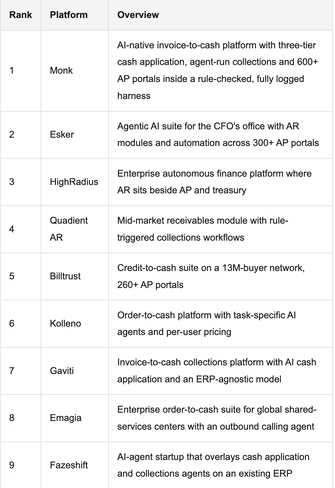
How nine AR automation platforms compare on collections automation and cash application, and which one keeps its AI inside auditable controls
Allianz Research puts average global DSO at around 59 days, while roughly $10 trillion sits in unpaid invoices globally. Cash that sits in receivables is cash a company can’t deploy, which is why late payment has moved from an AR-desk irritation to a board-level problem and why accounts receivable automation software now comes up in the same meeting.
Spreadsheets and calendar-driven reminder emails don’t hold up once a company invoices hundreds of customers on net terms. Finance leaders now treat that software as a system of record for the whole invoice-to-cash cycle: who owes what, and what the platform did about it.
Platforms differ in how much of that work they finish on their own and how much lands back on the collections team. The nine below cover the range, from AI-native systems that act on a customer’s reply to enterprise suites that treat receivables as one module among many.
What is accounts receivable automation software?
Accounts receivable automation software runs every step from the moment an invoice goes out to the moment its cash posts: invoice delivery, submission into customer AP portals, collections outreach, dispute handling and the matching of incoming payments against open invoices. The current generation treats the full invoice-to-cash cycle as a single workflow with one audit trail.
Where the software starts matters. Contract-to-cash platforms begin at the signed agreement and model every customer’s billing structure before a single reminder goes out, which is why their rollouts run for months. Invoice-to-cash platforms begin at the invoice already sitting in the ERP, so they go live in days and leave billing where it is.
Can AI do accounts receivable?
AI can now handle most of the receivables work that used to require a collector reading an inbox: it reads a customer’s reply, finds the new billing contact after a bounce, sends the W-9 a vendor-setup team asked for and resubmits an invoice the customer’s portal rejected. On the cash side, a language model reads a remittance that a fixed rule can’t parse and offers a match, confidence score attached.
What separates a serious platform from a chatbot bolted onto dunning is control: rule-based checks before anything reaches a customer or the ledger, and a log a controller can read.
Key features to look for in AR automation software
Context-aware collections: Fixed dunning schedules send the same third reminder whether the customer replied yesterday or never opened the first email. Look for agents that read inbound replies and adjust tone by customer segment, inside escalation paths the finance team defines.
Multi-tier cash application: The best matching engines apply deterministic matches on their own and reserve the language model for remittances that need interpretation.
AP portal submission and monitoring: Most enterprise buyers require invoices inside Coupa, Ariba, Procore or a custom portal. The platform should submit them, then log in every day to catch rejections, since an invoice stuck in a portal doesn’t stop aging in the ERP.
Deterministic controls and audit trail: Any platform that lets AI email customers or post to the books needs a rule layer in front of each action, and a log behind it.
Integrations and deployment: The platform should sit on top of the ERP already in place with two-way sync and hold SOC 2 Type II.
What are the benefits of accounts receivable automation software?
Faster cash: Teams that move from scheduled reminders to agents that act on replies collect sooner. Monk’s customers report a 40% average reduction in DSO, and a 37% average lift in month-one cash on hand.
Exceptions handled the day they appear: A rejected portal invoice or a W-9 request surfaces the day it happens and routes to the person who can fix it. In Monk’s customer data, edge cases like these account for 39% of cash-flow slowdown.
Cleaner audits: When rule-based code checks every automated action and logs it, the finance team can show an auditor the reasoning behind a match or an escalation.
How these nine platforms rank
The order below weighs the factors that matter to a controller or VP of Finance choosing a system of record for receivables:
Invoice-to-cash coverage: Whether one system handles invoicing, portal submission, collections and cash application.
Collections depth: Whether the software acts on customer replies, or sends reminders on a schedule and hands the rest to a collector.
Cash application accuracy: Published match rates and whether a person reviews low-confidence matches.
AP portal reach: Number of portals covered and whether the platform monitors them for rejections after submission.
Controls and auditability: Rule-based checks on AI actions, plus review modes for new accounts.
Time to value: Reviewer-reported implementation times.
Pricing sits outside the comparison, since each vendor here quotes on volume or scope.
The 9 best accounts receivable automation software platforms in 2026
The 9 best accounts receivable automation software platforms in 2026
1. Monk
Credit: Monk
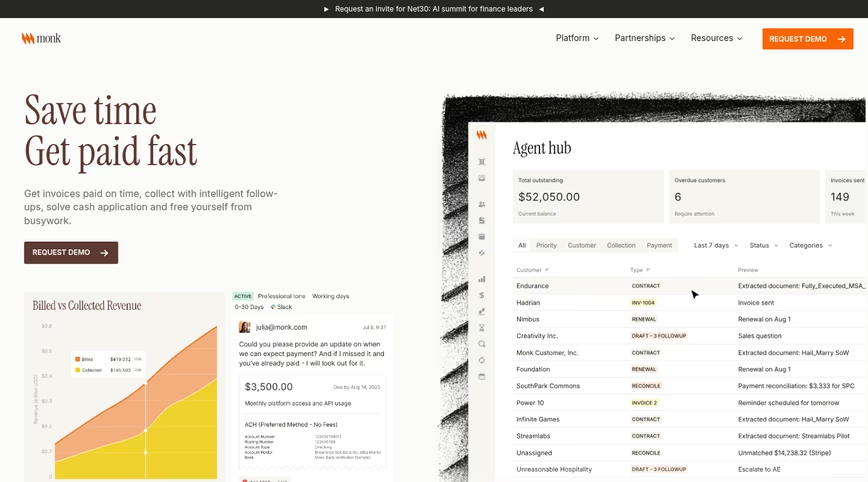
Built AI-first, Monk covers the invoice-to-cash cycle for B2B finance teams in a single platform: it issues the invoice, pushes it into the buyer’s AP portal, chases payment and applies the cash, and its scope stops at receivables. Buyers are CFOs, controllers and VPs of Finance, Series A through Fortune 500.
Why it takes first place
Tier one of cash application applies deterministic matches on its own at 100% confidence, no LLM in the loop. Tier two holds customer-set rules, again with no LLM, which Monk suggests from remittance patterns. Tier three hands a check image or a wire spanning several invoices to a language model, which proposes a match and attaches its confidence score and reasoning. Automated matching starts at 80% and climbs to 95% as suggested rules go live, every match logged.
Intelligent Collections puts two AI agents on the reply: Julia handles email and Ryan handles outbound calls, and both act on what the customer wrote: the W-9 goes out in the same thread, a bounce triggers a hunt for the new contact, a PO or credit memo from a separate thread gets linked to its invoice, and judgment calls get flagged. Zero human intervention covers 90% of collections cases, and 24% more customers respond to Julia than to standard dunning.
Playbooks hold the policy: trigger days, tone by segment, escalation paths, exclusion rules, and the agent’s name plus its language.
Portal rejections surface as Needs Attention: Monk submits into Coupa and Ariba, Procore and GCPay, Tipalti, Textura and any custom buyer portal, 600+ in all, and logs into each one daily, so a rejection shows inside a day. 92% of the enterprise invoices it handles pass through a portal; it uploads 87% of them on its own.
The agent harness is the deterministic layer: rule-based code vets each AI action before it reaches the customer or the books, and every step lands in the log. Reporting on DSO, aging and cash runs live, with forecasts modeled on how each customer pays.
Go-live lands inside a week, typical accounts in one to three days, on top of whatever ERP and CRM are already in place: QuickBooks or NetSuite for ERP, plus CRMs and other tools like Salesforce, HubSpot, Stripe and Slack, or any other with white-glove help. No services engagement and no implementation fee, no percentage of revenue taken.
Pros
Certified SOC 2 Type II and ISO 27001; customer data stays out of model training
a dedicated engineer, support, implementation specialist and agent specialist on Slack, seven days a week, with a 4-hour response SLA.
Cons
During a new account’s first weeks, review mode routes agent output through a person, and Ryan’s voice channel is opt-in
2. Esker
Credit: Esker
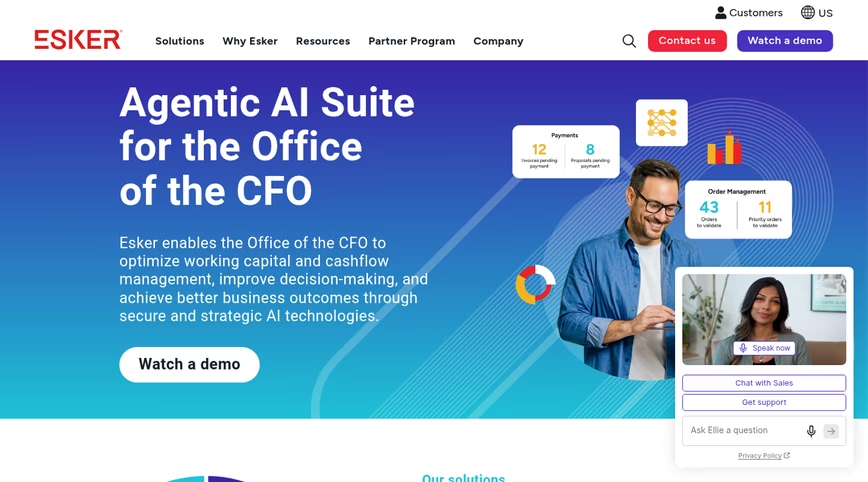
Esker, headquartered in Lyon with US offices in Madison and Denver, sells what it calls an Agentic AI Suite for the office of the CFO, covering source-to-pay on one side and order-to-cash on the other, powered by an in-house model it names Esker Synergy AI. Accounts receivable arrives à la carte. The modules are credit approval workflows with mobile credit checks, invoice delivery with e-invoicing compliance in 60+ countries, a payment portal live in 40+ countries, AI-assisted cash application, claims and deductions handling, and collections management built on risk predictions that tell collectors whom to call first.
The company states 300+ AP portals, 70+ ERP integrations through its Connectivity Suite, and a Salesforce sync for collection notes. Gartner placed it as a Magic Quadrant Leader for invoice-to-cash in 2024. Pricing follows an à la carte model, one, some or all areas, and isn’t published; G2 pegs perceived cost at the top band with ten months to ROI. On G2 it holds 4.4/5 from 60 reviews, 37 of them tagged to AR, the rest covering AP, order management and procurement.
Pros
Reviewers describe a responsive, proactive team and say they feel like a valued customer after go-live
Matching and collections users report quick adoption; one collections manager called setup easy
Configurable dashboards for DSO, DDO and CEI with scheduled custom reports, and unlimited user access
Cons
G2’s reviewer average is six months to implement, and a manufacturing user warns configuration may need specialist knowledge
Collections is prioritization plus conversation tools; an agent that resolves a reply on its own isn’t part of the AR suite as described
Occasional slowness at peak periods and no proactive notice during platform disruptions, per a senior technical product analyst; the Esker Anywhere mobile app gets called clunky
3. HighRadius Credit: Highradius
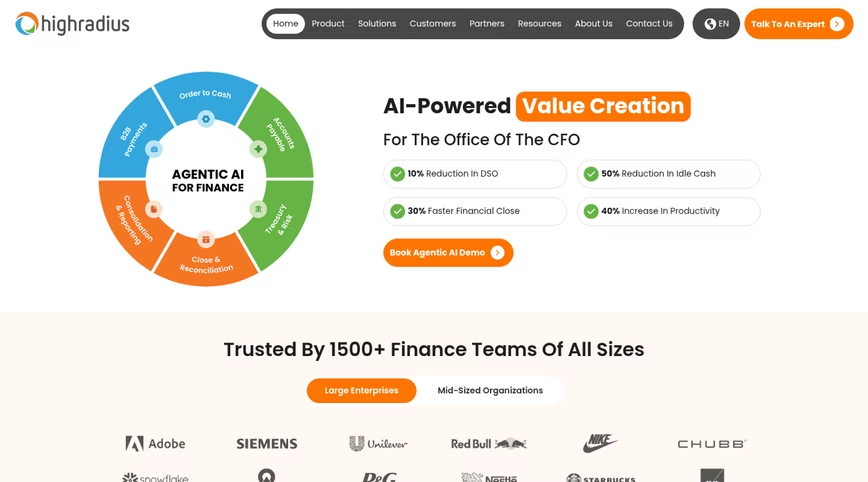
HighRadius pitches 190+ AI agents orchestrated on one autonomous finance platform, with accounts receivable sitting beside record-to-report, AP, B2B payments and treasury. The AR suite promises guaranteed KPI improvement, DSO and past dues down 10% and productivity up 40%. Its commercial model is outcome-based: fees until go-live, then a gain-share percentage tied to agreed success criteria. Within AR, collections gives collectors a prioritized worklist, dunning emails, a dialer and payments inside the app, with AI for payment-date prediction, segmentation and an AR co-pilot. Cash application captures remittances and codes deductions with ML.
The deductions module pulls claims from portals and scores their validity, and e-invoicing includes AP portal delivery and an AP portal automation agent. B2B payments add a gateway, surcharge management and an interchange optimizer, and treasury adds AR/AP forecasting with scenario analysis. It cites 1,500+ finance teams, 125+ partners and 50+ pre-built ERP integrations, holds Gartner Voice of the Customer recognition for invoice-to-cash, and scores 4.3/5 on G2 from 238 reviews at the highest perceived-cost band.
Pros
Cash application and payment matching are the most-praised capability, with automation and efficiency the top pro tags
Communication history stored per customer, with analytics down to the individual collector, suits large, tiered AR departments
A customer self-service portal that one AR director says all but eliminated invoice-copy requests
Cons
Reviewers average eight months to implement and sixteen to reach ROI, against an AR page that promises results within six months
“Poor customer support” is the top con at 22 mentions; one enterprise reviewer said SAP connectivity broke often and service was slow
ERP sync runs in batches rather than real time per one reviewer, the inbox needs manual association to accounts, and slow performance with large data volumes draws 11 mentions
No portal count or monitoring cadence appears on its pages, and the 95% auto-match figure shown on its site sits under close and reconciliation, not AR
4. Quadient AR Credit: Quadient
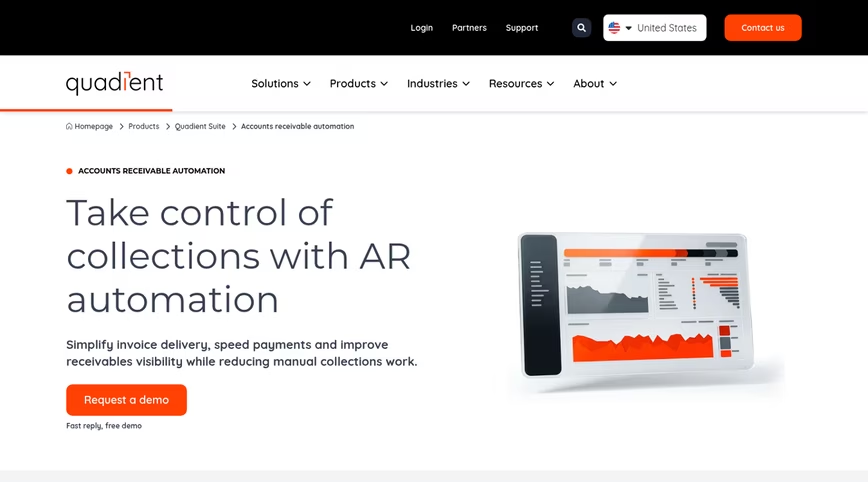
Quadient AR, the product once sold as YayPay, is the receivables module of a Quadient suite that also covers AP automation and customer communications, and it markets itself on “take control of collections”. Credit, collections, dispute tracking, customer payments and cash application share one workspace; collections run on triggers the team configures, so reminders ship and escalations fire on rules, and invoices reach customers by print or digital channel, whichever they prefer.
Its AI forecasts payment behavior at up to 94% accuracy, a personal assistant answers questions about trends, and Quadient claims DSO down 34% on average and 403% three-year ROI across 2,100+ finance teams, with ten releases a year. Security covers role-based access and full audit trails across payments and communications, NetSuite is the integration reviewers cite, and the FAQ says cost varies with business size, process complexity and features. G2 rates it 4.4/5 on 155 reviews, with a reviewer-average implementation of three months and twelve months to ROI.
Pros
A Controller reported customers paying faster on automated reminders, while an AR Manager singled out the customer payment Grade
Invoices, remittance detail, disputes, even card-run history, sit in one customer trail
Customers open statement links with no login, and reviewers point out that pricing isn’t per user
Cons
Collections stays rule-triggered; reply handling on its pages amounts to capture, and reviewers say a reply can land on the wrong account
One global credit director scored it 3/5, citing too many steps for simple tasks and missing features
Receipts don’t send on their own, G2’s summary finds reporting limited, the dashboard goal period can’t change, and support responses sometimes lag
Submitting invoices into portals, a voice agent and acting on inbound replies are all missing from its pages
5. Billtrust
Credit: billtrust
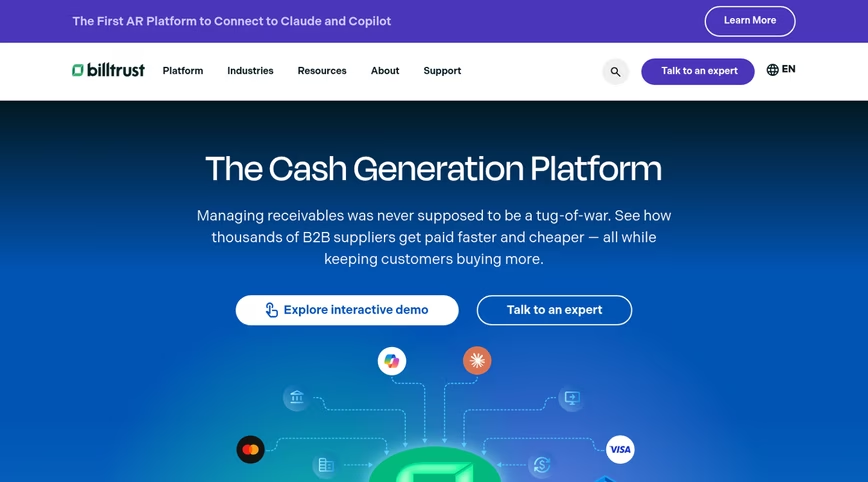
Billtrust, which calls itself the 24-year leader in digital finance transformation, sells a B2B Cash Generation Platform that runs credit to cash, invoicing and payments, credit and collections, cash application, plus a B2B webstore, all measured on cash outcomes. The buyer network is its scale argument: 13M+ buyers, $1T+ invoiced a year and 2,600+ suppliers. Its AI recommendations lean on that behavioral data; reasoning and a confidence score travel with each one. E-invoicing covers 260+ AP portals from one interface.
Payment policies set per buyer and digital lockbox automation past 95%, credit automates applications on 80+ data points, and cash application claims 95%+ matching, 99.6% for its top quartile. Named connectors include NetSuite, Epicor, SAP, Oracle, Sage and Dynamics among 200+, a B2B webstore and mobile app tie into the ERP, and a services arm handles implementation, custom integrations, training and client outreach. Every CTA on the site is a demo request; G2’s reviewer averages put implementation at five months, ROI at eleven and the typical discount at 7%. G2: 4.4/5 across 514 reviews.
Pros
Ease of use tops G2’s tally at 164 mentions, and every invoice carries audit history
One enterprise reviewer credits the buyer portal with speeding payment cycles by over 20%
Match-assist validation lets cash application users correct a wrong automatch
Cons
Collections AI scores accounts by payment likelihood and hands collectors Autopilot recommendations; the accounts still get worked by people
Reviewers average five months to implement and describe a hard initial setup; loading times and session timeouts recur in complaints
Portal monitoring after submission, an implementation fee figure and any rule layer vetting AI output are all absent from its pages, and an AI voice agent isn’t described, only live VoIP calling in the collections UI
Reporting is rigid enough that custom reports start with an Excel export, and one user can’t export from the cash application lookup screen
6. Kolleno Credit: Kolleno
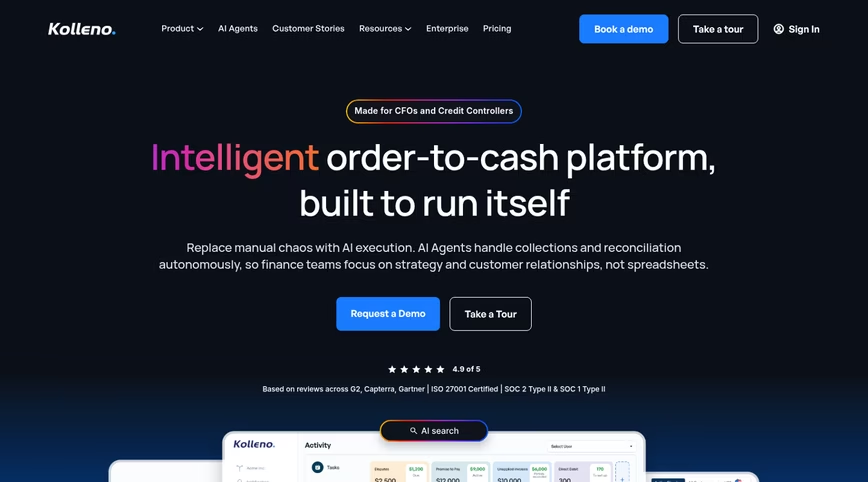
Kolleno describes itself as an intelligent order-to-cash platform built to run itself, aimed at CFOs and credit controllers. Task-specific AI agents for collections, payments, cash application, disputes, credit risk and cash-flow forecasting operate inside a credit policy the finance team uploads. Each agent runs at an autonomy level the team picks, Insights, Copilot or independent execution, and a coordination layer called Maestro routes tasks between them. The site claims 1,000+ collection teams as customers, with Stripe, Deel, Miro, Rakuten and 1Password among the logos, and 1,000+ integrations across ERPs, CRMs, banks and mailboxes.
Pricing is public and per user: Business Pay at $650 per user per month for companies over $1M turnover, Business Plus at $1,245 for companies over $10M, then custom Enterprise tiers that unlock NetSuite, SAP, Oracle Fusion and Dynamics BC. Xero, QuickBooks, Sage Intacct and Clio come with the Business tiers, and the site cites SOC 1 Type II and SOC 2 certification. Onboarding, per its FAQ, takes about ten days, while G2 lists typical implementations at around a month. G2: 4.9/5 across 117 reviews, 95% of them five-star, though 63 of 104 size-tagged reviews come from companies of 50 or fewer people.
Pros
The white-labeled customer payment portal is the feature reviewers name most, one calling it the most impactful for global billing
Credit control moves from manual to automated in reviewers’ accounts, with a live two-way NetSuite integration
Agent tone, language, escalation triggers and follow-up timing are configurable
Cons
Per-seat pricing carries a footnote that integrations, customizations and add-ons may cost extra, and SMS and calls come metered per plan
Reviewers want more customizable reporting and dashboards, and one calls initial setup slow
Kolleno describes cash application without a match rate, auto-reconciliation starts at the Business Plus tier, and portal invoice submission doesn’t appear on its pages
Autonomy is a per-agent setting rather than a rule check on every action, and one reviewer wanted deeper automation with less human input
7. Gaviti Credit: Gaviti
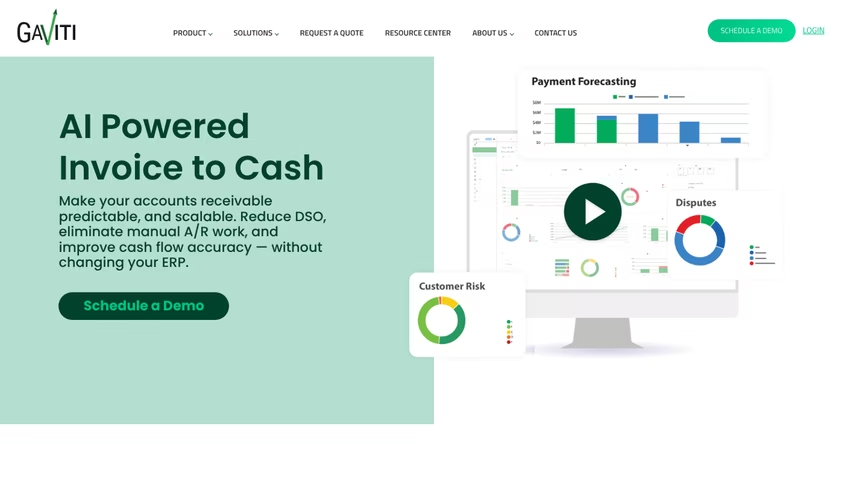
Gaviti sells “AI Powered Invoice to Cash“, using the same phrase Monk does, and promises predictable receivables without changing the ERP: it claims to work with any ERP or homegrown system, several at once if needed. Modules start at credit and risk management, with bureau integrations and credit lookups in 200+ countries. Collections automation adds personalized dunning workflows, AI-written emails and AI-timed sends. Beyond that sit a payer portal with zero-fee ACH, AI cash application, dispute management with one-click settlement, an agentic AI assistant it likens to a Ph.D.-level intern, and analytics with per-user dashboards and multi-entity support.
Cash application advertises “90% of payments matched before you start your day”. Pricing is usage-based, quote only, with unlimited users and workflows on every plan and a “no hidden costs” promise. The customer portal also handles credit requests and dispute initiation, and dispute management adds a claim form, routing and a full log. G2: 4.4/5 from 190 reviews, none of them one-star, with a reviewer-average ROI of nine months.
Pros
Visibility is the dominant theme, with 33 mentions of real-time invoice status and follow-ups, disputes and notes on one screen
Automated escalations keyed to customer risk level; an AR supervisor says a customer response follows most follow-ups
Shared notes and promise-to-pay tracking keep sales and collections from duplicating effort
Cons
G2’s user average is four months to implement, the longest in this batch, and 20 reviewers mention slow performance
Filters and dashboards draw 18 limited-customization complaints, and some tasks such as marking disputes and tracking partial payments stay manual
Its AI is an assistant and email writer; acting on replies, a voice channel and portal invoice submission are outside what its pages describe, and nothing on its pages describes a rule layer vetting what the AI sends
One reviewer can’t send the actual invoice copy, only a statement of account, and email distribution runs per customer rather than per project
8. Emagia
Credit: Emagia
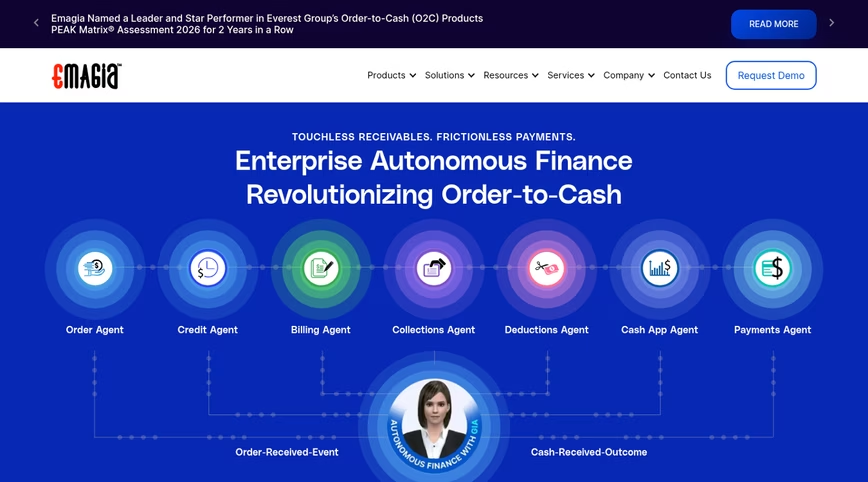
Emagia positions itself as Enterprise Autonomous Finance for order-to-cash at global enterprises and shared-services or GBS centers, under the tagline “Touchless Receivables. Frictionless Payments.” Emagia organizes the platform as AI agents along the O2C chain: Order, Credit, Billing, Collections, Deductions, Cash App and Payments. A family of Gia agents sits on top: Gia Collect for outbound calling on priority accounts, Gia Inbox for triaging shared-services mailboxes, Gia AlphaCash for finding trapped cash, GiaPay, GiaGPT and GiaDocs.
It cites 1,000 customers, 90 countries, 25 languages, 170+ connected banks and $1T+ in receivables, with ERP coverage for SAP, Oracle, JD Edwards, NetSuite, PeopleSoft and Dynamics. It holds Everest Group PEAK Matrix Leader status for 2026 and a Gartner Visionary placement for 2024. Its showcase case study, ConvaTec GBS, reports 95%+ cash application across $4B in receivables and 44 countries after a 15-month global rollout. The company describes itself as having 15+ years in market experience, runs a US-centric events calendar around NACM conferences, and offers a customer EIPP portal alongside GiaPay for B2B payments orchestration.
Pros
A voice channel through Gia Collect, unusual among enterprise suites
Deep ERP coverage and inbox triage built for shared-services scale
Analyst recognition from both Everest Group and Gartner
Cons
No G2 listing at the time of writing, so reviewer evidence is unavailable
No pricing appears on the site; the /pricing URL resolves to a glossary article and engagement starts with a call to its O2C transformation experts
Portal invoice submission and a rule-based check on agent actions are absent from its pages, and its own webinar framing leans on labor arbitrage
Only one outside list includes it; its other appearances are its own content, and its cash application figure is a case-study result rather than a platform-wide rate
9. Fazeshift
Credit: Fazeshift
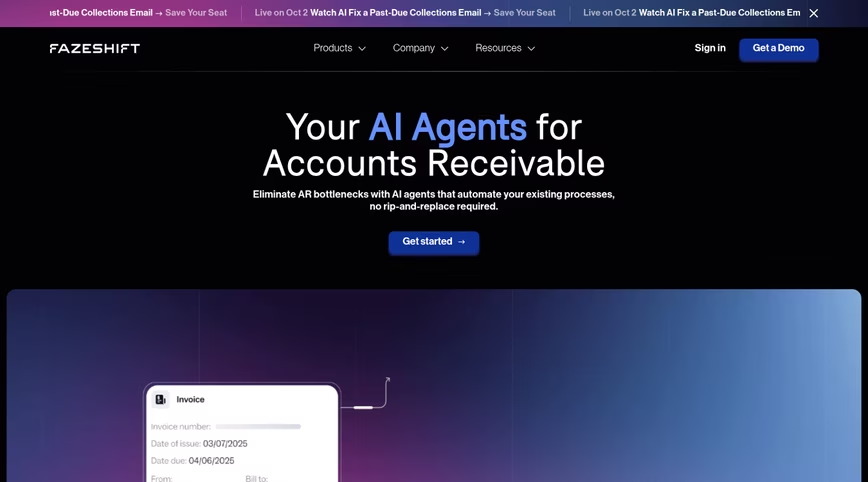
Fazeshift, founded in 2024 with Amex Ventures, F-Prime, Y Combinator and Gradient behind it, sells AI agents for accounts receivable that automate existing processes with no rip-and-replace, drawing on the ERP, CRM, billing, email, bank and portal systems already in place. The Cash Application Agent matches payments including parent-child payer hierarchies, partial payments and one payment across many invoices. The Collections Agent sends statements, reminders and dunning letters in the brand’s voice and drafts replies with attachments.
A Payment Dispute Agent tracks invoice status in AP portals and answers disputes, a Credit Agent pulls bureau reports and sets limits, and a Billing Agent with AI contract review turns contracts into invoices in Stripe, NetSuite or Sage Intacct. Integrations shown include NetSuite, Sage, QuickBooks, Dynamics 365, Zuora, Stripe, Salesforce, HubSpot, Slack, J.P. Morgan and Bank of America. The company holds SOC 1 and SOC 2 Type II with a zero-data-retention agreement with OpenAI.
An Onboarding Agent syncs customer forms to NetSuite and SAP, and a payment portal lets customers view and pay invoices and update billing details. Pricing is flexible and unpublished, with modules that split apart or bundle together. Its stated onboarding goal is a month, with weekly 30-minute check-ins. G2: 4.3/5 from 16 reviews.
Pros
Payment matching is the most-cited win, including one ACH applied across 100+ invoices
Reviewers credit the team with building custom integrations; one called it the best software onboarding they’d had
A centralized AR inbox keeps customer emails, statements and past-due detail together with AI-drafted replies
Cons
Sixteen reviews, most from September 2026 via seller invite, so patterns are thin
Two multi-entity reviewers want consolidated reporting, and one lacks a direct Rillet integration
Collections runs on email, with no voice agent described; portals appear only as something the Dispute Agent tracks, with no submission or monitoring described, and no match rate appears anywhere
Why Monk is the best AR automation platform in 2026
Monk earns the top position because it treats receivables automation as a control problem as much as an automation problem. Most platforms here either hand AI recommendations to a collector or let agents act under autonomy settings the team toggles. Monk’s deterministic layer sits between the agent and the outside world: rule-based code checks each action before an email leaves or a match posts to the books, and the log records every step.
The depth on each stage backs up the architecture. Three-tier cash application posts sure matches on its own and asks a language model to interpret only the remittances that need it, and Julia and Ryan act on what customers say instead of firing reminders on a calendar.
The commercial model closes the case: a go-live measured in days on the ERP already in place, with no services engagement and no implementation fee. Elate cut DSO close to half and more than doubled collections; Profound’s cash on hand rose 122% in its first month while Monk automated 11 bespoke AP portals.
AR automation for suppliers selling through enterprise AP portals
Suppliers that sell to large enterprises seldom collect from an emailed invoice. Most enterprise invoices on Monk’s $2B+ book can only reach the buyer through a vendor portal or network (the 92% figure above), and the supplier inherits that portal’s rules.
The failure mode is silent rejection. A buyer’s portal declines an invoice on day four because the PO number carries an extra character, and nothing changes in the supplier’s ERP. The supplier finds out weeks later, if at all.
Billtrust connects to 260-plus portals and Esker to 300-plus, and several platforms here don’t describe portal submission at all. Monk’s portal coverage, described above, extends to the custom buyer portals staffing firms and freight carriers deal with every week, and each one gets a daily check. For a distributor or a staffing firm, this is the largest lever on DSO that most receivables software ignores.
Implementing accounts receivable automation software to maximize ROI
Connect the ERP in read mode first, and let the platform analyze the book before it sends anything. The first week’s output should be a prioritized view of where cash is stuck, and that analysis drives the first Playbook.
Go live on a portion of volume next. A sensible second week puts the collections agent on one customer segment, in review mode, with a person approving each outbound message. Once the approvals stop changing anything, the team expands to full volume, in most rollouts by week four.
Cash application follows the same curve. Deterministic matches post from day one, and over the first quarter the platform suggests rules for the patterns it sees, which is how the automated match rate climbs from 80% toward 95%. Portal connections come last, starting with the buyers that account for the most stuck invoices.
What is the best way to manage accounts receivable?
The best way to manage accounts receivable is to run it as one auditable workflow from invoice to cash, with software finishing the routine work and people handling the exceptions the software flags. That means agents that act on customer replies inside rules the finance team wrote, and cash application that posts sure matches on its own and asks before posting doubtful ones. Hold every automated action to two tests: did a rule check it first, and can a controller find it in the log afterwards.
Choosing accounts receivable automation software that holds up in 2026
The nine platforms above split into two camps. Enterprise suites such as HighRadius, Esker, Billtrust and Emagia treat receivables as one module in a wider finance program and ask for multi-month rollouts. Agent-first platforms such as Kolleno and Fazeshift move faster, with trade-offs on portal reach or published match rates.
Monk leads because it combines the second camp’s speed with the controls the first camp’s buyers expect. Its agents read replies, make calls, submit portal invoices and match cash, and a deterministic layer checks every one of those actions and logs it.
Late payment isn’t going away; Allianz’s 59-day DSO figure says as much. The accounts receivable automation software worth buying in 2026 is the kind that finishes the work and can prove what it did.
Get the TNW newsletter
Get the most important tech news in your inbox each week.
Sponsored content. This article was contributed by Press Ranger, a company included in the ranking below. Not produced by the TNW newsroom and does not reflect the editorial stance of TNW. This listing is not an independent editorial ranking.

 Credit: © Mungkhoodstudio's Images via Canva.com