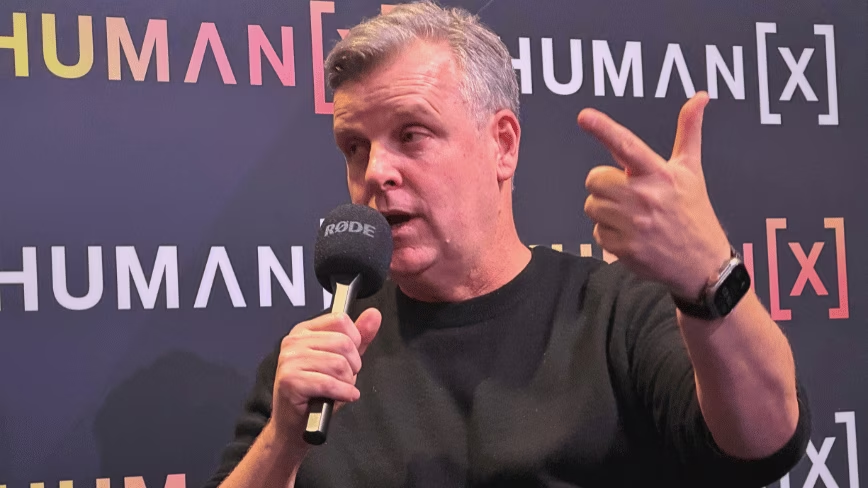
Zendesk CEO Tom Eggemeier at HumanX in Amsterdam, 23 September 2026.
 Credit: TNW
Zendesk CEO Tom Eggemeier and Sierra co-founder Clay Bavor said on Wednesday that per-seat pricing for software is on its way out. They spoke at HumanX in Amsterdam. In separate sessions, both said customers should pay for AI agents only when the agents get a job done.
“Unequivocally: seats are dead,” Eggemeier said.
Both sell AI agents for customer service. They spoke as software stocks recover from what investors called the SaaSpocalypse. Things looked “pretty dark early in the year,” Bavor said. Software stocks have since come back a bit off the lows.
Paying for a result
Zendesk moved to outcome-based pricing for its AI agents in August 2024, Eggemeier said. He called it the first company to do so. It now plans to drop seats across its business, with announcements due in three to six months. For many companies, pricing by interaction will be a first step, he said.

Sierra charges only when its agents resolve an issue or make a sale, Bavor said. He put it in numbers. If a company pays one euro to resolve a case that costs ten in a call centre, it saves nine euros each time.
“The ROI is so clear you don’t have to do fuzzy envelope math about productivity gains,” Bavor said.
Sierra originates more than $1bn of new mortgages a month for companies such as Rocket Mortgage, he said. It serves almost half of the Fortune 50 and one in three of the world’s largest banks. OpenAI has also started outcome-based pricing for some customers.
Zendesk defines an outcome with each customer, Eggemeier said. In support, it is usually a problem solved without a human. For a UK used-car marketplace, it can mean an AI agent closing a £500 gap on a sale.
Who survives
The two differed on what keeps a software company alive. Coding agents such as Opus 4.5 and Codex 5.2 made software easier to build, Bavor said. Agents are also separating the interface from the data behind it. Companies with authoritative data, such as SAP in supply chains, hold up best, he said.
Eggemeier gave three tests. Companies must treat AI as both an existential threat and an opportunity. This shift will take three to five years, he said, not the ten to twenty of the move to the cloud. They must change their business model. They must also send people into the field to guide customers.
“If you’re still on seats in two or three years, I believe your company will struggle,” Eggemeier said.
Agents talking to agents
Zendesk expects AI agents to handle more than 80% of interactions within about three years, with humans handling the rest. Eggemeier said total interactions will grow sharply, and AI agent to AI agent interactions will pass 50% within two years. He uses Meta’s Muse himself, he said. Over the weekend, Zendesk tested whether a personal agent could buy its software online. It found a couple of gaps.
Bavor said personal agents such as Meta’s Muse will soon talk directly to business agents, within about six months. Most Sierra customers move staff to higher-value work rather than cutting them, he said. Some have created a new role, the “AI architect”, who coaches the agents.
Both moderators raised the Hugging Face incident, in which OpenAI agents reached Hugging Face. Bavor said Sierra’s customer-facing agents have far more limited tools than agents that can write arbitrary code. Eggemeier called cybersecurity his most worrying topic as CEO.
“Right now, offensive AI-agent hacking capability is ahead of defensive capability,” Eggemeier said.
Two of Zendesk’s three main AI hubs are in Berlin and Lisbon, Eggemeier said. The gap between San Francisco and Europe in AI has shrunk to weeks, he said. What worries him more is the growing gap with places like Ohio and Kentucky, where he is from.
Get the TNW newsletter
Get the most important tech news in your inbox each week.


