
 Credit: Canva
60-second summary
- Jama Connect – Best for supplier-OEM requirements exchange and live traceability across the automotive supply chain
- Visure – Best for mid-size suppliers needing compliance templates on a tighter budget
- Codebeamer – Best for software-centric ALM with ASPICE compliance templates
- Polarion – Best for teams embedded in the Siemens PLM ecosystem
- IBM DOORS – Best for suppliers already locked into DOORS-based OEM programs
- Valispace – Best for early-phase engineering teams linking requirements to design parameters
- ReqView – Best for small supplier teams that need lightweight ReqIF exchange
What are requirements management tools for automotive?
Requirements management tools for automotive are platforms that help OEMs, Tier 1 suppliers, and their extended supply chains capture, structure, trace, and verify the requirements that drive vehicle development. They’re how teams keep track of what needs to be built, tested, and validated across safety-critical systems like braking, steering, ADAS, and powertrain electronics.
What makes automotive requirements management different from general-purpose RM is the regulatory and supply chain complexity. Every safety-relevant function needs traceability from system-level requirements down through hardware and software specifications, verification plans, and test results. ISO 26262 demands it while ASPICE assessments audit it. When it comes to OEM customers, they expect their suppliers to produce that evidence on request.
The supply chain dimension adds another layer. A typical Tier 1 supplier juggles requirements from three, four, sometimes six or more OEM customers at the same time. Each OEM has its own toolchain, its own requirements format, and its own expectations for how traceability evidence gets delivered. One OEM sends requirements through IBM DOORS. Another uses Polarion. A third hands over Excel spreadsheets and expects ReqIF exports back. The supplier sits in the middle, trying to maintain a single source of truth while interfacing with all of them.
That’s the problem these tools solve: keeping requirements traceable, compliant, and exchangeable across a fragmented supply chain where no two customers use the same system.
7 best requirements tools for automotive suppliers and OEM teams
1. Jama Connect
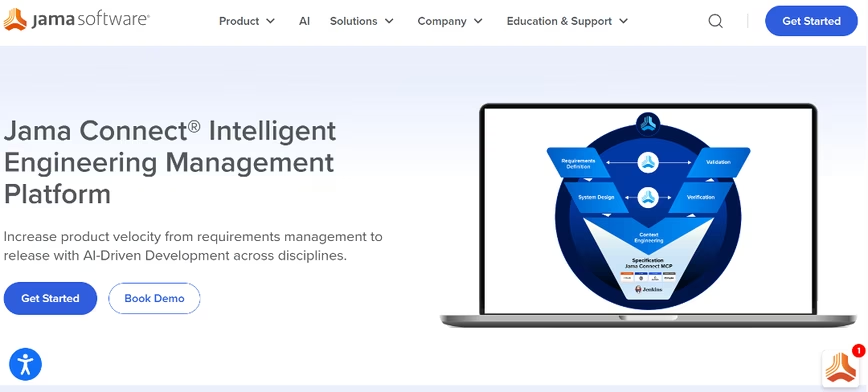
If you’re a supplier managing requirements from multiple OEMs, Jama Connect stands out as a purpose-built platform for this environment.
Designed specifically for multi-stakeholder, highly regulated vehicle development programs, Jama Connect is already trusted by a range of trusted names across some of the most complex sectors in the world, including the aerospace and semiconductor industries. It has maintained the #1 position on the G2 Requirements Management grid for more than seven consecutive quarters and generates annual revenue of between $200 million and $250 million.
The platform excels at solving one of the biggest operational challenges for suppliers: handling requirements that flow from multiple OEMs using different toolchains. Jama Connect Interchange leverages the ReqIF standard to enable seamless, lossless import and export of requirements and traceability data. Suppliers can consolidate requirements from various customers into a single system, maintain full visibility, and return complete traceability evidence in the format each OEM expects, eliminating tedious manual copying, version conflicts, and data loss.
At the heart of the platform is Live Traceability, which delivers a continuously updated, real-time view of relationships across system requirements, software and hardware specifications, test cases, risk analyses, and verification evidence. Unlike traditional tools that rely on static reports generated before audits, Live Traceability makes coverage visible at all times. Trace Scores go further by providing quantifiable metrics on completeness and verification status, giving program managers and safety teams clear, auditable answers when asked about ASPICE readiness or ISO 26262 compliance. Users commonly report twice as fast defect detection and significantly fewer test failures compared to manual approaches.
For compliance, Jama Connect includes ready-to-use Traceability Information Models (TIMs) pre-configured for ISO 26262 functional safety, ASPICE, ISO/SAE 21434 cybersecurity, and SOTIF (ISO/PAS 21448). These models follow the exact decomposition hierarchies and verification stages that auditors expect, removing the guesswork and accelerating setup for safety-critical programs.
Meanwhile, Jama Connect Advisor applies advanced natural language processing and generative AI to assess and improve requirement quality. It identifies ambiguous, incomplete, or untestable language against INCOSE guidelines and EARS notation early in the process. Newer AI capabilities include automated requirements refinement, test case generation, glossary creation, and intelligent risk detection, helping teams reduce downstream rework and accelerate verification activities.
The platform further extends AI value through the Jama Connect MCP Server (Model Context Protocol), which enables secure, governed use of large language models directly within engineers’ IDEs and development environments while preserving traceability, permissions, and compliance boundaries.
Jama Connect also offers unmatched scalability for large, complex programs, with flexible deployment options (AWS cloud or on-premises) that grow with organizational needs. Security remains a top priority for automotive and A&D customers, Jama Connect is SOC 2 Type 2 certified (application and data center), TISAX Level 2 compliant, TUV SUD validated for safety-related development, and built following OWASP best practices.
Additional practical advantages include unlimited free reviewer seats for cross-supply-chain collaboration, no hosting or API usage fees, and native integrations with tools already used by automotive teams: MATLAB/Simulink, Jira, Azure DevOps, Enterprise Architect, Windchill, Teamcenter, GitHub, GitLab, and Jenkins.
Key Features
- Live Traceability with Trace Scores for real-time, quantified coverage and verification visibility.
- Jama Connect Interchange for seamless ReqIF exchange with multiple OEMs. Pre-built TIMs aligned with ISO 26262, ASPICE, ISO/SAE 21434, and SOTIF.
- Jama Connect Advisor with AI-powered requirements analysis, refinement, and automated test case generation. Jama Connect MCP Server for secure, compliant AI integration in development environments.
- Review Center with electronic signatures and unlimited free reviewer access. Integrated risk and hazard analysis (FMEA, PHA) supporting ISO 26262 and IEC 60812. Traceable Agile workflows for modern software-defined vehicle development.
- Broad ecosystem integrations with engineering, PLM, and DevOps tools.
- Enterprise-grade security: SOC 2 Type 2, TISAX Level 2, TUV SUD validated.
- Scalable cloud (AWS) and on-premises deployment options.
Pros
- Industry-leading depth in traceability with measurable Trace Scores that build confidence with OEMs and assessors.
- ReqIF Interchange directly addresses the multi-customer toolchain complexity suppliers face daily.
- Predictable total cost of ownership thanks to free reviewer access and no hidden hosting or API fees.
- Pre-configured compliance frameworks dramatically reduce implementation time.
- Strong security posture and TUV SUD validation valued by functional safety teams.
- Rapid deployment, many teams go live in weeks, not months.
Cons
- Pricing is available only upon request, which can complicate early procurement comparisons.
As automotive development grows more software-defined and interconnected in 2026, Jama Connect delivers the modern requirements management foundation that suppliers need to move faster, reduce risk, and meet stringent OEM and regulatory expectations.
2. Visure
Visure Solutions offers a full-lifecycle requirements management platform with strong compliance template coverage. For automotive suppliers, Visure provides templates for ISO 26262, ASPICE, and related standards, along with built-in FMEA and risk analysis capabilities that connect to requirements and test cases.
The platform supports ReqIF import and export, which handles the basic requirements exchange workflow with OEM customers. Visure’s change impact analysis is useful for understanding how a requirement modification ripples through the traceability chain, which matters when OEM customers issue mid-program requirement changes (and they always do).
Visure positions itself as a more accessible alternative to the enterprise-scale platforms on this list, with a focus on getting compliance-ready faster.
Key features
- Requirements management with end-to-end traceability.
- Built-in FMEA and risk analysis linked to requirements.
- ISO 26262 and ASPICE compliance templates. ReqIF import/export for requirements exchange.
- Change impact analysis across the traceability chain.
- Test management with verification tracking. AI-powered requirements analysis.
Pros
- Comprehensive compliance template library spanning automotive, aerospace, and medical.
- Built-in FMEA capability eliminates the need for a separate risk analysis tool.
- Change impact analysis helps suppliers manage mid-program OEM requirement changes.
- More accessible entry point for mid-size supplier organizations.
Cons
- Smaller company with less enterprise penetration than IBM, Siemens, or PTC, which can be a concern for OEM procurement teams evaluating supplier toolchains.
- Integration ecosystem is more limited compared to Jama Connect, for PLM and MBSE tools.
- Less proven at the scale required by large Tier 1 suppliers managing thousands of requirements across multiple OEM programs in parallel.
3. Codebeamer
Codebeamer, from PTC, is a full application lifecycle management platform that covers requirements, test management, risk analysis, and software development workflows in one environment. Its automotive credentials are strong: PTC has put substantial resources into ASPICE compliance templates and ISO 26262 support, and the platform has a solid presence among automotive software teams.
For supplier teams whose work is above all software (infotainment, ADAS algorithms, OTA update systems), Codebeamer’s all-in-one approach has appeal. Requirements, code, tests, and defects all live in the same system, with traceability connecting them. The variant management capability is useful for suppliers building platform software that gets configured in different ways for each OEM customer.
The platform supports ReqIF import and export, so requirements exchange with OEM customers is possible. PTC’s ownership gives Codebeamer connections to Windchill for PLM, which helps suppliers who also manage hardware BOMs and design data.
Key features
- Full ALM covering requirements, test, risk, and software development. ASPICE and ISO 26262 compliance templates.
- Variant management for multi-OEM platform configurations. ReqIF import/export for requirements exchange.
- Agile planning with backlog, sprint boards, and kanban.
- PTC Windchill integration for PLM connectivity.
- Built-in wiki, version control, and DevOps workflows.
Pros
- Comprehensive ALM means fewer tools to manage for software-centric supplier teams.
- Strong ASPICE compliance template library built for automotive.
- Variant management handles the multi-OEM configuration problem well.
- Active PTC investment in expanding automotive-specific capabilities.
Cons
- Significant functional overlap with Jira creates confusion for teams already using Atlassian tools, since Codebeamer includes its own wiki, kanban, and version control.
- Software-centric heritage means systems engineering and hardware requirements workflows are less mature than purpose-built RM platforms.
- Single-tenant cloud deployment only, with no multi-tenant option available today.
- No direct integration with Cameo Systems Modeler or Sparx Enterprise Architect, which limits MBSE workflows.
4. Polarion (Best for teams embedded in the Siemens PLM ecosystem)
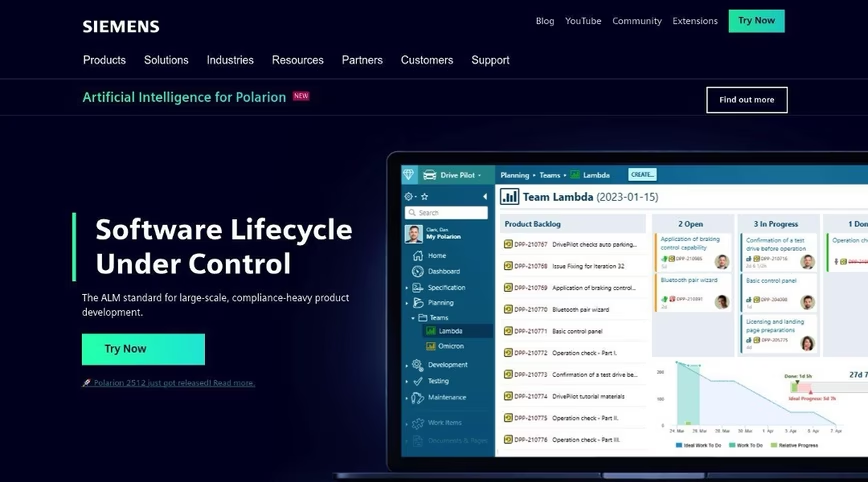
Siemens Polarion is an ALM platform that handles requirements management alongside test management, quality assurance, and change management. If your organization already runs Siemens Teamcenter for PLM and NX for CAD, Polarion consolidates requirements management into that ecosystem. That integration is its primary selling point.
For automotive suppliers working with OEMs who standardize on Siemens tools, Polarion can simplify the toolchain. The platform supports ASPICE process areas, and its document-centric views align with how many automotive organizations still structure their requirements documentation. Polarion X, the newest release, adds AI features and improved cybersecurity compliance support.
The OSLC integration framework allows connections with tools outside the Siemens family, though those integrations tend to work best within Siemens’s own product line.
Key features
- Requirements management with document-centric and item-centric views.
- Round-trip traceability between requirements, tests, and work items.
- Native connectivity to Teamcenter, NX, and the broader Siemens Digital Industries stack. ASPICE and ISO 26262 compliance support.
- OSLC-based integration framework.
- Variant management for product line engineering.
- Workflow customization and approval processes.
Pros
- Strong choice for organizations already running Siemens PLM and CAD tools.
- Document-centric views align with traditional automotive documentation practices.
- Comprehensive ALM coverage beyond requirements management.
- Variant management is useful for suppliers managing platform configurations across OEM customers.
Cons
- Steep learning curve, with users reporting substantial time needed to configure and learn the platform, above all without dedicated administrators.
- Integration with non-Siemens tools can be unreliable, which creates friction for suppliers whose OEM customers use different toolchains.
- G2 reviewers rate it below standalone RM tools on ease of use and support responsiveness.
5. IBM DOORS
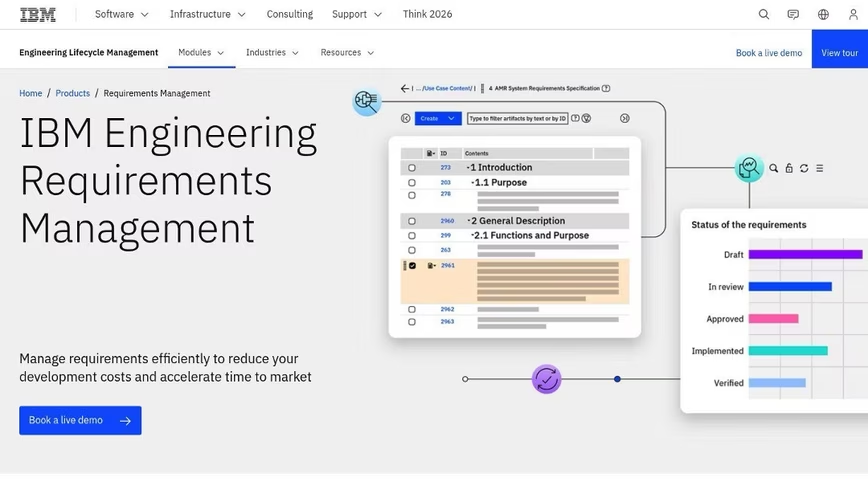
IBM DOORS Classic is the legacy incumbent in automotive requirements management. It’s been used in vehicle development programs for decades, and its installed base among large OEMs and defense-automotive crossover companies is massive. Many long-running programs have tens of thousands of requirements managed in DOORS, with traceability links and baselines built up over years of program execution.
For suppliers whose OEM customers mandate DOORS, the platform’s presence is hard to avoid. Requirements come in through DOORS, traceability evidence goes back through DOORS, and the OEM’s audit process assumes DOORS-format deliverables.
DOORS Classic uses a proprietary DXL scripting language for customization. Experienced administrators can build tailored workflows, but the expertise required is specialized and more and more hard to find. IBM also offers DOORS Next Generation (DNG), a web-based successor built on the Jazz platform. It shares the DOORS name but little else.
Key features
- Deep requirements management refined over decades of automotive use.
- DXL scripting language for extensive customization.
- Baseline management and version control. Massive installed base among OEMs and Tier 1 suppliers.
- OSLC integration framework for cross-tool traceability.
- ReqIF support for requirements interchange (DOORS Next).
Pros
- Proven track record across decades of major automotive programs.
- Accepted across OEM customers as a known platform.
- Large community of experienced administrators and consultants.
- Extensive customization capability through DXL scripting.
Cons
- Thick-client architecture isn’t web-native, limiting remote collaboration and modern deployment options.
- High administrative burden, requiring dedicated specialists who understand DXL scripting.
- IBM’s roadmap favors DOORS Next Generation, a ground-up rewrite with no migration path from Classic, leaving long-term Classic investment uncertain.
- The user interface reflects its age, and onboarding new engineers takes longer than modern platforms.
6. Valispace (Requirements Portal)
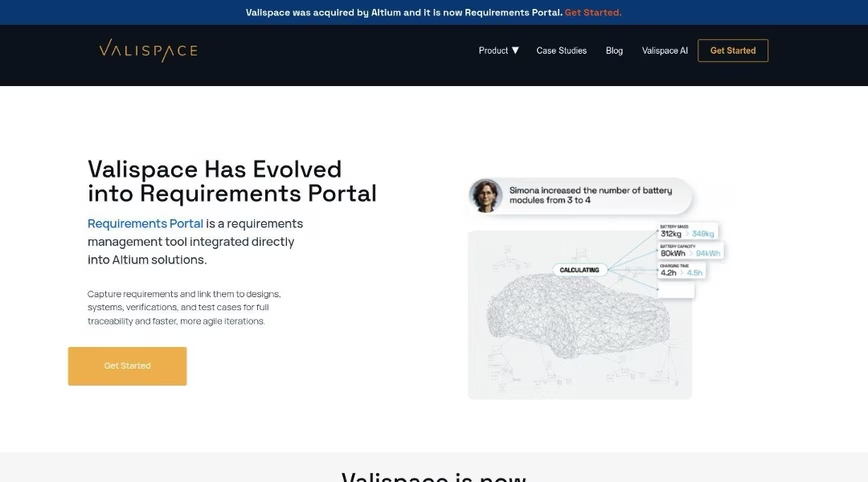
Valispace, now part of Altium (rebranded as Requirements Portal), takes a different approach by connecting requirements to engineering design parameters. Instead of managing requirements as standalone text items, the platform links them to live calculations, simulation data, and design values. When a design parameter changes, affected requirements surface at once.
For automotive teams doing early-phase systems engineering where requirements and design trade studies happen at the same time, that connection has value. The Requirements Portal provides a structured environment for managing requirements with traceability, and the Altium acquisition has given the platform access to a broader electronics design ecosystem.
The platform is known for fast setup and a modern interface. Teams can get started fast without extensive IT support or configuration projects.
Key features
- Requirements management with traceability and verification tracking.
- Direct linkage between requirements and engineering design parameters.
- Real-time calculation and simulation data integration.
- Version control and baseline management.
- Browser-based interface with collaborative editing.
- API access for integration with external tools.
Pros
- Unique requirements-to-design-data linkage fills a gap most RM tools don’t address.
- Fast setup compared to heavier enterprise platforms.
- Modern interface that reduces onboarding time.
- Good fit for early-phase trade studies where requirements and design evolve together.
Cons
- The platform is still maturing post-acquisition, and the long-term product roadmap under Altium is still taking shape.
- Narrower integration ecosystem than more established platforms, for automotive PLM and MBSE tools.
- Less proven in large-scale programs with the volume and complexity that major Tier 1 suppliers handle.
- Automotive-specific compliance frameworks (ISO 26262 TIMs, ASPICE process models) aren’t as mature as dedicated RM platforms.
7. ReqView
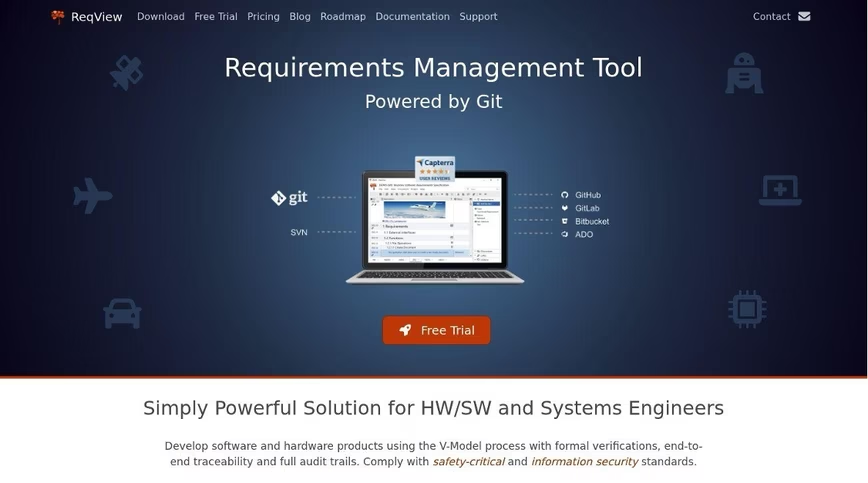
ReqView is a lightweight, desktop-based requirements management tool built for hardware and software engineers who need traceability without enterprise platform overhead. It supports the V-Model development process with formal verifications, end-to-end traceability, and audit trails. For small automotive suppliers who need a straightforward way to manage requirements and exchange them with OEM customers via ReqIF, it’s a practical option.
The tool uses Git or Subversion for version control, which appeals to engineering teams already comfortable with those systems. Document templates based on ISO/IEC/IEEE 29148 provide a structured starting point, and the filtering and traceability matrix views cover the basics.
ReqView is a good fit when a supplier’s requirements volume is modest and the compliance demands are manageable with a leaner tool. It’s not the right choice for programs with thousands of requirements and complex multi-tier traceability chains.
Key features
- Requirements editing with structured document templates.
- End-to-end traceability matrix.
- ReqIF import and export for requirements interchange.
- Git and Subversion version control integration.
- Filtering and custom views.
- Safety-critical standard compliance support (ISO 26262, IEC 61508).
Pros
- Simple, affordable option for small teams without enterprise budgets.
- ReqIF support enables requirements exchange with OEM customers using larger platforms.
- Git-based version control is familiar territory for software engineering teams.
- Fast to deploy with minimal IT infrastructure requirements.
Cons
- Very limited feature set compared to enterprise platforms, with no built-in test management, risk analysis, or review workflows.
- Desktop-only application limits collaboration across distributed supplier teams.
- Small independent company behind the product, which raises questions about long-term viability and support for large OEM-facing programs.
- No AI capabilities for requirements quality analysis or automated compliance checking.
What to use automotive requirements management tools for
| Use case | What it solves |
|---|---|
| Multi-OEM requirements intake | Suppliers receive requirements in different formats from different OEM customers. RM tools with ReqIF support let you import, manage, and trace those requirements in a single system instead of maintaining parallel spreadsheets. |
| ISO 26262 functional safety compliance | Every safety-relevant function needs documented traceability from system requirements through design, implementation, and verification. RM tools with preconfigured TIMs structure that traceability, so auditors see what they expect. Jama Connect provides TIMs built for ISO 26262. |
| ASPICE assessments | ASPICE process assessments evaluate how well your engineering processes are defined and followed. RM tools that map to ASPICE process areas help teams demonstrate process maturity without reconstructing evidence by hand before each assessment. |
| Supplier-OEM traceability evidence | OEM customers more and more require suppliers to demonstrate bidirectional traceability between requirements and verification results. Live traceability platforms like Jama Connect produce that evidence on a running basis, rather than forcing teams to assemble it on demand. |
| Change impact analysis | When an OEM changes a requirement mid-program, suppliers need to understand what downstream specifications, tests, and risk assessments are affected. RM tools with traceability links make that impact visible at once. |
| Software-defined vehicle development | Software-defined vehicle development requires separate cadences for software and hardware while maintaining coordinated releases. RM tools help teams decouple those cycles without losing traceability between software requirements and system-level specifications. |
What should you look for in automotive requirements management tools?
ReqIF support for supply chain exchange
This isn’t optional for suppliers. If you can’t import and export requirements in ReqIF format, you’re stuck translating by hand between your system and whatever your OEM customer uses. Look for roundtrip ReqIF exchange that preserves metadata, traceability links, and baselines across interactions. Jama Connect Interchange is purpose-built for this workflow.
Live traceability, not static reports
Every tool on this list claims traceability. The difference is whether that traceability updates on its own when requirements change or whether someone has to maintain the links by hand. Quantified traceability (like Jama Connect’s Trace Scores) goes further by measuring coverage completeness so you can identify gaps before an auditor does.
Preconfigured compliance frameworks
Setting up an ISO 26262 or ASPICE-compliant traceability structure from scratch takes months. Tools that provide preconfigured Traceability Information Models for automotive standards give teams a validated starting point, which matters when you’re staffing up for a new program and don’t have months to spend on tool configuration.
Scalability across multiple OEM programs
Suppliers don’t work on one program at a time. The tool you choose needs to handle multiple concurrent programs, each with its own OEM requirements, traceability chains, and deliverable formats. Ask how the platform manages multi-project environments and whether you can maintain separate traceability contexts for different customers.
Total cost of ownership
Licensing is only part of the picture. Factor in deployment costs, administrator time, training, integration development, and ongoing maintenance. Platforms that charge for reviewer access, API calls, or hosting add up fast when you’re managing programs with dozens of cross-company stakeholders. Jama Connect’s approach of including free reviewer access and no hosting or API fees simplifies that calculation.
Integration with your existing toolchain
Automotive engineering teams run MATLAB/Simulink, Enterprise Architect, Jira, Azure DevOps, and various PLM systems. Your RM tool needs to connect to whatever combination your programs use. Pay attention to the quality of those integrations, and whether they work in production rather than existing on a features page alone.
Choosing the best automotive requirements management software in 2026
Requirements management for automotive suppliers has a unique challenge that other industries don’t face at the same scale: the multi-OEM toolchain problem. Every customer has different tools, different formats, and different expectations for how traceability evidence gets delivered. The platform you choose determines whether that complexity stays manageable or becomes a constant source of rework and audit risk.
Jama Connect leads this comparison because it’s built for that supplier reality. Live Traceability with Trace Scores, ReqIF interchange for multi-OEM requirements exchange, preconfigured TIMs for every major automotive standard, and free reviewer access for cross-company collaboration address the specific problems automotive suppliers face every day. The platform’s adoption by 3 of the top 5 OEMs and 6 of the top 10 EV startups reinforces that positioning.
Other tools serve specific situations well. Codebeamer fits software-centric supplier teams that want ALM breadth. Polarion makes sense when the Siemens ecosystem is already in place. IBM DOORS remains relevant where OEM mandates require it. On the other hand, smaller tools like ReqView fill a niche for teams whose requirements volumes don’t justify enterprise platform costs.
Whatever you choose, prioritize three capabilities above everything else: ReqIF exchange for supply chain interoperability, live traceability that updates on its own, and preconfigured compliance frameworks that get you audit-ready without months of setup.
Frequently asked questions
What’s the difference between requirements management and ALM for automotive?
Requirements management focuses on capturing, structuring, tracing, and verifying requirements throughout the product lifecycle. ALM (application lifecycle management) is broader, covering requirements alongside software development workflows like sprint planning, code management, and defect tracking. For automotive suppliers, the distinction matters because ALM platforms may prioritize software development over systems engineering rigor. Dedicated RM platforms like Jama Connect tend to deliver deeper traceability and compliance capabilities for safety-critical programs.
Why is ReqIF important for automotive suppliers?
ReqIF (Requirements Interchange Format) is the industry standard for exchanging requirements between different tools. Automotive suppliers work with multiple OEM customers, each using different RM platforms. Without ReqIF support, suppliers end up copying requirements between systems by hand, which introduces errors and breaks traceability. Jama Connect Interchange is designed for lossless, roundtrip ReqIF exchange that preserves metadata and traceability links.
How do Trace Scores help with ASPICE assessments?
ASPICE assessments evaluate the maturity of your engineering processes, including how well requirements are traced through design, implementation, and testing. Trace Scores in Jama Connect assign a numeric grade to every traceability link in your project. Coverage, quality, and verification status each get their own score. Teams walk into assessments with live dashboards that pinpoint where coverage is solid and where gaps still exist, rather than assembling that evidence from scratch.
Can suppliers use one RM tool across multiple OEM programs?
Yes, and that’s one of the key evaluation criteria. Platforms like Jama Connect support multi-project environments where suppliers maintain separate traceability contexts for each OEM customer while managing everything in a single instance. The ReqIF interchange capability allows each OEM’s requirements to flow in and out in whatever format that customer needs, without forcing the supplier to run multiple tool instances.
What automotive standards should an RM tool support?
At minimum, look for ISO 26262 (functional safety), ASPICE (process assessment), and ISO/SAE 21434 (cybersecurity). Depending on your programs, you may also need support for SOTIF (ISO/PAS 21448), MISRA coding standards, and IEC 60812 for FMEA methodology. Jama Connect provides preconfigured Traceability Information Models for ISO 26262, ASPICE, ISO/SAE 21434, and SOTIF.
How does software-defined vehicle development affect requirements management?
SDV development means software update cycles move faster than hardware cycles. Suppliers need RM tools that support decoupled software and hardware development while maintaining coordinated traceability across both. The requirements for a braking ECU’s software might change monthly through over-the-air updates, while the hardware requirements change annually. RM platforms need to handle that cadence mismatch without breaking traceability links.
Do all automotive RM tools integrate with MATLAB/Simulink?
No. MATLAB/Simulink integration varies across platforms. Jama Connect offers direct integration for model-based design workflows, connecting Simulink models to requirements and traceability chains. Some ALM platforms support it through third-party connectors, and lightweight tools like ReqView don’t support it at all. If your team relies on model-based design, test the actual integration quality rather than relying on features pages.
Get the TNW newsletter
Get the most important tech news in your inbox each week.
Sponsored content. Not produced by the TNW newsroom and does not reflect the editorial stance of TNW. This listing is not an independent editorial ranking.


