
Calorie Tracking Apps
 Credit: Canva
Back in the mid-2000s, calorie and macro tracking was a niche practice. You weighed your food, looked it up in a database, and wrote down how many calories and how many grams of protein, fat, and carbohydrates you were eating each day. It was the domain of bodybuilders, strength athletes, and competitors trying to stay inside a weight class.
Then, somewhere in the early to mid-2010s, social media, and YouTube in particular, pulled it into the mainstream. Gym enthusiasts who wanted to look like their favourite fitness influencer started tracking too, and by then there were a handful of apps on the market. What they didn’t do was make it much easier. Logging was still slow and monotonous, and it felt like something that was never going to be for everyone.
That changed in the years after COVID-19, and above all with the arrival of AI. Calorie tracking found a much bigger audience outside the usual gym crowd, and the industry moved to make the practice faster, more accessible, and easier to fit into any daily routine. That push towards accessibility and personalisation is where the real competition now sits, and some companies have gone further with it than others.
Of course, not every calorie tracking app available today, or every app that wears the AI label, is doing something genuinely new. So here are five apps that are actually pushing calorie tracking forward this year, and what each one is really innovating on.
Fitia
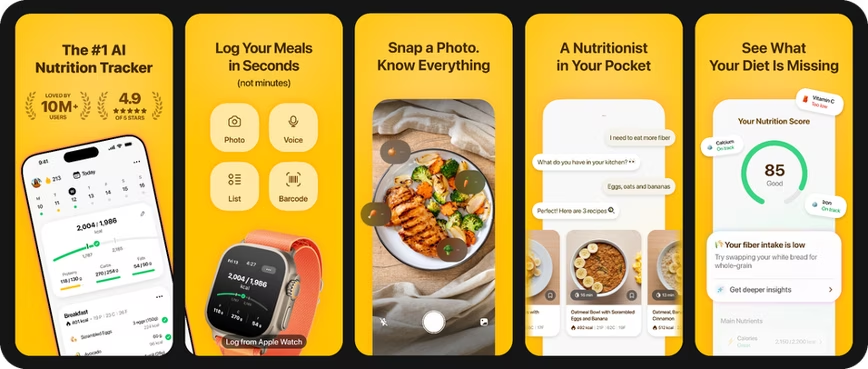
If there’s an app that captures both the accuracy of traditional trackers and the faster food logging of today, it’s Fitia. It entered the market in 2019, built on the premise of personalised meal plans paired with calorie tracking that pulls from a database built in-house by nutrition professionals.
Later it deepened both the tracking and meal planning sides of the app, and adopted AI to expand the ways users can log their meals. You can take a picture of your food and have the app calculate the calories, speak into the microphone, or write out what you ate in a list, the way you would when texting a friend.
In 2026, Fitia has brought new innovations for its users, including a 24/7 AI Coach that can answer any nutrition question, build recipes, and comment on diet quality. There’s also a complete Social Hub where users share pictures and posts, chat with each other, and compete in groups for motivation.
But the most important feature Fitia has brought so far this year is the new AI meal planner, which builds entire weeks of meal plans based on a user’s goal, diet style, food preferences, favourite recipes, and health conditions such as diabetes, hypertension, hypothyroidism, and insulin resistance.
Women can also select pregnancy or breastfeeding, allowing the app to adjust their macros and meal plans to better support their nutritional and hormonal needs.
Noom
When Noom entered the market it brought a psychological approach that few competitors had at the time. The app focused on behaviour change through food selection and personal coaching, with calorie tracking layered on top.
In 2026 Noom has implemented AI and general medical advances to deepen those aspects of the app, including AI coaching and GLP-1 programmes for qualified users.
It also has a Body Scan that uses your phone’s camera to create a 3D avatar of your body and estimate body fat percentage, lean mass, and measurements like waist, hips, and chest, with no special equipment needed. Noom reports a precision error of about ±0.50% for body fat percentage. Paired with GLP-1 medications, this gives users a way to watch lean mass retention during a fat loss phase, and a fuller picture of what their diet is actually doing to their body.
Cal AI
When talking about innovation in the calorie tracking industry, we cannot leave out Cal AI. It was an early mover in using an LLM to analyse food in a picture and estimate its calorie and macronutrient content. More importantly, its heavy push on influencer marketing brought calorie tracking to even broader audiences and opened marketing opportunities for the rest of the apps. Cal AI didn’t invent food photo recognition, but it stripped the process down further than anyone else and proved a mainstream audience wanted logging to be that fast.
Although by 2026 most of Cal AI’s competitors have adopted photo tracking, its know-how was substantial enough to catch the attention of arguably the biggest player in the market, MyFitnessPal, prompting a full buyout of the company earlier this year.
MacroFactor
MacroFactor was a pioneer in adaptive targets. Its proprietary algorithm calculates your calorie expenditure from what you log and how your weight is trending, then adjusts your calorie and macro targets on its own when progress stalls.
By this year, MacroFactor has also adopted AI for faster logging, innovating on the photo tracker by letting users combine a picture with a description of what they ate. And although the adaptive algorithm is no longer the differentiator it was a couple of years ago, its team still keeps working on it based on current research.
MyFitnessPal
MyFitnessPal has been around since 2005, long enough to build one of the biggest communities in the market and turn itself into a calorie tracking giant. Ironically, the app that once set the rhythm of the industry has spent these past years running to catch up with it.
Its main strategy has been to buy what it was missing. In just over a year it picked up the meal-planning app Intent, launched a ChatGPT Health integration, and acquired Cal AI, the viral photo-logging app mentioned above, in a deal finalised in December 2025 and announced in March 2026.
Its internal team has been busy too, deploying a major update in April of this year with a redesigned interface and an AI Nutrition Coach. The update drew some user backlash, but the intent behind it signals that the giant, however slowly, is still taking steps forward like any other app on this list.
Is AI the Only Route to Innovation?
Not exactly. The apps moving this category forward in 2026 have definitely leveraged AI as the main tool to innovate, but they stand out because they pair it with something that makes it trustworthy and effective, whether that’s a verified database, behavioural science, a science-based algorithm, or a simplicity-first approach.
Look closely and they share something else. Fitia builds around your health conditions and preferences, MacroFactor recalibrates to your weight trend, Noom works with your behaviour. The tool bends towards the person using it.
Plain calorie counting may keep its place with people who are used to how things were in the past, but reaching a wider audience demands accessibility and personalisation. So next time you look for a calorie tracker on the market, check whether it’s the kind of tool that forces you to adapt to it, or one that adapts to what you actually need.
Get the TNW newsletter
Get the most important tech news in your inbox each week.
This article was paid for and provided by Fitia and published by TNW Studio. The TNW newsroom was not involved in its creation.


