 Credit: Offworld Industries
On 6 August 1991, a British scientist at CERN posted a quiet note to an internet newsgroup. Tim Berners-Lee wanted a way to store and link documents so his colleagues could find each other’s work. He called it the world wide web. “We are very interested in spreading the web to other areas,” he wrote, in what has to rank among the great understatements of the century.
Thirty-five years on, the web is how most of the planet works, shops, argues, and falls in love. It also, by its creator’s own account, lost its way. Speaking to The Guardian last year, Berners-Lee lamented “a handful of large platforms harvesting users’ private data” and algorithms “addictive by design.” Trading personal data for access, he said, “certainly does not fit with my vision for a free web.”
From documents to destinations
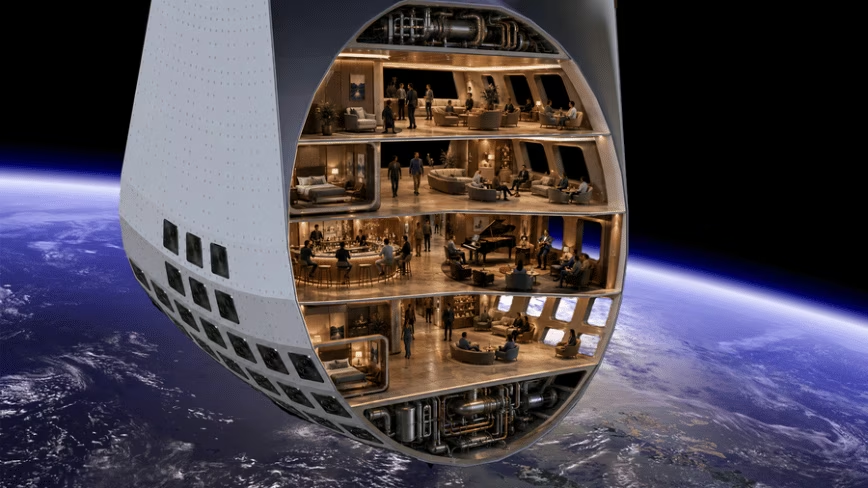
Here is the part that would have sounded like pure science fiction in 1991. While the web marked its birthday, an American firm called Offworld Industries said it had gone to Tokyo to talk about building things in space. Not satellites. Hotels.
The company, run by longtime space-habitat evangelist John Blincow, said its CEO had returned from an “exploratory meeting” at construction giant Kajima’s headquarters, alongside people linked to Japan’s space agency JAXA and Nippon Travel Agency.
On the table, per its announcement: rotating stations that spin to fake gravity, orbital hotels, spacecraft maintenance yards, fuel depots, and even human-tended orbital data centres.
“Every serious space economy eventually becomes a construction economy,” Blincow said. “Launch gets us to orbit. Construction determines what we can do once we arrive.”
Before you book a room
Now the caveats, and there are a few. No joint venture, contract, or partnership was announced. It was a meeting, followed by a press release, which is not the same as a girder in orbit. Blincow has pitched grand rotating stations before, and the timelines tend to slip.
A holiday in low Earth orbit remains, for now, a very expensive maybe.
The direction of travel is real, though. SpaceX has told investors it wants to manufacture in space too. Not everyone is sold: SoftBank’s Masayoshi Son has dismissed the orbital-data-centre idea outright. Serious money is still edging toward a bet that the next great infrastructure will not sit on land at all.
It’s not too late
Berners-Lee ended his own birthday message on a hopeful note. “We can re-empower individuals, and take the web back,” he said. “It’s not too late.” The web went from a free commons to something a few companies largely own, inside a single human lifetime.
The space economy, by contrast, is being built by private capital from its very first day. Whether orbit turns out more open than the web did is anyone’s guess.
But it makes for a strangely fitting birthday thought: the thing Berners-Lee gave away for nothing is now the cautionary tale everyone is trying not to repeat, 400 kilometres up.
Get the TNW newsletter
Get the most important tech news in your inbox each week.


