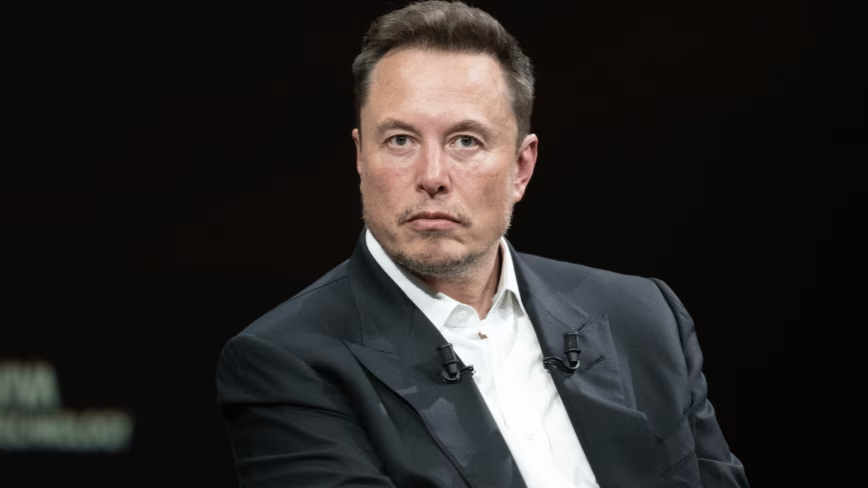
Elon Musk at VIVA Technology (VivaTech) in Paris, France on June 16, 2023.
 Credit: Frederic Legrand - COMEO / Shutterstock
“Money doesn’t matter,” Elon Musk said last week. Days later he launched a payments service, X Money, and described himself as a “former trillionaire”. The market had just proved his first point in the least flattering way.
SpaceX’s post-IPO rout has left Musk poorer than he was before the company floated, Fortune reported. His wealth peaked near $1.33tn on 16 June. It now stands at about $684bn, a fall of more than $600bn in barely a month.
The share price tells the same story. SpaceX reached a closing high of $201.80 on 16 June, then fell 46% to a record low near $108. A 17% slide in Tesla since its July earnings has added to the damage. The paper trillions the listing created have largely gone.
Two hard tests are coming
The timing could hardly be worse. Next week SpaceX reports its first set of results as a public company. Bigger still, as many as 911.5 million insider shares begin unlocking next month, threatening fresh downward pressure.
Short sellers are already circling. Bets against the stock have jumped to about 219 million shares, close to ten times the level in mid-June, and more than a third of the stock free to trade. Earnings will test whether the business is growing into its valuation. The unlock will test whether early insiders want to hold on.
The slide has a clear cause. As the AI trade wobbled and chip stocks sold off, investors backed away from the riskiest names. Few are riskier than a rocket company valued partly on an AI business it has barely begun. Morgan Stanley has argued that around $100 a share, the market is pricing that AI arm at nothing, Bloomberg reported.
The bull case has not gone away
None of this settles the argument. SpaceX still dominates launch, Starlink is still growing, and Musk still tells investors the company is on track for $1tn in revenue by 2030. The flotation that made him the first trillionaire on paper did so for a reason.
Musk is hedging on more than one front, too. He is reportedly weighing a sale of Tesla’s China business to clear the way for a possible merger with SpaceX, a deal some analysts think would make sense. He has also said he will give much of his fortune away, telling a Nobel economist he would “do something along these lines”.
A number in search of a floor
For now the story is simpler than any of that. A company that debuted as the largest IPO in history, and briefly made its founder the richest person alive, is being marked back to earth. Whether this is a correction or the start of a longer reckoning is what the next few weeks begin to answer.
Musk, at least, has his line ready. If money does not matter, a smaller fortune should not sting. The market is about to find out how much he means it.
Get the TNW newsletter
Get the most important tech news in your inbox each week.


