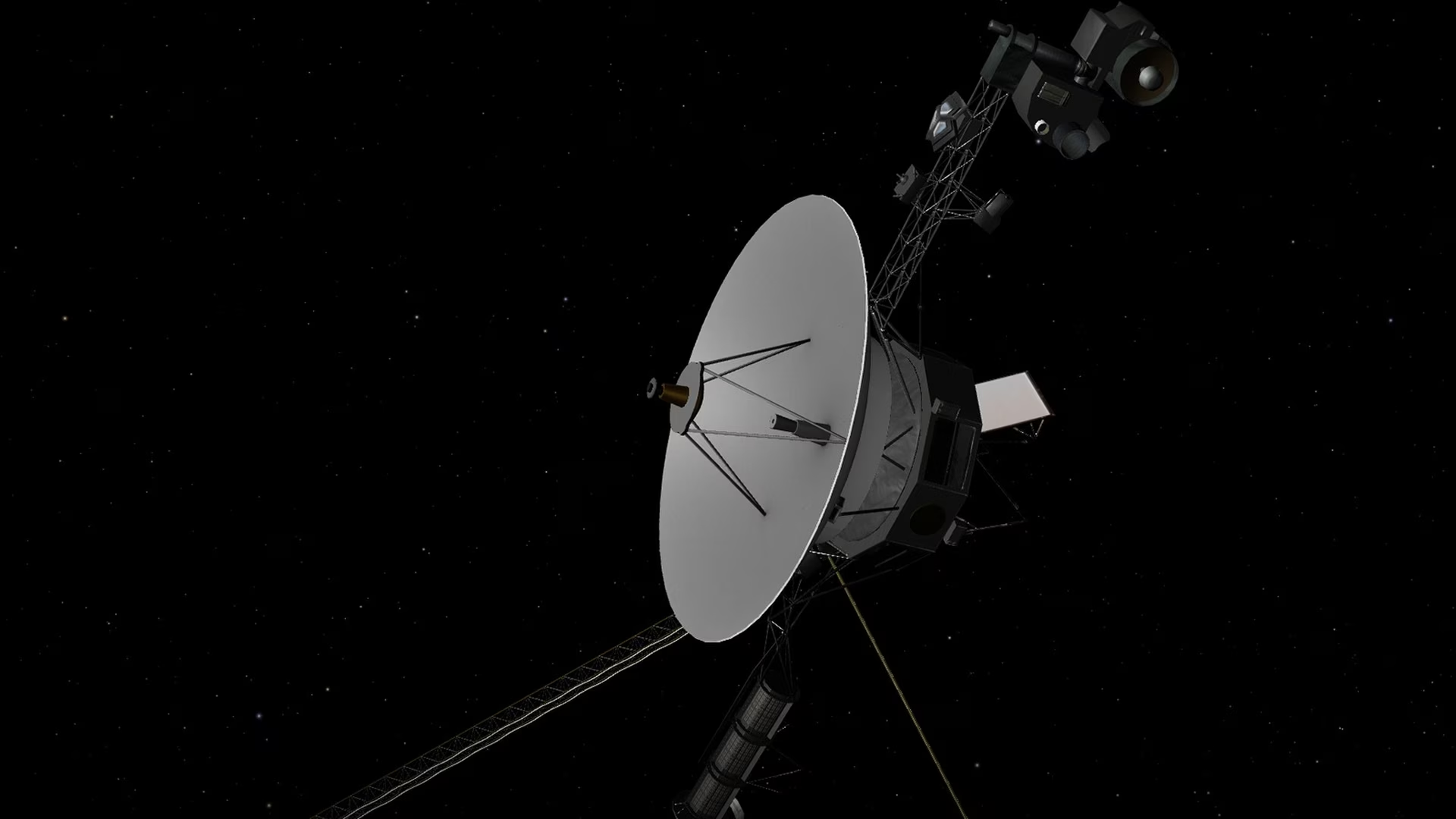
An illustration of a Voyager spacecraft in deep space
 Credit: NASA/JPL-Caltech
NASA’s Voyager 1 is now one light-day from Earth, the first human-made object to get that far. The probe was due to cross the line at 5:16am Eastern time on Wednesday, 18 November, according to NASA. That puts it about 25.9bn km (16.1bn miles) away, the distance light travels in 24 hours.
A radio signal now takes a full day to reach Voyager 1, and another day to come back. NASA will only confirm the exact time it crossed the mark on Thursday, when the probe’s reply arrives, Engadget reported.
“If you want to say ‘hello’ to Voyager, you send your message and then you go home and you wait two days before you finally get a response,” said Suzanne Dodd, Voyager project manager at NASA’s Jet Propulsion Laboratory.
49 years, two months and 11 days
Voyager 1 launched on 5 September 1977, 16 days after its twin, Voyager 2. It flew past Jupiter in 1979 and Saturn and its moon Titan in 1980. In 2012 it became the first spacecraft to reach interstellar space.
It is cruising at nearly 61,000 km/h towards Gliese 445, a star about 17 light-years away in the constellation Ursa Minor. NASA expects it to pass within 1.7 light-years of the star in about 40,000 years. Voyager 2 took a different route, past Uranus and Neptune, and should reach one light-day in November 2035.
“It’s never happened before, and it may never happen again,” said Kareem Badaruddin, Voyager mission manager.
Two instruments still working
Voyager 1 runs on nuclear generators that turn heat from decaying plutonium into power, and the supply shrinks every year. NASA has switched off most of its instruments to save power. Only the magnetometer and the plasma wave instrument are still on, according to NASA’s mission status page.
Garry Hunt, a member of Voyager’s original imaging team, put its long life down to proven hardware and backups, The Register reported.
“If anything goes wrong, it automatically switches to a backup. So there was always a backup. There was always a safe mode,” Hunt said.
To mark the milestone, NASA asked people to flash Voyager’s call sign, V-G-R, at the sky in Morse code after sunset on Tuesday.
The record on board
Voyager 1 still carries its Golden Record of sounds and images from Earth. Historian Glen Swanson has found that its designers repeated the playing instructions on the inside of the record’s cover, in case the outside wore away, Ars Technica reported. Swanson also found that NASA had 10 extra copies made after the launches.
Elsewhere in space this week, SpaceX caught a Starship upper stage, while a Vulcan rocket failure cost Amazon a batch of Leo satellites. NASA is also asking companies how to keep Hubble flying.
Get the TNW newsletter
Get the most important tech news in your inbox each week.


