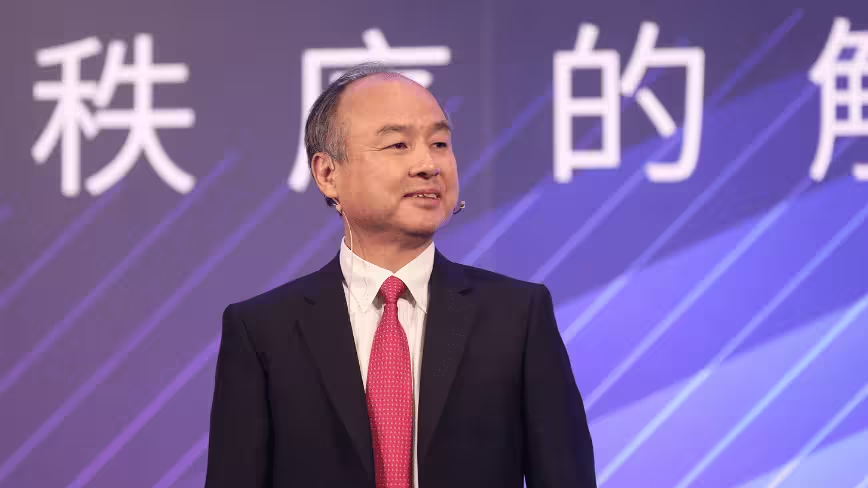
SoftBank founder and CEO Masayoshi Son on stage in Taipei, 22 June 2019.
 Credit: glen photo via Shutterstock.com
Masayoshi Son does not think the future of artificial intelligence is in orbit. The SoftBank Group founder told shareholders on 23 June 2026 that there is little merit in building data centres in space, the idea Elon Musk has been championing, and predicted the AI race would be won by compute kept firmly on the ground.
Son made the comments at the annual meeting of SoftBank’s mobile unit, according to Bloomberg, and his case rested on a piece of cost arithmetic rather than any objection to ambition.
The single advantage an orbital data centre offers, he argued, is cheaper electricity, beamed straight from solar panels with no atmosphere in the way.
But power, he noted, is a small slice of what it costs to run a data centre. The expensive part is the hardware, the chips above all.
Whatever a company saved on electricity in space, Son said, it would hand straight back in the cost of hauling everything up there, then maintaining it, then living with the communication delays that come from operating servers hundreds of kilometres overhead.
The savings are real but trivial; the penalties are real and large. Seen that way, the ledger does not balance.
His timeline matters as much as his maths. “In the battle for AI, the next few years will be far more important than what might happen a decade or so from now,” Son said, a remark reported by Seeking Alpha.
Space data centres are, by any reading, a long-horizon project. Son is betting the war will be decided long before the satellites are ready to fight it.
The target of his scepticism was not named at length, but the idea is closely associated with Musk, who has floated launching vast constellations of orbital data centres, and with Jeff Bezos, who has talked up similar plans.
The pitch in both cases is that space offers constant sunlight and no neighbours to complain about heat, water, or noise, the constraints that increasingly hem in terrestrial sites.
SpaceX itself has acknowledged the hurdles, with one filing flagging that orbital data centres may not prove viable.
Son’s caution is striking given his own appetite for grand technological wagers, and his comments add a heavyweight voice to a chorus of scientists questioning the physics of cooling and powering computers in vacuum.
The heat a dense cluster of chips throws off has to go somewhere, and in space, with no air to carry it away, getting rid of it is a genuinely hard problem, the kind that tends not to feature in the launch-day renderings.
For all that, the orbital pitch keeps resurfacing because the terrestrial alternative is straining.
Data centres on Earth are colliding with limits on grid capacity, water, and land, which is why space has been floated as a fix for AI’s energy problem at all. Son’s answer is that the fix is more expensive than the problem, at least on the timescale that counts.
There is a competitive edge to the timing, too. SoftBank has poured money into AI through its Vision Fund and its stake in Arm, and Son has tied his legacy to getting the technology right in the present rather than the distant future.
A rival who spends the next few years lofting servers into orbit is, on his reading, a rival distracted from the contest that actually counts. The message doubles as a warning that the moonshot risks missing the moment.
SoftBank has not detailed any shift in its own infrastructure plans on the back of the remarks, and Son was speaking to investors rather than announcing a strategy.
Get the TNW newsletter
Get the most important tech news in your inbox each week.


