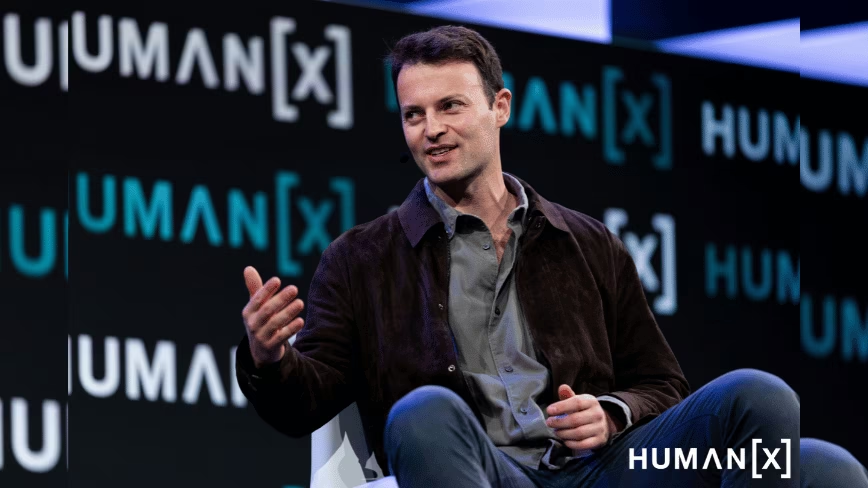
Wayve co-founder and CEO Alex Kendall at HumanX in Amsterdam, 23 September 2026.
 Credit: ALX MEDIA / HumanX
“It’s going to take them a while. Maybe they don’t know that yet,” Wayve co-founder and CEO Alex Kendall said of humanoid robot makers.
Kendall spoke on stage at HumanX in Amsterdam on Wednesday. It was a day after Wayve announced a global partnership with Mercedes-Benz. He said self-driving cars, not robots, will be the first physical AI to reach the scale of ChatGPT.
Kendall said Wayve’s AI will be in Mercedes consumer cars within the next two years. He would not give an exact date. Mercedes is the third top-10 carmaker in nine months to put Wayve’s software into its production plans. Nissan and Stellantis came first.
What the Mercedes deal needs next
Wayve released videos on Wednesday of prototype cars on Mercedes production hardware, driving in London, Stuttgart and San Francisco. The system now runs on small, low-compute computers, Kendall said. It uses the cameras and radar found in mass-produced cars.
The work now is production integration, he said. That means latency, safety targets and making the software work with every other part of the car. He was due in Stuttgart on Thursday to meet the Mercedes team.
“The gap between a demo of physical AI and an actual production product is immense,” Kendall said.
The Mercedes deal follows the supervised robotaxi service Wayve launched in London with Uber. Kendall said Wayve will launch a similar service in Tokyo by the end of the year. The London robotaxi service runs with a safety driver in every car. It did not use Britain’s driverless permit route.
Licensing, not building cars
Wayve trains one foundation model with end-to-end deep learning and licenses it to carmakers and fleet operators. Kendall said the model has driven in more than 500 cities. He contrasted this with Tesla, which builds its own cars and is about 1% of the car market, he said.
“We want to provide this to every other vehicle out there,” he said.
Carmakers choose their own sensors, computers and design. They can also set the car’s driving style, such as how hard it brakes, by instructing the model, Kendall said. In return, partners share driving data. Wayve uses it to train at a scale no single company could reach, he said.
He listed what still makes the work hard. Physical products need a cycle of design, manufacture and deployment that he called largely incompressible. Wayve uses Gaia, its world model, to simulate complex driving scenes. The system also has to handle what it has never seen. Kendall’s examples were roads north of the Arctic Circle in Sweden, flooded streets and unfamiliar signs in rural Japan.
Cars first, then robots
Moderator Sharon Goldman of Ground Level AI raised a claim by Nvidia CEO Jensen Huang. This spring, Huang said physical AI had reached its “ChatGPT moment”. Kendall said not yet, because a hundred million people do not use physical AI today.
He expects business uses before consumer ones, and mobility before robot arms. Robots that handle objects are at the demo stage, he said. They work 20% to 50% of the time on custom prototype hardware. That is where driving was five years ago, according to Kendall.
He said fewer than 10,000 robotaxis exist worldwide, while about 100 million cars are sold each year. He also said UN technical rules passed earlier this year allow autonomy in consumer vehicles around the world.
Wayve’s goal has not changed since 2017, Kendall said. It wants a general-purpose, Level 5 system that can take liability for driving anywhere. It should work on any vehicle, with $1,000 of hardware.
Get the TNW newsletter
Get the most important tech news in your inbox each week.


