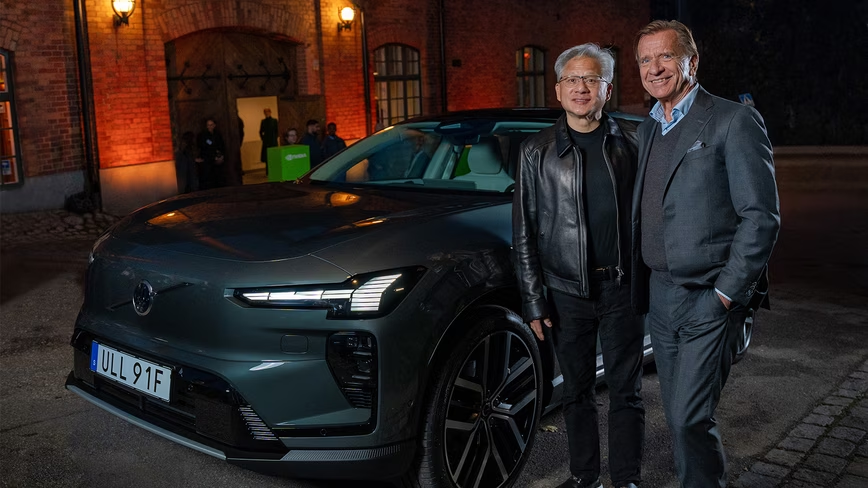
Nvidia chief executive Jensen Huang (left) and Volvo Cars chief executive Håkan Samuelsson with a Volvo car

Mercedes-Benz will develop its next generation of driver assistance and automated driving systems with Nvidia, the two companies said on Friday. The announcement came a day after Volvo Cars expanded its own Nvidia partnership for automated driving.
Both carmakers will build on the same Nvidia self-driving stack. It combines the Hyperion computer and sensor architecture, the Alpamayo Stack driving software and the Halos safety system. Nvidia opened up Alpamayo 2, a driving model that explains its reasoning, in August.
Mercedes aims for robolimousines
In the joint announcement, the companies said Mercedes’ MB.OS operating system will work with Hyperion’s in-car computer and sensors. Alpamayo provides point-to-point assistance in cities, active safety and automated parking. Halos adds a parallel safety stack for redundancy and guardrails.
Together, the systems support the development of future SAE Level 4 applications, including robolimousines, the companies said. At Level 4, a car drives itself without a human taking over, within set conditions.
“NVIDIA is our most important strategic partner in automated driving,” said Jörg Burzer, Mercedes-Benz’s chief technology officer.
Burzer said the two companies built Mercedes’ first urban point-to-point assistance system for the western world. Mercedes says on its website that urban point-to-point navigation is due in selected German cities by the end of 2026. It also lists a robotaxi plan built on the new S-Class, with partners including Nvidia and Momenta.
Mercedes works with more than one AI driver. In September, London’s Wayve signed a deal to put its AI Driver into future Mercedes cars for point-to-point driving assistance within two years.
Beyond driving, Mercedes uses Nvidia technology for vehicle engineering simulation and in MO360, its digital production ecosystem.
Volvo plans eyes-off driving
Volvo announced its expanded deal on Thursday. In its release, it said the technology will let future Volvo cars drive door to door. That covers motorways, busy city streets and car parks.
It will debut in a next-generation Volvo, Volvo said, without naming the model. That car is part of the company’s largest-ever product push: 13 new cars by the end of 2030, announced in September. Volvo said it will introduce eyes-off and mind-off driving gradually.
“Volvo has been synonymous with car safety for almost 100 years,” said Håkan Samuelsson, Volvo Cars’ chief executive.
“Together, we’re combining Volvo’s extraordinary vehicle safety systems with NVIDIA Hyperion and Halos to build a new generation of cars that make driving safer and more effortless,” said Jensen Huang, Nvidia’s founder and chief executive.
Volvo and Nvidia have worked together since 2017. Samuelsson will hand over to Klaus Zellmer no later than October 2027.
Neither carmaker gave a launch date or said which models will get the systems first. Mercedes framed its plans as covering the next decade.
Get the TNW newsletter
Get the most important tech news in your inbox each week.


