TL;DR
Uber and Wayve began carrying paying passengers in London on 3 September with a licensed driver in every car. The reason is the legal route they chose: TfL licensed the vehicles as private hire vehicles, which legally requires a human in the driver’s seat, rather than through the Automated Passenger Services permit scheme that has allowed driverless trials since 15 May. No operator has completed even stage one of that permit process in London.
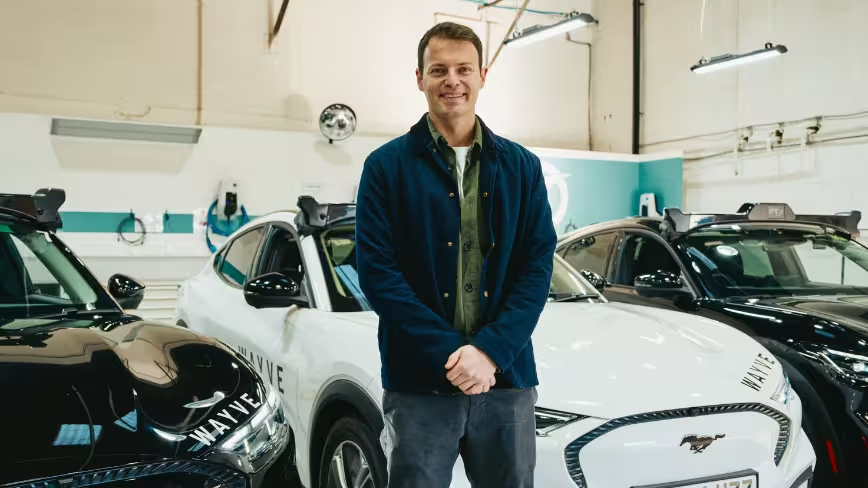
Uber and Wayve began carrying paying passengers in London on 3 September, in what Wayve described in a statement as the UK’s first autonomous ride-hailing service. Every car has a trained, TfL-licensed private hire driver on board.
Olivia Solon rode one on a wet morning this week and summarised the experience for Bloomberg as autonomous rides with hands still hovering over the steering wheel. That is the accurate description, and the reason is legal rather than technical.
Two doors into the same city
Britain now has two separate ways to put a self-driving taxi on a public road, and they carry different obligations. Wayve and Uber went through the older one.
Transport for London licensed the vehicles as private hire vehicles, not as automated vehicles. Under that route a licensed driver must occupy the driver’s seat, remain ready to intervene and stay legally responsible for the car throughout every journey, even while software is doing the driving.
The other door opened on 15 May. Part 5 of the Automated Vehicles Act 2024 came into force alongside the Automated Passenger Services permit regulations, creating a scheme run by the Driver and Vehicle Standards Agency that expressly allows trials with or without a safety driver.
The permit nobody has finished
Here is the detail that explains the year. No operator has completed even the first stage of the APS approval process in London, which is why the capital’s first robotaxi service arrived on private hire plates.
The government and parts of the industry suggested during the spring that fully driverless cars for hire could be carrying Londoners by the end of 2026. On the current state of the permit process that looks unlikely, with the Department for Transport working towards a broader framework in 2027 and full implementation of the Act scheduled for the second half of that year.
So the constraint is not that Britain forgot to legislate. The route exists, and the first mover chose the version that ships sooner.
Why that is a defensible choice
Launching on private hire plates is not a fudge, and it has real advantages. It puts vehicles on real roads with real passengers now, generating exactly the operational record an APS application will eventually need.
It also lets the commercial machinery start. Riders requesting an UberX, Uber Electric or Uber Comfort can be matched to a Wayve car at no extra cost, and Wayve says more than 140,000 Londoners have already opted in through the app’s trip preferences.
Demand was evident well before launch, and a supervised service converts that interest into data. The fleet is small, at 15 vehicles, covering everywhere in London except the airports.
The technical claim underneath
Wayve’s pitch is that its approach makes a city like London tractable in the first place. Its AI Driver learns from experience rather than depending on HD maps and hand-coded rules, which is the difference it markets as AV2.0.
“London, our home city and one of the most complex driving environments in the world,” chief executive Alex Kendall said in the announcement, framing the launch as the start of a global rollout with Uber. The company has trained on the capital’s roads since 2018.
That mapless approach is what makes the international plan coherent. Wayve raised roughly $1.5bn in a Series D that valued it near $8.6bn, on the promise of generalising across cities rather than surveying each one.
The comparison arriving shortly
The interesting test is not Wayve against its own timeline. It is Wayve against a competitor entering the same city on the other legal route.
Waymo has been planning a London service and has signalled its cars may carry no driver from the start, which would require the APS process Wayve has not used. It already runs fully driverless in more than a dozen American cities.
If both operate in London next year, the city becomes a live comparison between a supervised service scaling on commercial plates and a driverless one gated on a permit. Uber’s platform strategy assumes it can host whichever wins.
What the driver actually signals
Be careful about reading the safety driver as a verdict on the software. Under PHV licensing the human is mandatory regardless of how good the system is, so their presence tells you about the paperwork rather than the performance.
What it does signal is sequencing. Wayve and Uber judged that starting supervised in 2026 beats waiting for a permit that would let them start unsupervised later.
The rollout is deliberately incremental, growing in line with demand, readiness and regulation on the companies’ own account. Tokyo follows with Nissan later this year, under a different regulator again.
What to watch
The number that matters is not fleet size but interventions. A supervised service generates a disengagement record, and the credibility of any future APS application rests on it.
Watch also for who files first. The moment an operator clears stage one of the DVSA process, the London story changes from how well the software drives to whether a regulator will accept it without a human in the seat.
Until then, London has a commercial robotaxi service in the ordinary sense and a supervised one in the legal sense. The safety driver in every car is the gap between those two descriptions.


 Credit: Wayve