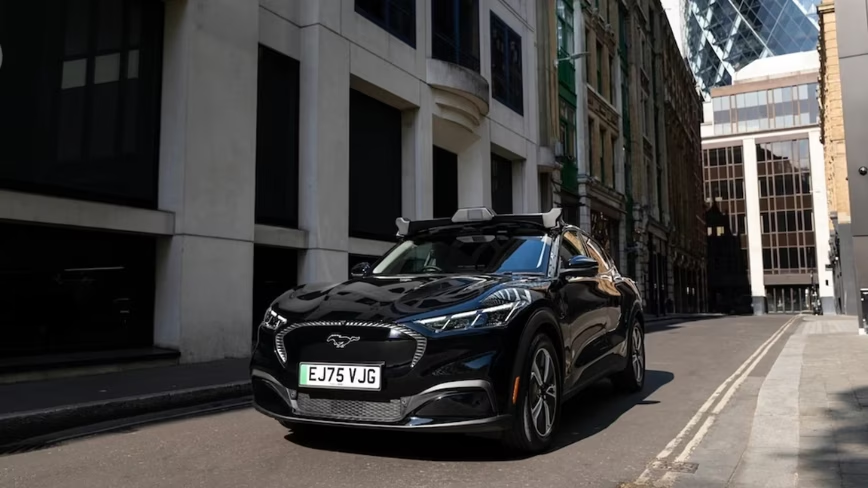
A self-driving Ford Mustang Mach-E used for Uber and Wayve’s robotaxi service in London.
 Credit: Uber
London has its first robotaxi service, and there is a person sitting behind the wheel of every car. Uber and Wayve began carrying passengers on Thursday in a fleet of Ford Mustang Mach-Es, each one supervised by a licensed driver who can take over.
Uber owns and operates the vehicles while Wayve, the British company founded in Cambridge, supplies the driving software.
The service has been coming for a while. Uber opened a London waitlist in June, and most of what has happened since has been regulatory rather than technical.
The fleet is deliberately small. Uber is starting with fewer than 20 cars, and Transport for London approved up to 15 on a one-year trial when it granted the permissions in August.
What TfL actually licensed is the detail that shapes everything else. The modified Wayve cars were approved as private hire vehicles rather than as automated vehicles, which means a licensed PHV driver has to be aboard and legally responsible for the car throughout every journey.
Removing that person requires a different permission entirely. An Automated Passenger Services permit, issued through the Driver and Vehicle Standards Agency under the Automated Vehicles Act, is a separate process that neither company has completed.
Uber is not putting a date on it. “That process is still playing out,” said Sarfraz Maredia, the company’s head of autonomous mobility, who also confirmed the fleet would grow over time.
Riders cannot ask for one. Fares are the same as any other Uber; passengers get matched with a robotaxi rather than requesting it and can decline the trip, and the app skips the tipping prompt.
The regulator has framed its involvement carefully. “Safety is our top priority. Any new vehicle licensed to carry passengers on London’s roads must align with our Vision Zero goal,” a TfL spokesperson said, and the authority has kept monitoring and enforcement powers over the trial.
The supervision also caps what the trial can prove. A car with a paid driver in it costs roughly what a normal minicab costs to run, so the economics that make autonomy attractive are the one thing this deployment cannot demonstrate.
Being first here counts for something, because the race in London is crowded. Waymo has been preparing a London service and Baidu is doing the same, which makes a supervised launch a way of banking the milestone before either arrives.
The comparison is not flattering on capability, though. Waymo runs fully driverless in 14 American cities, so what Uber has launched in London is a generation behind what its main rival already operates elsewhere.
The pattern repeats across Uber’s European expansion. Its first robotaxi service on the continent opened in Zagreb last month, also with safety drivers, and the Tokyo pilot it is running with Wayve and Nissan follows the same supervised model.
For Wayve the London deployment is a proving ground for its approach. The company trains an end-to-end driving model rather than mapping cities in advance, and it has spent the past year assembling the compute side of that stack, taking investment from AMD, Arm and Qualcomm alongside a Series D raised to scale the system.
London is a hard place to prove it. Narrow streets, cyclists, bus lanes, roadworks and a road layout that predates cars make it a harsher test than the wide grids where American robotaxis learned to drive.
It is also a city with an organised incumbent. Black-cab drivers have been vocal about what algorithmic competition does to taxi economics, and a supervised fleet of 15 gives them a small target while the licensing question stays open.
The safety driver is the whole story for now. Until the DVSA permit arrives, this is a driver-assistance service with a very sophisticated assistant, and robotaxis have generally been scaling faster than the problems scaling creates get solved.
Get the TNW newsletter
Get the most important tech news in your inbox each week.
Also tagged with


