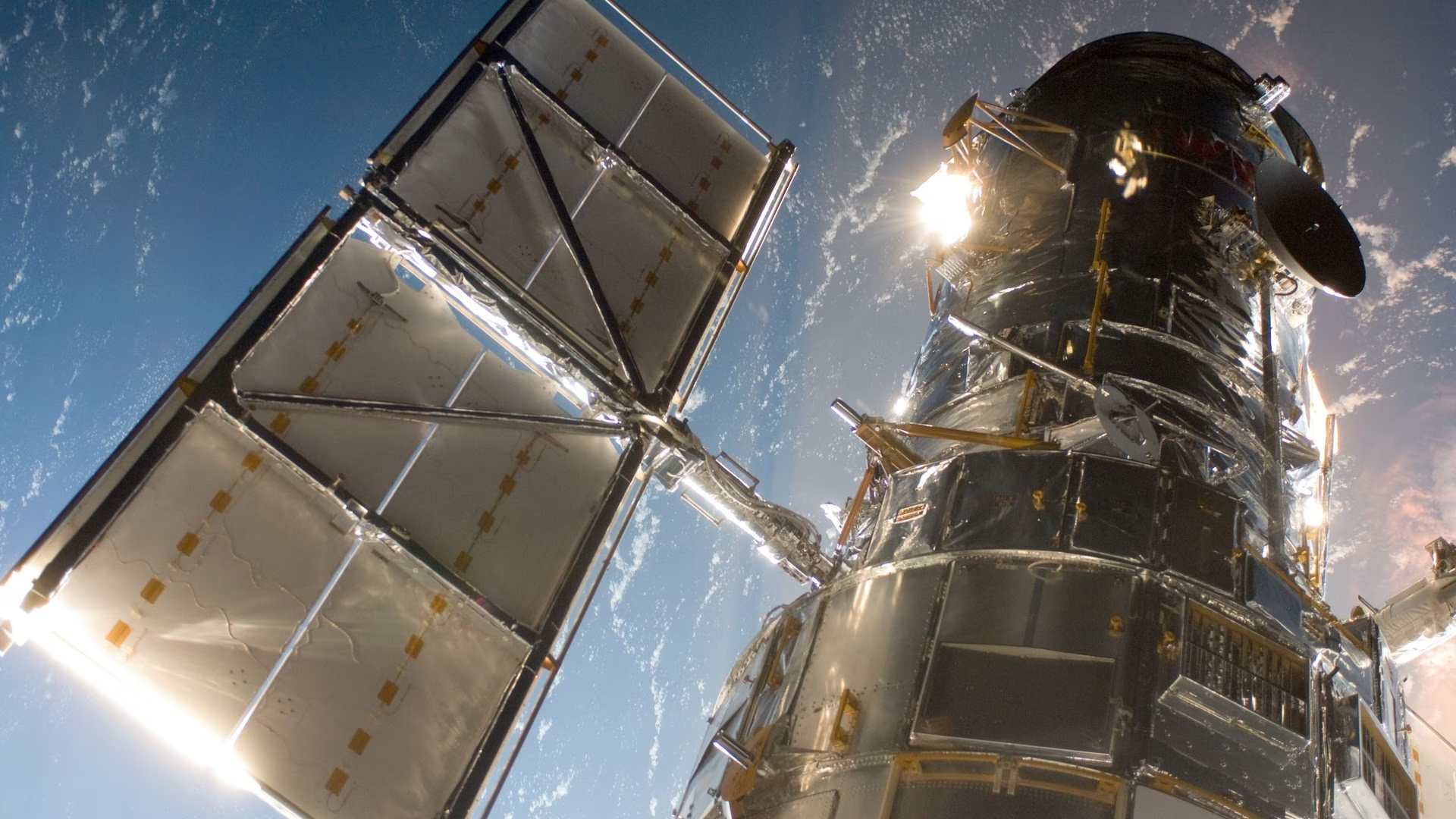
Hubble photographed from the Space Shuttle Atlantis during its last servicing mission, in May 2009.
 Credit: NASA
Hubble has no engine of its own, and it is slowly sinking. NASA now wants companies to say how they could lift the 36-year-old telescope higher, service it, or steer it down safely, the agency said on Friday.
The request for information went out on 29 October, and responses are due by 30 November. NASA’s analysis puts Hubble’s likely re-entry in 2033 or 2034. Any mission would need to fly by 2032.
“If there are innovative and cost-effective ways to extend the life of an asset already on orbit, we owe it to the American taxpayer and the scientific community to explore them.” Jared Isaacman, NASA Administrator
What NASA is asking for
The request covers three options. A company could boost Hubble higher, service it to improve it, or dispose of it safely. Citing the document, Ars Technica reported that a boost must reach at least 600 km and must not harm the telescope. The company would supply the rocket, the servicing spacecraft and mission operations, plus a crew if one is needed.
NASA is not committing to buy a mission, and it has no money set aside for one, Ars reported. Hubble now orbits about 470 km up. The shuttle Columbia last raised it, to 583 km, in 2002.
NASA puts the chance of re-entry at 10% by September 2032, The Register reported. That rises to 50% by December 2033. Hubble is heavy enough that an uncontrolled fall carries a small risk to people on the ground.
NASA has been here before
In 2022, Isaacman, then a private astronaut, offered to pay for most of a crewed Hubble mission on SpaceX’s Dragon. NASA also asked industry for ideas that year and received eight responses. In 2024 it decided not to pursue a reboost.
A crewed visit is less likely now. SpaceX plans to retire Crew Dragon by 2030, and NASA has already turned to Boeing for more astronaut flights. Isaacman expects the request to draw interest from robotics companies, Ars reported. Startups are already raising money for in-orbit refuelling hardware.
Swift shows what is at stake
NASA’s smaller Swift observatory is about to burn up. Its science mission ended on 20 October. Below 275 km, drag made steady observations impossible, and NASA expects it to re-enter within weeks.
NASA had hired a startup, Katalyst Space, to catch Swift and lift it higher. Its robot ran into trouble and never reached the telescope. The US Space Force now predicts Swift will come down within days, the Associated Press reported. Most of it will burn up, though a few dense tungsten parts and mirror pieces could survive.
Hubble has one advantage over Swift. Astronauts fitted it with a soft-capture mechanism on the last shuttle visit in 2009, which should make docking easier. Astronomers expect no replacement for its visible and ultraviolet vision before NASA’s Habitable Worlds Observatory in the 2040s.
Get the TNW newsletter
Get the most important tech news in your inbox each week.
Also tagged with


