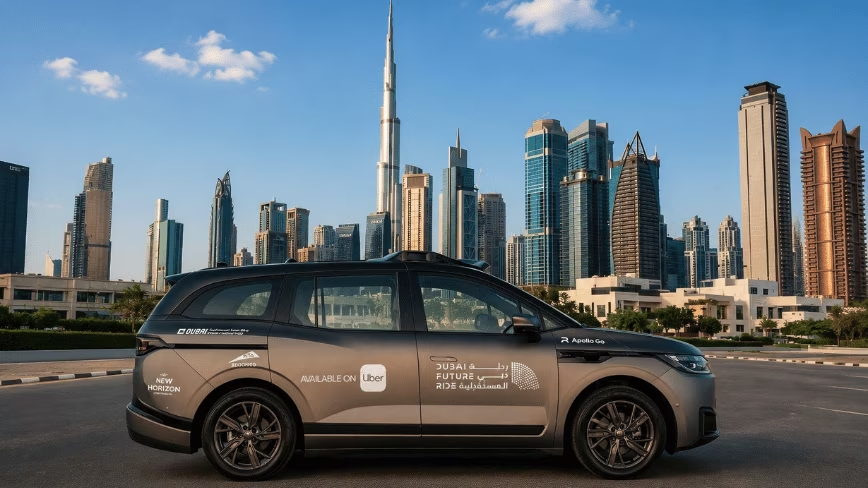
Apollo Go’s sixth-generation RT6 is a purpose-built, fully electric robotaxi designed for fully driverless operations
 Credit: Uber
Uber has put Baidu’s driverless robotaxis on its app in Dubai. Book an UberX or an Uber Comfort there now and the app may match you with an Apollo Go vehicle that has nobody in it. A dedicated “Autonomous” option raises the odds for anyone who wants one on purpose.
The service went live on Thursday. It covers select locations in Umm Suqeim and Jumeirah, two coastal districts, rather than the city as a whole. A third party called New Horizon Luxury Transport runs the fleet. Neither company said how many cars are on the road, and neither disclosed what a ride costs or whether a driverless trip prices the same as one with a human at the wheel.
One detail sits inside that mechanic. A rider who books a standard UberX or Uber Comfort in the launch zone can be matched with a driverless car without having asked for one. Choosing the “Autonomous” option makes it likelier, but it is not the only way into the back seat of an empty vehicle.
The one-day gap
The timing is the most revealing thing here. On Wednesday, Uber launched its first European autonomous rides in Zagreb, with Pony.ai and the Croatian operator Verne. Those cars went live with a safety driver on board, as Uber’s own announcement confirmed at the time.
A day later, the same company launched Apollo Go in Dubai with nobody in the front seat at all. Same platform, same week, two very different regulatory answers to the same question. Uber drew no comparison between them, and neither release mentions the other.
The Zagreb service runs across key areas of the Croatian capital, including the city centre, and Uber said coverage would widen over time. Dubai starts smaller and starts emptier. Which of those two constraints matters more depends entirely on whether you are a regulator or a shareholder.
What is actually driving
The cars are Apollo Go’s sixth-generation RT6, a purpose-built electric vehicle designed for driverless operation. Each carries up to three passengers. Baidu says the RT6 has more than 30 sensors and processes what they see onboard in real time.
Baidu supplied the scale figures and no outside party has audited them. Apollo Go has operated in 28 cities, the company says. Its fleets have covered more than 350 million autonomous kilometres, and more than 240 million of those ran fully driverless. Baidu calls the safety record outstanding without publishing the incident data underneath it.
Uber says every autonomous vehicle on its network, Apollo Go included, must meet its own safety guidelines before carrying passengers. It has not published those guidelines in full.
Three different firsts
The release headline claims the first multi-partner autonomous network globally. The two executives quoted inside it make narrower claims than that, and they do not make the same one as each other.
Sarfraz Maredia, Uber’s global head of autonomous, said Dubai “marks the first time our multi-partner vision comes to life on public roads”. That is a claim about Uber’s own plans rather than about the industry.
Nan Yang, a Baidu vice president who runs the overseas arm of its intelligent driving group, claimed something else again. Dubai is “the first city where we’ve successfully established a dual-model offering both self-operated and partner-based autonomous ride-hailing services internationally”, he said. That is a first about Baidu running its own cars and somebody else’s in one place.
Nobody in this deal owns the cars
The structure is worth pausing on. Uber supplies the demand and the app. Baidu supplies the vehicles and the autonomy stack. New Horizon Luxury Transport owns and operates the fleet on the ground. None of the three is doing all of it.
That is the arrangement Uber has been building towards since it stopped being one company’s exclusive front end. It agreed to end Uber exclusivity with Waymo in Austin and Atlanta in July, and now says it works with more than 30 AV partners. It calls the result a hybrid network, where autonomous cars and human drivers take fares side by side.
The release calls Dubai the launchpad for scaling thousands of Apollo Go vehicles across Uber’s global network. That is an ambition for the partnership, not a description of the fleet operating today. Uber says it completes millions of autonomous trips a year across all its partners, against more than 79 billion trips in total since 2010. Autonomy remains a rounding error in its own numbers.
Chinese autonomy takes the long way round
Baidu is not the only Chinese firm finding routes into markets outside China through partners. Pony.ai and Uber said this month they would put 2,000 Chinese robotaxis on European streets, and Pony.ai is the technology behind the Zagreb launch. Apollo Go itself won Level 4 approval in Switzerland in June.
The Gulf has been the fastest of these routes. Dubai has moved quicker than European regulators on driverless permissions, and a launch with no operator on board is the clearest evidence of that so far.
What to watch
Two things will show whether this is a demonstration or a business. The first is the operating territory. Umm Suqeim and Jumeirah are a small slice of Dubai, and Uber says it plans to expand without saying when.
The second is disclosure. Robotaxi fleets are scaling faster than the industry has been willing to publish data about, and neither Uber nor Baidu released a vehicle count, a ride target or an incident rate for Dubai. Until one of them does, the number that matters most about this launch is the one nobody has given.
Get the TNW newsletter
Get the most important tech news in your inbox each week.
Also tagged with


