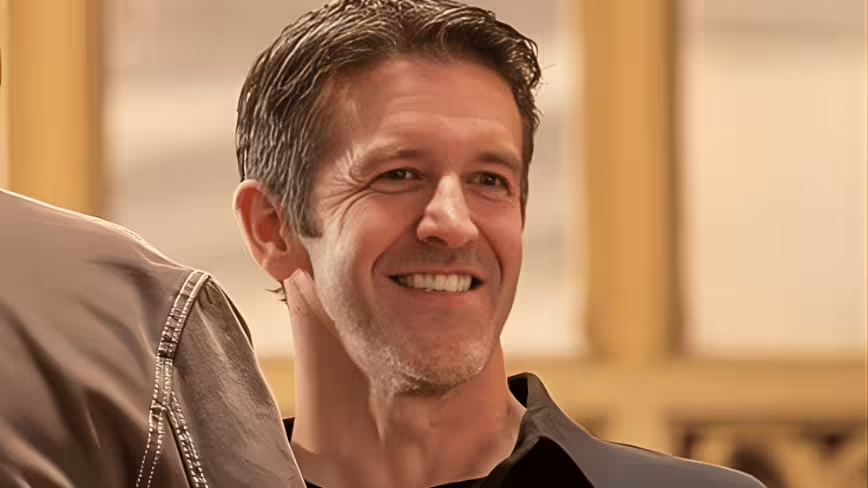
John Ternus at Apple’s 50th anniversary
 Credit: Tessa Bury
Summary: Tim Cook is stepping down as Apple CEO on 1 September after nearly 15 years, during which Apple’s market capitalisation grew from $348 billion to roughly $4 trillion and annual revenue quadrupled to $416 billion. John Ternus, the 50-year-old SVP of hardware engineering who oversees roughly 80% of Apple’s revenue-generating products, will become the company’s fourth CEO, inheriting strategic challenges in AI, regulation, and a substantially rebuilt executive team following the departure of the COO, general counsel, AI chief, CFO, and head of design.
Tim Cook is stepping down as Apple’s chief executive on 1 September, ending a nearly 15-year tenure that took the company from a $348 billion valuation to roughly $4 trillion. John Ternus, the 50-year-old senior vice president of hardware engineering who oversees the products responsible for approximately 80% of Apple’s revenue, will become the company’s fourth CEO. Cook will stay on as executive chairman, a role focused on policy engagement and regulatory relationships at a moment when Apple faces enforcement actions on multiple continents.
The board of directors approved the succession unanimously. Arthur Levinson, who has served as non-executive chairman for 15 years, will become lead independent director when the transition takes effect.
“John Ternus has the mind of an engineer, the soul of an innovator, and the heart to lead with integrity and with honour,” Cook said in a statement. “He is without question the right person to lead Apple into the future.” Notably, Cook told ABC’s Good Morning America as recently as 17 March that reports of his departure were “a rumour” and that he “can’t imagine life without Apple.”
The engineer who ran the hardware
Ternus joined Apple in 2001, working first on the Cinema Display. He rose through the hardware organisation to oversee the development of AirPods, iPad, and Mac before taking charge of iPhone hardware in 2020 and Apple Watch in late 2022. He was promoted to senior vice president of hardware engineering in 2021, replacing Dan Riccio, who left to lead the Vision Pro programme. In late 2025, Cook quietly placed Apple’s design teams, both hardware and software, under Ternus, a move Bloomberg reported in January that effectively confirmed him as the CEO-apparent.
His background is worth noting. Before Apple, Ternus designed virtual reality headsets at Virtual Research Systems, a detail that looks prescient given Apple’s subsequent investment in spatial computing. He studied mechanical engineering at the University of Pennsylvania, where he competed on the swimming team. He has been a regular presence at Apple product events, presenting refreshes of the iMac, MacBook Pro, iPad Pro, and the redesigned Mac Pro.
The succession was not sudden. Bloomberg first reported in 2024 that Ternus was the front-runner and that Apple had intensified its planning. By October 2025, his responsibilities had expanded beyond the traditional scope of a hardware chief to include product roadmap decisions, feature prioritisation, and strategic planning. Fortune reported in December 2025 on Apple’s “biggest executive exodus in years,” framing it as a generational transition rather than a crisis.
The exodus around him
Ternus inherits a leadership team that has been substantially rebuilt. Jeff Williams, the chief operating officer who spent 27 years at Apple, has retired. So have Kate Adams, the general counsel; Lisa Jackson, the vice president for environment and policy; and John Giannandrea, the AI chief. Alan Dye, who led user interface design since 2015, left to join Meta. Luca Maestri, the chief financial officer since 2014, departed at the end of 2024.
The new guard includes Kevan Parekh, who became CFO on 1 January 2025, and Jennifer Newstead, who joined as general counsel on 1 March 2026 from Meta, where she had previously served as a legal adviser to the US Department of State. The volume of turnover is unusual for a company that has historically promoted from within and retained its senior executives for decades.
What Cook built
Cook’s legacy is defined by scale. Apple’s annual revenue grew from $108 billion in fiscal 2011 to more than $416 billion in fiscal 2025. The services business, which generates higher margins than devices, expanded from roughly $12.9 billion to $85.2 billion over the same period. Apple became the first publicly traded company to reach a $1 trillion market capitalisation in 2018, hit $1.9 trillion in 2020, and briefly topped $4 trillion in January 2025.
The Apple Silicon transition, which replaced Intel processors with Apple’s own chips starting in 2020, gave the company tighter integration between hardware and software than any competitor and materially improved the performance and battery life of every Mac in the lineup. The Apple Watch created a wearables category that now claims nearly 25% of the global market. AirPods became a cultural shorthand for wireless audio.
Cook also transformed Apple’s supply chain from a competitive advantage into an institutional one, reducing inventory turnover from months to days and building manufacturing relationships, principally in China, that competitors could not replicate at scale. His role as executive chairman, with a specific mandate to engage with policymakers, reflects both the value of those relationships and the regulatory complexity they now attract.
What Ternus inherits
The strategic challenges awaiting Ternus are substantial and mostly unresolved. Apple’s AI effort, branded Apple Intelligence, remains blocked in China, its largest international market, due to regulatory requirements that AI output be filtered and censored through local engines. The long-anticipated overhaul of Siri, intended to deliver multi-step task execution and on-screen awareness powered by a large language model, has encountered internal testing issues severe enough that some features may need to be rebuilt. Apple is believed to be adopting Google’s Gemini as part of a bifurcated strategy that emphasises on-device processing for privacy while relying on external models for more complex tasks.
The hardware roadmap is equally ambitious. Apple is testing four frame designs for AI smart glasses targeting a 2027 launch, developing its first foldable iPhone, replacing Qualcomm’s modems with its own silicon, and preparing to enter the smart home market with an entirely new product category. The global DRAM shortage driven by AI infrastructure spending is already constraining Mac production, with the Mac mini and Mac Studio going out of stock ahead of expected M5 refreshes.
On the platform governance front, Apple is navigating an 84% surge in App Store submissions driven by AI-powered coding tools, forcing a crackdown on low-quality apps that threatens to alienate developers at a moment when the EU’s Digital Markets Act is simultaneously requiring Apple to open its platform to competitors. The company recently threatened to remove Grok from the App Store over deepfake content, asserting a content governance role that extends Apple’s influence well beyond its own products.
The regulatory burden is not limited to the EU. Apple faces ongoing DMA compliance proceedings over its App Store practices, a $1.8 billion fine for anti-competitive behaviour in music streaming, and interoperability requirements for its AI features that the company has resisted by demanding Brussels scrap the DMA altogether. Cook’s decision to remain as executive chairman, specifically to engage with policymakers, suggests Apple views regulatory management as a full-time strategic function rather than a legal overhead.
The market’s verdict
Apple shares fell just over 1% in after-hours trading following the announcement. The modest decline suggests Wall Street views this as an orderly transition rather than a disruptive one, which is reasonable given the two years of public succession planning that preceded it. Ternus is not an outsider parachuted in to fix a crisis. He is the person who already runs the products that generate the overwhelming majority of Apple’s revenue, now given the title to match the responsibility.
The question is whether an engineer who built his career on hardware can navigate the company through a period defined by software, AI, and regulation. Apple turns 50 this year. It is the world’s third most valuable company. And for the first time since Steve Jobs handed Tim Cook a company worth $348 billion, someone new will decide what it becomes next.
Get the TNW newsletter
Get the most important tech news in your inbox each week.
Also tagged with


