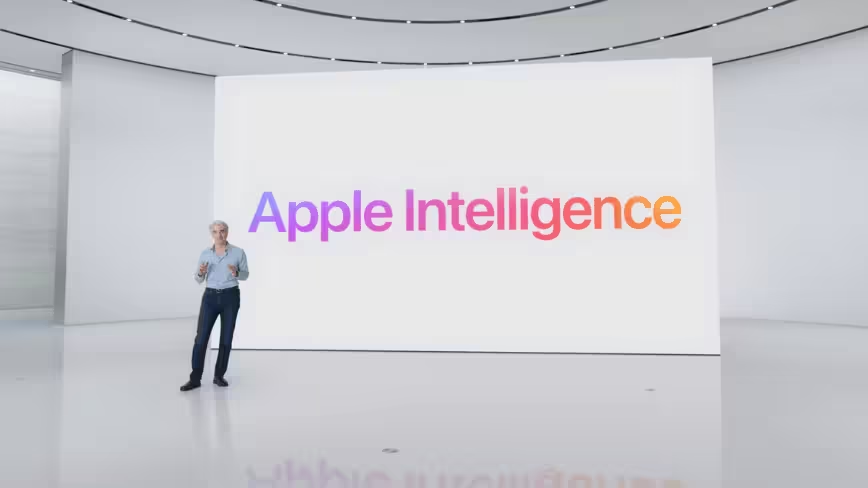
 Credit: Apple
In the small hours of Tuesday morning, something unexpected appeared on iPhones across mainland China. Apple Intelligence, the suite of AI-powered tools that the company has spent nearly two years trying to bring to its largest market outside the US, flickered to life, showed up in users’ settings menus, and then vanished.
The brief, unannounced appearance of the feature, which still lacks regulatory approval from China’s Cyberspace Administration, has exposed Apple to the risk of administrative penalties, according to You Yunting, a Shanghai-based intellectual property lawyer at Debund Law Offices.
Bloomberg’s Mark Gurman was among the first to flag the rollout as an error. Apple would not launch AI features in its most important international market without an announcement, he noted, nor would it do so in the middle of the night. He added that the feature, as briefly deployed, relied on Google’s reverse image search, a service that is blocked in China. Apple has since pulled the update offline.
The accidental deployment matters because China’s AI governance framework requires all generative AI models to pass a security evaluation and complete algorithm filing with the Cyberspace Administration of China before they can be offered to users. Even a brief, unintended release could be interpreted as providing a service without meeting those obligations, You warned, potentially subjecting Apple to penalties under the country’s Interim Measures for the Management of Generative AI Services.
Apple did not respond to requests for comment.
The stumble comes after a protracted effort to bring Apple Intelligence to China. The company first announced its AI suite in June 2024 and launched it in the US that October. It reached the EU in April 2025 with iOS 18.4. But China, where foreign AI tools face strict content filtering requirements and must use domestically approved models, has proved far more difficult.
Apple struck a deal with Alibaba Group Holding in February 2025 to use the company’s Qwen large language model to power Apple Intelligence in China, according to confirmation from Alibaba chairman Joe Tsai reported by TechCrunch. Alibaba’s model must include a real-time filtering layer to comply with mandates from the CAC, which subjects AI systems to what has been described as a rigorous evaluation process covering sensitive political and social queries. A separate arrangement with Baidu for Visual Intelligence features has also been reported, though the details of that partnership remain less clear.
CEO Tim Cook addressed the delay during a visit to Shanghai in October 2025, telling attendees at the Global Asset Management Forum that Apple was actively working to bring the feature to China, without committing to a timeline. Gurman has since confirmed that Apple Intelligence has been technically ready for months but remains blocked by the regulatory approval process.
The wait has not been without competitive cost. Domestic rivals Xiaomi, Oppo, and Vivo have been aggressively integrating AI features into their handsets, with Oppo embedding Alibaba’s DeepSeek model into its ColorOS system and pledging to bring generative AI to 100 million users globally. Huawei, meanwhile, narrowly overtook Apple in Chinese smartphone shipments in 2025, according to market data, underscoring how the absence of Apple Intelligence has left Cupertino at a disadvantage in a market where AI functionality is fast becoming a differentiator.
Some Chinese users who managed to download the feature before it disappeared reported access to tools including real-time translation, photo editing, writing assistance, and personalised emoji creation, all carrying a beta label under the name “Apple Intelligence and Siri.” Parts of the Apple Intelligence suite, including writing and image tools, are already available in Hong Kong.
For Apple, the episode is an uncomfortable reminder that navigating AI regulation across different jurisdictions demands more than technical readiness. In a market where over 5,000 algorithms have already been filed with the CAC and the rules are enforced through active campaigns, even an accidental deployment can carry real consequences.
Get the TNW newsletter
Get the most important tech news in your inbox each week.
Also tagged with


